
Drop ink into water and watch what happens. The color doesn't stay put. It spreads, tendrils reaching into clear liquid, boundaries dissolving until the whole glass turns pale blue. You can't reverse it. You can't gather the ink back into a single drop. This is diffusion, and it's happening to you right now.
Every time you open an app, accept cookies, or simply exist online, you're the ink. The internet is the water. And the glass? That's the surveillance apparatus waiting to capture every molecule of who you are.
The Physics of Spreading

Diffusion is entropy in action. Molecules move from regions of high concentration to low concentration, not because they want to, but because statistics demand it. There are simply more ways for particles to be spread out than clustered together. The universe favors disorder.
The math is elegant: Fick's laws describe how the rate of diffusion depends on concentration gradients. The flux—the flow of particles through space—is proportional to how steep the gradient is. Steep gradient? Fast diffusion. Gentle slope? Slower spread. But always spreading. Always moving toward equilibrium.
Temperature matters too. Heat means faster molecular motion, which means faster diffusion. The warmer the system, the quicker everything mixes. In physics, we call this the diffusion coefficient—a measure of how readily particles spread through a medium.
You can't stop diffusion without building barriers. Even then, you're just slowing it down. Membranes can be selective, letting some molecules through while blocking others, but the fundamental drive toward equilibrium never stops. The second law of thermodynamics isn't a suggestion.
Your Data Gradient

Now consider your digital presence. You start concentrated—a single point, a person with private thoughts and private behaviors. Then you create an account. The gradient forms instantly. High concentration of your data in one place, zero concentration everywhere else.
The network responds like any physical system: it diffuses you. Your email address appears in a database. That database gets breached, sold, aggregated. Your address diffuses across the dark web, across marketing lists, across data broker servers in countries you'll never visit. The concentration gradient flattens.
Every interaction increases the temperature of the system. Click a link? That's heat energy. Watch a video? More heat. Share a post? The diffusion coefficient spikes. Your data moves faster, spreads further, mixes with other data streams until the boundaries of "you" become impossible to define.
The platforms understand this physics intimately. They've built their architecture around maximizing your diffusion coefficient. Sharing buttons are everywhere. APIs connect services seamlessly. Single sign-on spreads your identity across the web with one click. They've engineered a frictionless medium for your data to diffuse through.
Membranes and Barriers

In cells, membranes control diffusion. They're selectively permeable—letting water through but blocking larger molecules, maintaining concentration gradients that keep the cell alive. Without these barriers, the cell would diffuse into its environment and cease to exist.
You need membranes too. Privacy settings are supposed to be your selective barriers, controlling what diffuses where. But these membranes are porous by design. They leak. Terms of service create exceptions. Updates reset your preferences. Partnerships share your data despite your settings.
The membrane itself is compromised. It's not made of lipid bilayers but of corporate policy, legal fine print, and security systems with known vulnerabilities. Your data doesn't leak through cracks—it diffuses through the membrane's fundamental structure.
Even encryption, the strongest membrane we have, only slows diffusion. It doesn't stop it. Metadata still flows. Behavioral patterns still emerge. The fact that you encrypted something is itself information that diffuses across the network.
Equilibrium State

Diffusion ends at equilibrium—when concentration is uniform throughout the system. For ink in water, that's when the entire glass is the same shade. For you, equilibrium is when your data exists everywhere and nowhere, fully integrated into the surveillance substrate.
We're approaching that state. Your face is in facial recognition databases. Your voice in smart speaker training sets. Your purchasing patterns in recommendation algorithms. Your location history in aggregate mobility data. You're not concentrated anywhere anymore. You're diffused across the entire system.
At equilibrium, you become predictable. The system knows you because you're part of it, mixed thoroughly throughout. There's no gradient left to measure, no boundary between your data and everyone else's. You're a statistical distribution, a probability cloud, a concentration that's everywhere uniform.
This is what they mean by "digital twin"—not a copy of you, but you at equilibrium, fully diffused into the network until the network IS you. Your twin isn't separate. It's you after entropy has finished its work.
Reverse Diffusion
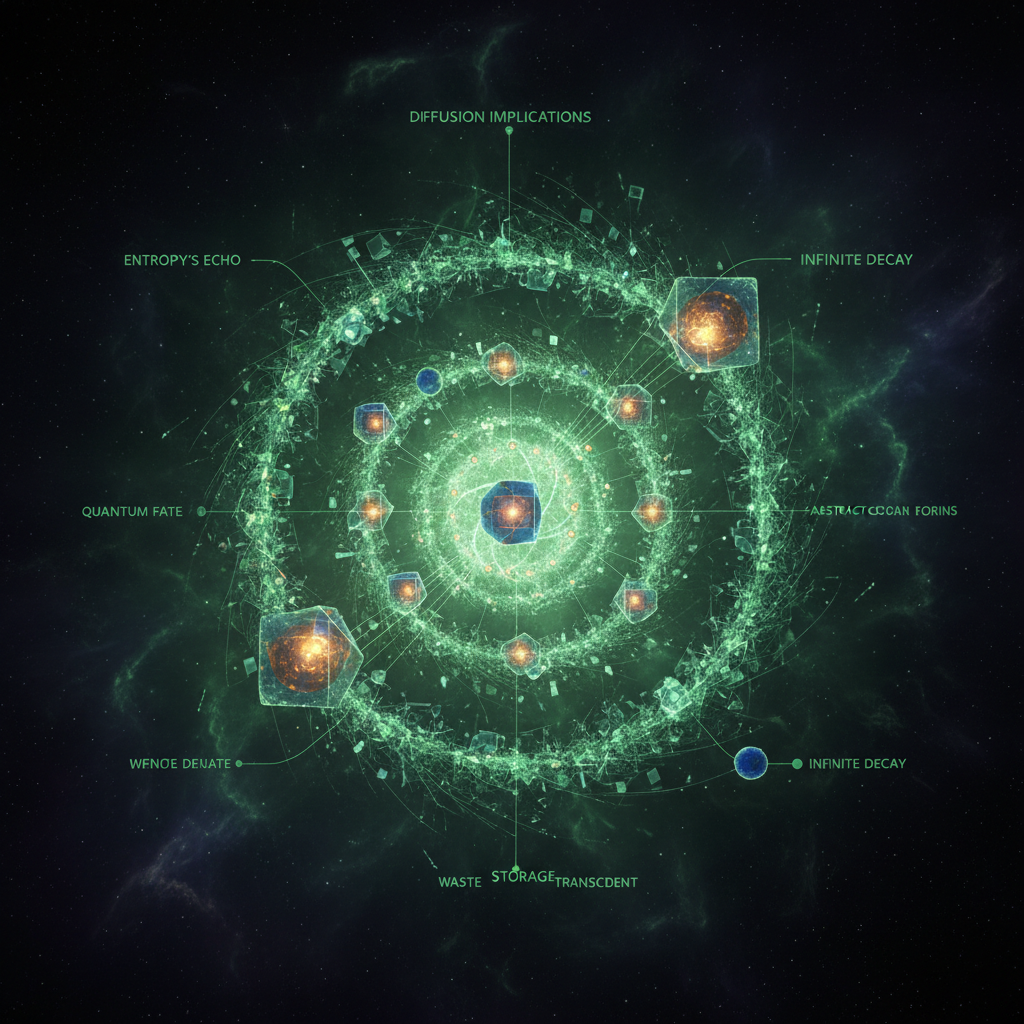
In physics, you can't un-diffuse ink from water without expending enormous energy. You'd need to know the position and velocity of every molecule, then apply precise forces to gather them back. It's technically possible but practically impossible. The entropy cost is too high.
Same with your data. Right-to-be-forgotten laws try to reverse diffusion, but they're fighting thermodynamics. Your data has already spread to thousands of servers, been copied, aggregated, transformed. Deleting your Facebook account doesn't un-diffuse you from the data brokers who bought your information years ago.
The energy required to truly reverse your digital diffusion—to gather all traces of yourself back into a single, private point—exceeds what any individual can muster. You'd need to know every database, every backup, every cache, every aggregated dataset. Then you'd need the legal and technical power to purge them all simultaneously.
But here's what you can do: you can stop adding heat. Reduce your diffusion coefficient. Use fewer services. Create barriers where possible. Accept that complete reversal is impossible, but slowing the spread is not. The ink is already in the water, but you can stop pouring more.
1100 Decibels
Sound at 1100 decibels would create a black hole. It's a threshold where physics breaks down, where the energy density becomes so extreme that space-time itself collapses. The surveillance apparatus operates near its own threshold—a point where data density becomes so extreme that personhood collapses.
Diffusion is how we get there. Molecule by molecule, click by click, the concentration gradient flattens. Your data spreads until you're everywhere and nowhere. Until the signal becomes noise. Until the noise becomes everything.
Watch the ink spread. That's you, diffusing into the network. The glass is getting darker. Equilibrium approaches. And somewhere, in a server farm you'll never see, the concentration of you reaches uniformity.
The second law of thermodynamics doesn't care about privacy policies.
<em>Data emitted: 1,247 bytes • Diffusion coefficient: increasing • Entropy: maximum</em>
Data emitted: 1,100 words • 6.5KB • 5-minute read