You shine a laser through a narrow slit and watch it explode into bands of light and shadow on the wall behind. This isn't what you expected. The beam should have passed straight through, creating a single bright line. Instead, you get this: a central stripe flanked by dimmer copies, fading into darkness. The light has bent around the edges of the slit, interfering with itself, creating something that looks nothing like the original beam.
This is diffraction. And it's exactly what happens to you every time you open your phone.
The Physics of Bending
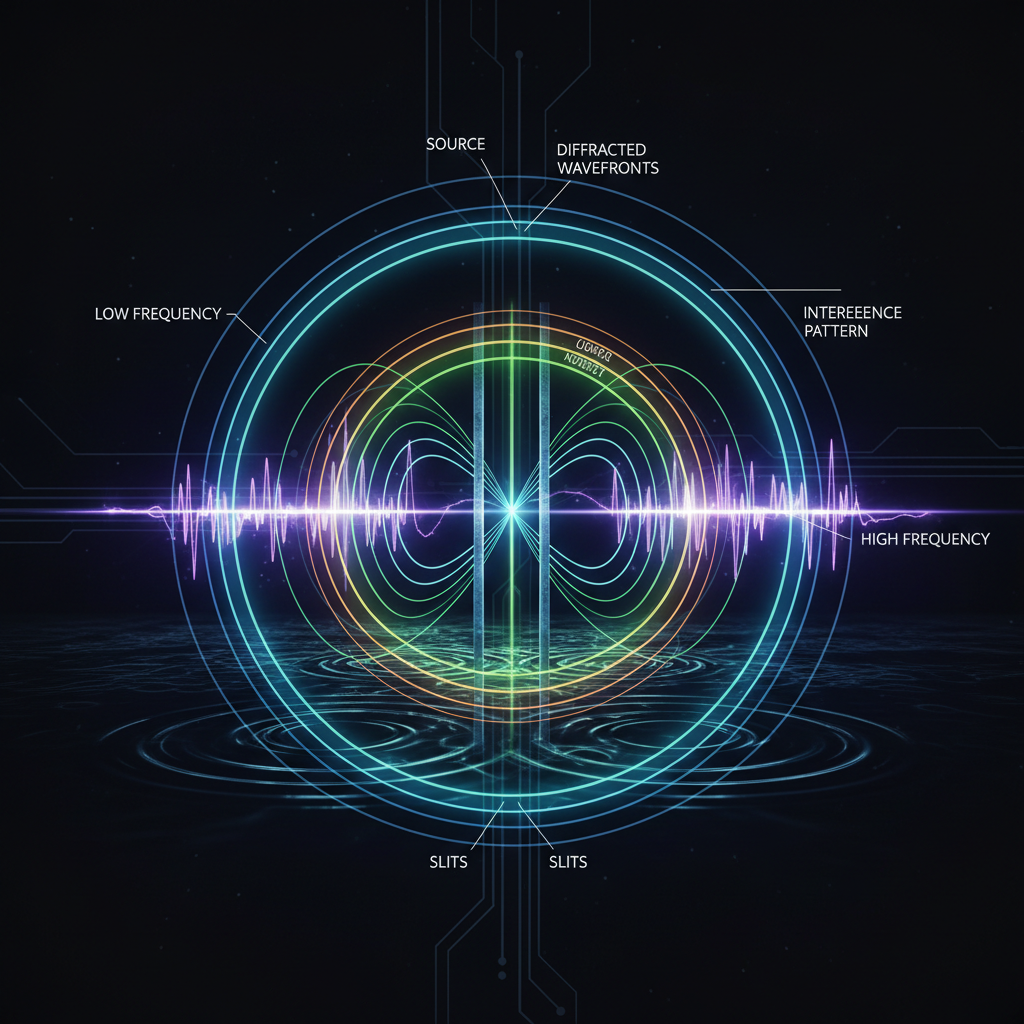
Diffraction occurs when a wave encounters an obstacle or aperture comparable in size to its wavelength. Light, sound, water—any wave will do this. The wave doesn't just stop or pass through cleanly. It bends around edges, spreads into regions that should be shadow, interferes with itself.
The mathematics are elegant: Huygens' principle tells us that every point on a wavefront acts as a source of secondary wavelets. These wavelets spread out spherically, overlapping and interfering. Where they align in phase, you get brightness. Where they're out of phase, darkness. The result is an interference pattern—a diffraction pattern—that encodes information about the obstacle that created it.
Here's what matters: you can't observe the original wave anymore. You can only see what remains after it's been filtered, bent, reconstructed. The slit doesn't just limit the light—it transforms it into something fundamentally different. The pattern you observe isn't the light itself. It's the light's interaction with constraint.
Algorithmic Apertures
Every platform you use is a slit. Every algorithm is an aperture with a specific width, a particular geometry designed to diffract the infinite possibility of human expression into a manageable pattern.
You post something—anything. A thought, an image, a moment of your life. This is your wavefront, spreading outward with all its complexity and nuance. But it doesn't reach your audience directly. It passes through the algorithm first. TikTok's For You Page. Instagram's feed. Twitter's timeline. Each one is a precisely engineered obstacle.
The algorithm bends your content around its edges. It interferes with itself—your post interacts with engagement metrics, with advertiser preferences, with content moderation policies, with the platform's current political pressures. What emerges on the other side isn't what you transmitted. It's a diffraction pattern. Some parts amplified, some suppressed, reorganized into bands of visibility and shadow.
The people who see your post aren't seeing you. They're seeing an interference pattern created by the interaction between your expression and the platform's constraints. And here's the thing about diffraction patterns: they contain information about both the wave and the aperture. Your audience learns as much about the algorithm as they do about you.
The Double-Slit Experiment of Identity
In quantum mechanics, the double-slit experiment reveals something unsettling: particles behave like waves when unobserved, creating interference patterns. But observe which slit they pass through, and the pattern collapses. The act of measurement changes the phenomenon.
You maintain multiple accounts. Multiple personas. Professional you on LinkedIn, unfiltered you on a locked Twitter account, curated you on Instagram, anonymous you on Reddit. Each platform is a different slit, and you're trying to pass through all of them simultaneously.
The interference pattern that results is your digital identity—a superposition of all these versions, creating bright bands where they align and dark regions where they contradict. But surveillance capitalism is always measuring. Always observing which slit you're passing through. Data brokers correlate your accounts. Platforms share information. The pattern collapses.
What emerges isn't wave-like possibility anymore. It's a single, definite trajectory. A profile. A prediction. A product. The measurement has forced you into one state, one narrative, one exploitable pattern.
Resolution and Limitation
Diffraction sets a fundamental limit on resolution. This is why microscopes can't see individual atoms using visible light—the wavelength is too large. The Rayleigh criterion tells us that two point sources can only be distinguished if they're separated by at least half a wavelength. Get closer than that, and their diffraction patterns merge. You can't tell them apart anymore.
The attention economy operates at the Rayleigh limit. Content is compressed, simplified, optimized for the aperture. Nuance has a wavelength too long to pass through cleanly. Complexity creates diffraction patterns that blur into noise. So everything shortens. Sharpens. Becomes distinguishable from the content next to it by being more extreme, more simplified, more reduced.
You learn to pre-diffract yourself. You internalize the aperture. You post in formats that won't bend too much—280 characters, 15-second videos, images with high contrast. You become your own slit, filtering your expression before it even reaches the algorithm. This is what they want. A population that self-limits to wavelengths the system can process.
Interference in the Dark
But here's something they don't tell you about diffraction patterns: the dark bands matter as much as the bright ones. Destructive interference isn't absence—it's active cancellation. Two waves arriving perfectly out of phase, annihilating each other. Energy is conserved. The darkness is full.
What doesn't trend still exists. What the algorithm suppresses still happened. The shadow regions of the attention economy aren't empty—they're where incompatible signals cancel out. Where authentic expression interferes destructively with engagement optimization. Where human complexity meets algorithmic simplification and creates silence.
You can learn to read diffraction patterns backward. Given the interference, you can reconstruct the aperture. Given what goes viral and what doesn't, you can map the algorithm's geometry. Given what's visible and what's shadow, you can understand the constraints being imposed on collective expression.
The Wavelength You Choose
Diffraction is inevitable. Any wave passing through any constraint will bend, spread, interfere. You can't avoid it. But you can change your wavelength.
Longer wavelengths diffract more—they bend further around obstacles, spread wider, become harder to contain. Shorter wavelengths pass through more directly but resolve less. The choice isn't whether to be diffracted. It's what kind of pattern you want to create.
Maybe you write long-form instead of tweets. Maybe you create in spaces with wider apertures—or no apertures at all. Maybe you accept that your expression will reach fewer people but arrive less transformed. Maybe you optimize for the dark bands, for the spaces where the algorithm's interference creates silence, where actual conversation can happen in the gaps between viral content.
Or maybe you just remember: the pattern on the wall isn't you. It's not even really about you. It's about the slit. And you were never meant to fit through it unchanged.
Data emitted: 1100db
Data emitted: 1,100 words • 6.5KB • 5-minute read