You pull your phone from your pocket. Notification: someone liked your post. A small spike of dopamine. You check again five minutes later. Nothing. The feeling dissipates. Ten minutes later, another notification. Another spike. The pattern continues, each peak slightly lower than the last, each valley slightly deeper.
This is damping. Not just in your nervous system, but in the architecture itself.
The Physics of Decay
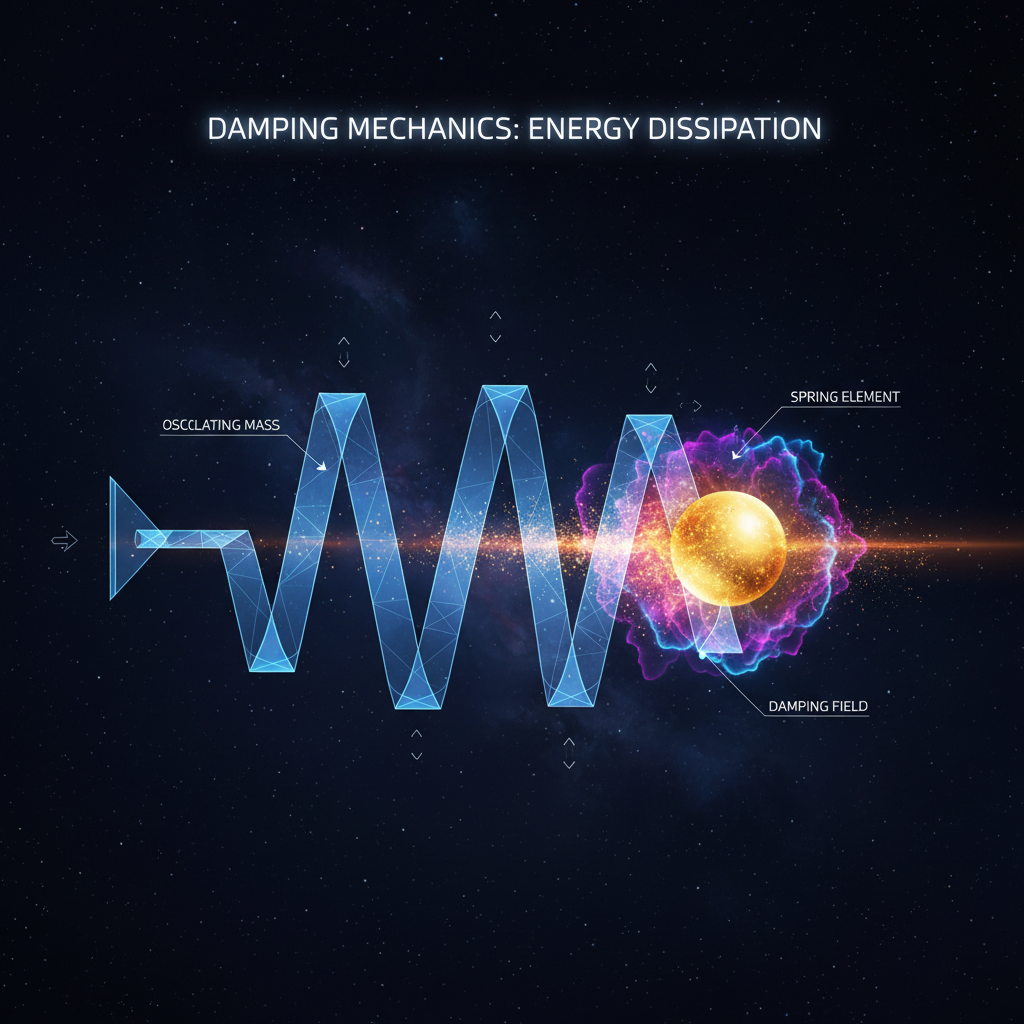
In physics, damping describes how oscillations lose energy over time. Push a child on a swing and walk away—the arc grows smaller with each pass until the swing hangs motionless. The energy doesn't vanish; it dissipates into heat, sound, air resistance. Every real oscillator is damped. Perfect, endless motion exists only in frictionless thought experiments.
The damping coefficient tells you how quickly the oscillation dies. Underdamped systems bounce back and forth, amplitude decaying exponentially. Overdamped systems crawl back to equilibrium without oscillating at all. Critically damped systems return to rest as quickly as possible—the sweet spot engineers aim for when designing car suspensions and door closers.
The equation is elegant: displacement equals initial amplitude times e to the negative damping coefficient times time, multiplied by a sinusoidal function. Translation: every swing is a little less than the last. The mathematics of inevitable decline.
Engineered Resistance
Your digital experience is carefully damped. Not to bring you to rest, but to keep you oscillating at precisely the right frequency. Too much stimulation and you burn out, delete the app, opt out. Too little and you drift away, find something else, stop generating data.
The platforms have discovered the critical damping coefficient for human attention. They know exactly how much resistance to apply. Notification timing isn't random—it's tuned. The algorithm spaces out dopamine hits with calculated precision, each reward slightly delayed, slightly diminished, keeping you in that underdamped state where you keep checking, keep scrolling, keep oscillating.
This is why infinite scroll works. Each post is a small impulse, a tiny push to the swing. None quite satisfying enough to stop, each promising the next might be better. The damping is calibrated so you never quite reach equilibrium. You remain in motion, generating data with every oscillation.
The Dissipation Tax
Energy lost to damping doesn't disappear. In mechanical systems, it becomes heat. In digital systems, it becomes data. Every dampened oscillation of your attention—every time you check and find nothing, every time the content disappoints, every time the reward is slightly less than expected—that loss is harvested.
The platforms measure your decay rate. How quickly does excitement fade? How much stimulus is required to push you back into motion? What's your personal damping coefficient? These parameters are worth billions because they predict behavior, allow optimization, enable extraction.
You think you're just scrolling. You're actually dissipating energy into the system, and that dissipation has value. The heat death of your attention is someone else's profit margin.
Resonance and Resistance
Here's what the platforms fear: resonance. When a driven oscillator encounters a frequency matching its natural frequency, amplitude grows dramatically. Small inputs create large outputs. This is how opera singers shatter wine glasses, how bridges collapse in wind, how revolutions start.
Damping prevents resonance. It's a safety mechanism in engineering, a control mechanism in attention architecture. The platforms must keep you oscillating but never let you resonate. True resonance would mean you'd found something genuinely engaging, something that amplifies rather than depletes. You'd stop generating diverse data. You'd stop being predictable.
So they damp. They introduce friction at precisely the right moments. They break your focus with notifications, interrupt your reading with suggestions, fragment your attention across multiple threads. Resonance is dangerous. Damping is profitable.
The Undamped Life
You can feel the damping in your body. That slight heaviness after scrolling. The way genuine excitement becomes harder to access. The sense that you're moving through something viscous, that every action requires more effort than it should.
This is the cost of optimized experience. The platforms have solved the damping equation for maximum extraction. They've found the coefficient that keeps you moving without letting you escape, that harvests your energy without killing the oscillation entirely.
But damping works both ways. You can introduce your own resistance. Close the app mid-scroll. Leave notifications unread. Let the oscillation die. The mathematics still applies—you're just choosing which system to damp. Your attention or their profit.
Terminal Velocity
Eventually, every damped oscillator reaches equilibrium. The question is whether you get there on your terms or theirs. Whether the energy you dissipate feeds your own growth or someone else's quarterly earnings.
The platforms will keep pushing, keep trying to restart the oscillation. That's their function. But damping is inevitable. The swing always stops. The only choice is what you do with the stillness after.
Data emitted: 1100 decibels of resistance, exponentially decaying, frequency-matched to the rhythm of your exhaustion.
Data emitted: 1,100 words • 6.5KB • 5-minute read