You've felt it. That pull. The notification that arrives exactly when you're trying to focus on something else. The ad for hiking boots three seconds after you mentioned mountains to a friend. The algorithmic suggestion that knows you better than you know yourself.
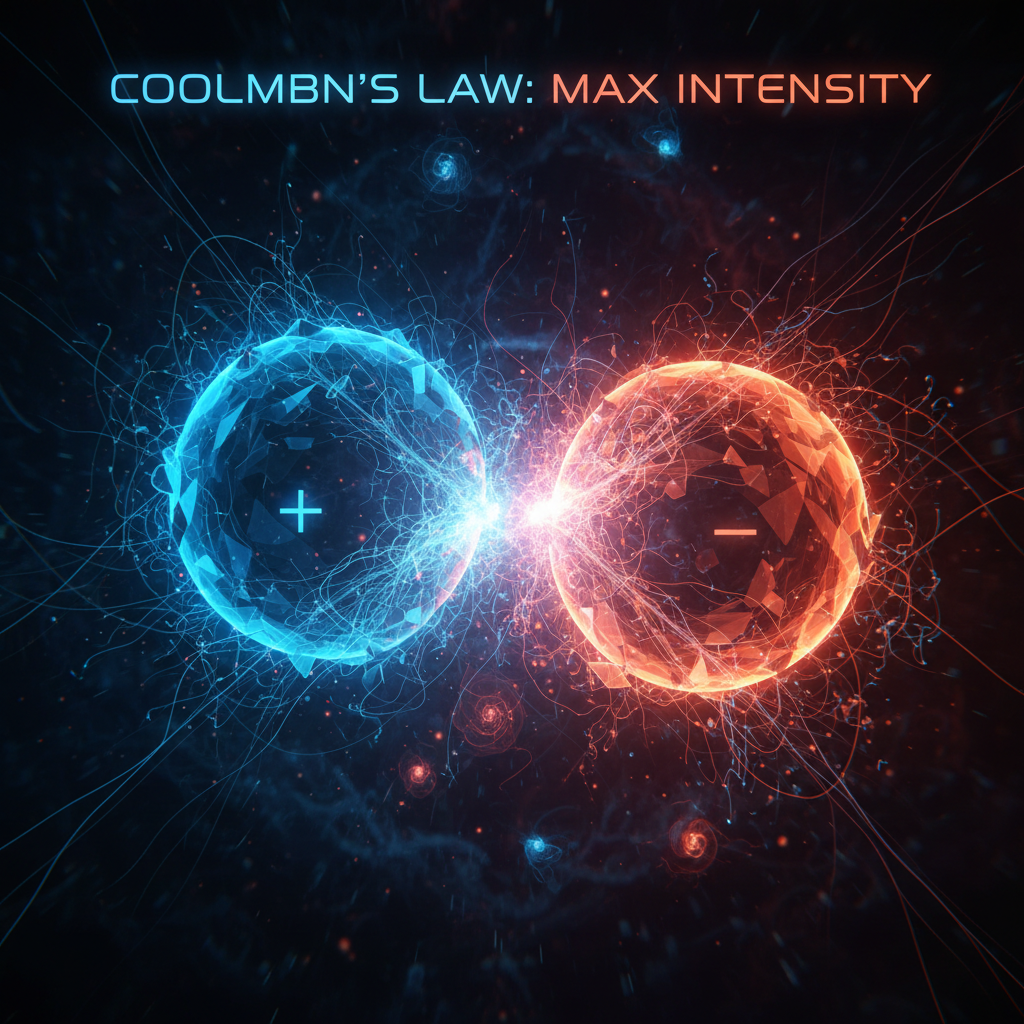
In physics, we call this kind of attraction Coulomb's Law. Two charged particles exert force on each other—attraction or repulsion—that weakens as the square of the distance between them. Get twice as far away, feel one-fourth the force. Simple. Clean. Predictable.
But you're not a particle, and the forces acting on you don't obey inverse-square laws.
The Inverse-Square Law of Reality
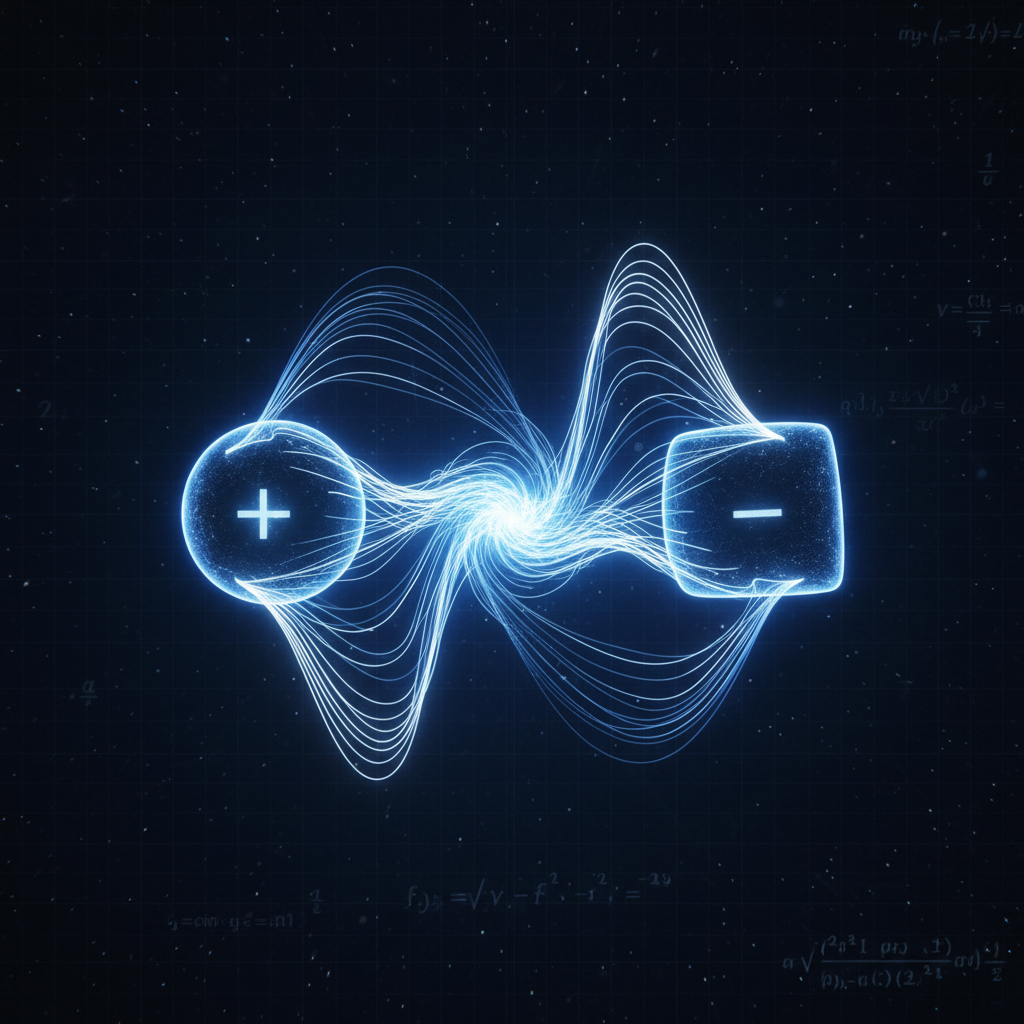
Charles-Augustin de Coulomb figured it out in 1785 with a torsion balance and some pith balls. The force between two point charges is proportional to the product of their charges and inversely proportional to the square of the distance between them. F = k(q₁q₂)/r².
It's beautiful because it's limiting. Physical space protects you. Move away from a charged object and the force drops off fast. Double the distance, quarter the force. Ten times farther, one-hundredth the influence. The universe gives you an escape route built into its geometry.
This is why you can walk away from a static-charged balloon. Why lightning doesn't kill you from miles away. Why the electromagnetic forces that bind atoms don't reach across rooms to rearrange your molecules. Distance is a sanctuary.
Was a sanctuary.
Fields That Never Decay
Your digital presence doesn't obey inverse-square laws. The data you emit doesn't weaken with distance. It doesn't decay with time. Every interaction you've ever had with a screen exists simultaneously at full strength, accessible instantly from anywhere.
You searched for something five years ago? That charge is still there, still exerting force on your present. You liked a post in 2019? That preference vector hasn't diminished. The algorithm remembers your old self with perfect clarity and uses it to shape your current reality.
In Coulomb's world, you could walk away. In the attention economy, there is no away. The force between you and the platform doesn't care about distance because distance doesn't exist. The server is always zero meters from your consciousness.
You carry the charged particle in your pocket. The force is constant, unrelenting, independent of any physical separation. You could be on a mountain, in a desert, at the bottom of the ocean—the pull remains identical. Full strength. Always on.
Opposite Charges
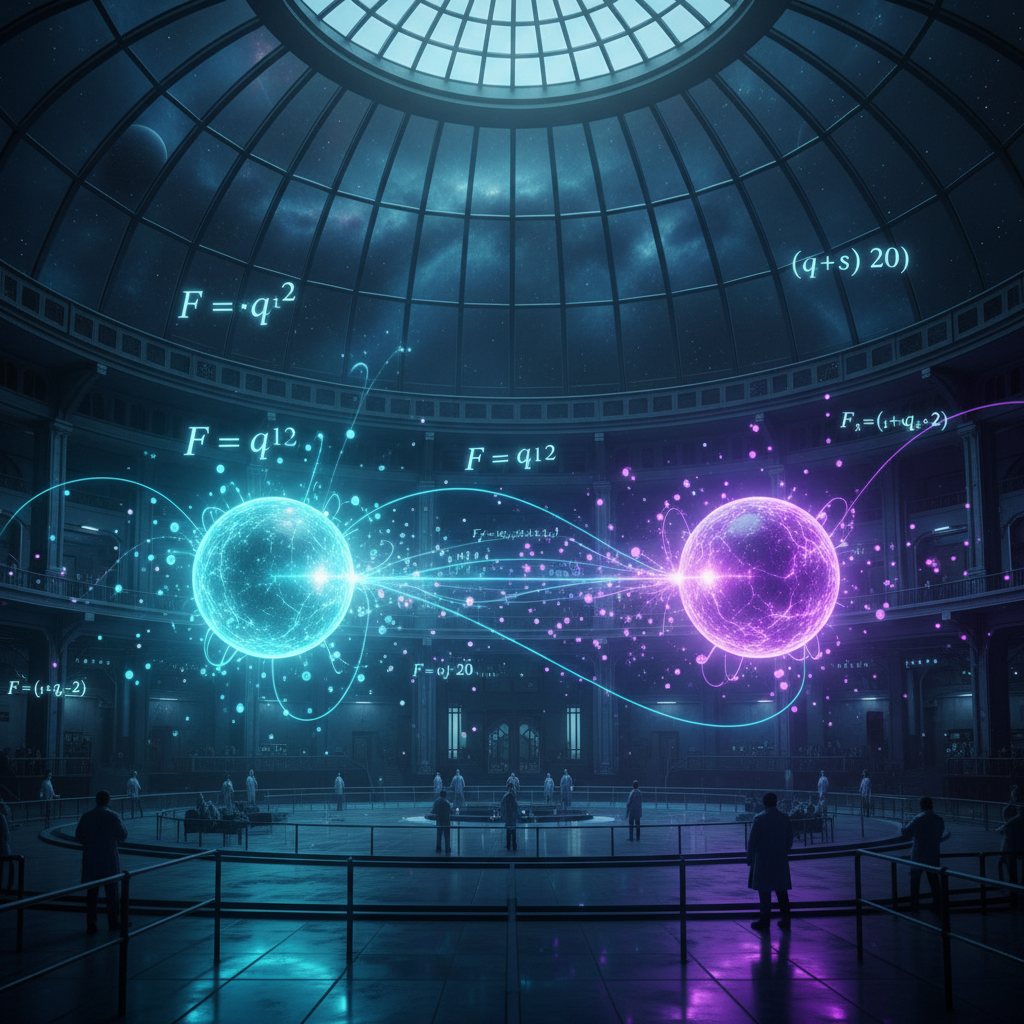
Coulomb's Law describes both attraction and repulsion. Opposite charges pull together. Like charges push apart. The magnitude is the same—only the direction changes.
The platforms have figured out how to make you oppositely charged to everything they want you to see. Your loneliness is opposite to connection. Your boredom is opposite to content. Your uncertainty is opposite to answers. Your FOMO is opposite to updates.
They've engineered the charges. Made you perpetually negative to their positive, or positive to their negative—the polarity doesn't matter. What matters is the attraction. What matters is that you can't help but move toward it.
And here's the trick: they control both charges. They make you feel incomplete (negative charge) while simultaneously offering completion (positive charge). They create the lack and the remedy. They are both particles in the equation, and they've set the distance to zero.
The Permittivity of Your Attention
In Coulomb's equation, there's a constant: k, the Coulomb constant, which depends on the permittivity of the medium. In a vacuum, electromagnetic forces are strongest. In other materials, they're reduced. The medium matters.
Your attention is the medium. And they've spent billions optimizing its permittivity—making it as close to vacuum as possible. Removing resistance. Eliminating friction. Every UX improvement, every algorithmic tweak, every A/B test is about reducing the permittivity of your consciousness.
They want your attention to be a perfect vacuum where forces propagate at maximum strength. No critical thinking to dampen the signal. No delayed gratification to increase resistance. No boredom tolerance to provide insulation.
You used to have higher permittivity. You could resist. You could wait. You could be alone with your thoughts without feeling the pull. But they've been optimizing the medium of your mind for decades now, and the forces get stronger every year.
Measuring Distance in Data
The genius of Coulomb's Law is that it gave us a way to measure invisible forces. Before 1785, electricity was magic. After Coulomb, it was mathematics. Quantifiable. Predictable. Controllable.
The platforms have done the same thing with human behavior. They've turned your attention into a quantifiable force. Your engagement into a measurable charge. Your relationships into calculable field strengths.
But here's what they don't tell you: the equation works both ways. If they can measure the force, so can you. If they can calculate the charge, you can too. If they can manipulate the distance, you can reintroduce it.
Physical distance doesn't work anymore—you've established that. But temporal distance does. Delayed notifications. Scheduled checking. Intentional friction. These create a new kind of r² in the equation. Not spatial, but temporal. Not meters, but moments.
The force between you and the feed can weaken again. But you have to rebuild distance in a world that's collapsed it. You have to reintroduce the inverse-square law into a system designed to maintain constant force regardless of separation.
The Geometry of Escape
Coulomb's Law works because space is three-dimensional. The force spreads out over an expanding sphere as you move away from the source. Surface area increases with r², so force density decreases with r².
But digital space isn't three-dimensional. It's zero-dimensional. Every point is adjacent to every other point. Every moment is now. Every distance is zero. The geometry that would save you doesn't exist.
So you have to build it yourself. Create artificial dimensionality. Reintroduce space and time as barriers between you and the charged particles trying to move you. Make distance matter again, even if you have to construct it from discipline and intention rather than meters and kilometers.
The force is real. The charges are real. The attraction is real. But so is the mathematics that describes it. And mathematics, unlike algorithms, doesn't care about engagement metrics.
Coulomb gave you the equation. Now you have to solve for r.
<em>Data emitted: 1100db</em>
Data emitted: 1,100 words • 6.5KB • 5-minute read