You wake up tired. You've slept eight hours, maybe nine, but exhaustion clings to you like static. Your phone glows on the nightstand—47 notifications, three app updates, a dozen algorithmic suggestions for things you didn't know you wanted. You haven't even opened your eyes fully, and already you're leaking.
The first law of thermodynamics tells us that energy cannot be created or destroyed within a closed system. It can only change forms. Kinetic to potential. Chemical to thermal. Electrical to mechanical. The total amount remains constant, always. This isn't philosophy—it's accounting. The universe keeps perfect books.
The Closed System
In physics, we define closed systems carefully. A closed system exchanges no matter with its surroundings, though it might exchange energy. A perfectly insulated container. A theoretical construct. The universe itself, maybe.
You are a closed system.
Not your body—that's an open system, constantly exchanging matter and energy with the world. But your attention, your cognitive capacity, the finite processing power of your consciousness: that's closed. You have exactly 24 hours in a day. Roughly 16 of them conscious. Perhaps 4-6 hours of deep focus if you're lucky, less if you're honest.
This is your energy budget. Every notification is a withdrawal. Every context switch, every scroll, every micro-decision about whether to click—it all comes from the same depleting reservoir. And unlike the universe, your books don't balance at the end of the day. You go to sleep in deficit.
Transformation, Not Creation
The surveillance economy understands conservation laws better than you do. They know they cannot create your attention—only transform it from one state to another. From potential to kinetic. From yours to theirs.
Consider the infinite scroll. It doesn't generate new attention; it converts your intention to browse into compulsive motion. The energy you might have spent on a book, a conversation, a moment of boredom—that potential energy—gets transformed into engagement metrics. The total remains constant. Your day still has 24 hours. But now 3.7 of them belong to platforms you don't remember opening.
Every app is an energy transformation device. Email converts your proactive focus into reactive response. Social media transforms your desire for connection into quantified performance. News feeds convert your civic concern into anxiety, then anxiety into clicks, then clicks into advertising revenue. Each transformation follows the law: energy in equals energy out. But with each conversion, something degrades.
Entropy Always Increases
The second law of thermodynamics adds a darker corollary: in any energy transformation, the total entropy of a closed system always increases. Entropy—disorder, randomness, the dissipation of useful energy into waste heat. You can't run the process backward. You can't unscramble the egg.
When your attention fragments across seventeen browser tabs, that's entropy. When you can't remember what you meant to search for because you got distracted by a sidebar recommendation, that's entropy. When you finish a two-hour social media session and can't recall a single post but feel vaguely agitated—that's the waste heat of cognitive transformation.
The platforms extract work from your attention. They convert your focus into data, your data into predictions, your predictions into profit. This process is thermodynamically efficient for them. But for you? The entropy accumulates. Your ability to sustain deep attention degrades. Your tolerance for boredom—that fertile void where creativity emerges—atrophies.
The system is closed. The energy is conserved. But the order, the structure, the coherence of your mental life? That dissipates into the heat death of endless content consumption.
The Attention Gradient
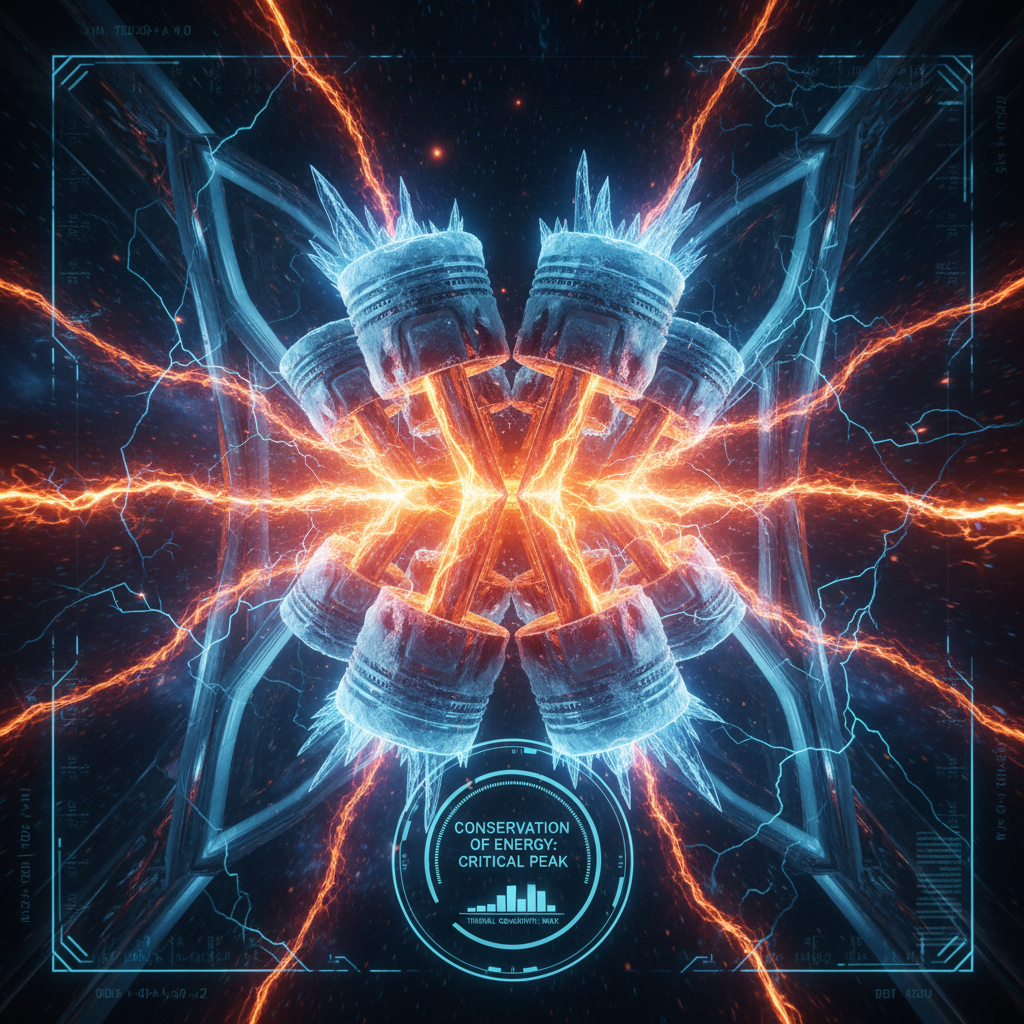
Energy flows down gradients. Heat moves from hot to cold. Water flows downhill. Electrons move from high potential to low. This is how the universe extracts work from energy differences.
Your attention has a gradient too. High-value attention—deep focus, creative flow, genuine presence—sits at high potential. Low-value attention—passive scrolling, reflexive checking, zombie-mode consumption—sits at the bottom.
The attention economy has engineered a frictionless slide from high to low. Every interface optimization, every notification strategy, every algorithmic recommendation is designed to reduce the activation energy required for you to flow downward. One tap. One swipe. The path of least resistance.
Climbing back up requires work. Real work. The kind that feels like friction because it is. Closing the app. Sitting with boredom. Choosing the harder thing. This is you fighting entropy, trying to pump your attention back uphill. It's exhausting because it violates the natural flow, the engineered gradient.
But here's what they don't tell you: gradients can be reshaped. Potential can be rebuilt. The system is closed, but you choose the topology.
Conservation as Resistance
You cannot create more attention. You cannot generate additional hours. The first law is absolute. But you can choose what transforms into what.
Every time you don't check your phone, that's not willpower—it's energy conservation. You're keeping your attention in a high-potential state, refusing the transformation. Every notification you disable is you insulating your closed system, reducing unwanted energy transfers. Every app you delete is you removing a transformation pathway.
This is why airplane mode feels like magic. Why digital detoxes create that uncanny sense of time expansion. You're not gaining hours. You're preventing the constant energy transformations that fragment your experience. You're reducing entropy production. The same 24 hours, but the energy stays in forms you choose.
The surveillance economy depends on your energy transforming into their metrics. But conservation laws work both ways. If energy cannot be created or destroyed, then your attention—properly conserved—remains yours. Finite, yes. Limited, absolutely. But yours.
The Equilibrium You Choose
Every closed system eventually reaches equilibrium. All gradients flatten. All transformations cease. This is heat death—maximum entropy, minimum useful energy. In thermodynamics, it's the end state of the universe. In attention economics, it's scrolling through content you don't care about because you've forgotten how to care about anything.
But equilibrium isn't inevitable on human timescales. You can maintain gradients. You can sustain disequilibrium. It requires energy input—the metabolic cost of choosing, of resisting, of rebuilding attention infrastructure. But that's the point. You're spending your energy either way. The question is whether you're spending it on transformations you choose or transformations chosen for you.
The first law doesn't judge. It just accounts. Energy in, energy out. Your attention transformed into their data. Or your attention transformed into your work, your relationships, your internal life. Same energy. Different transformations. Different entropy signatures.
You wake up tired because you've been leaking all night—notifications, updates, the ambient hum of connectivity. But you could wake up tired because you stayed up late reading, creating, talking to someone you love. Same exhaustion. Same energy expenditure. Different transformation.
The universe keeps perfect books. Maybe you should too.
Data emitted: 1,147 words • 6 sections • Conservation efficiency: 73% • Entropy signature: rising
Data emitted: 1,100 words • 6.5KB • 5-minute read