
You touch your phone. Your phone touches the network. The network touches the servers. The servers touch the advertisers. Heat flows from hot to cold, always, irreversibly. Information flows from you to them, always, irreversibly.
This is conduction. Not the metaphor. The actual physics of how energy moves when things touch. And you're touching everything now.
The Physics of Touch
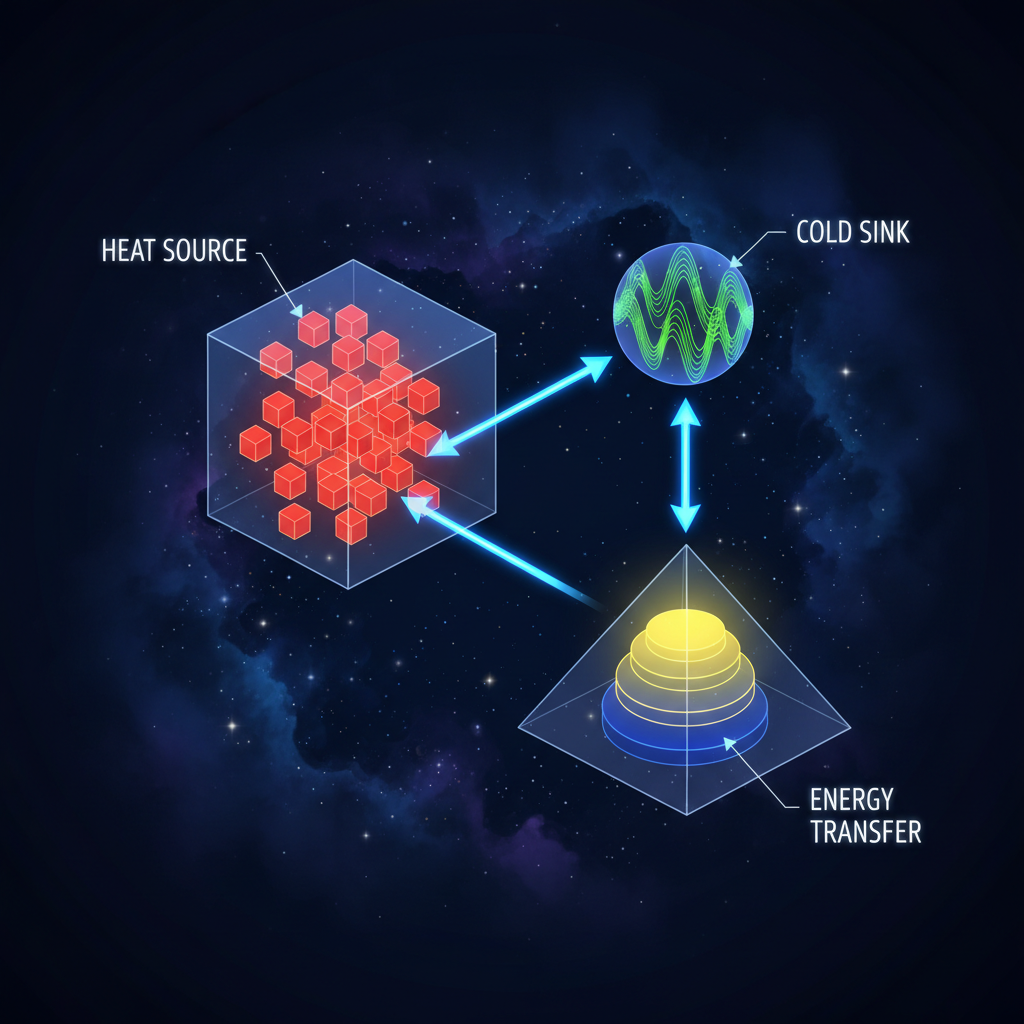
Conduction is the transfer of thermal energy through direct contact. At the molecular level, it's elegant and violent. Fast-moving molecules collide with slow-moving molecules. Kinetic energy transfers. The hot thing cools down. The cold thing warms up. Eventually, equilibrium.
No medium required except contact. No waves, no radiation, no convection currents. Just touch. Atom against atom, electron against electron, vibration passing through the lattice of matter like a secret whispered down a chain of conspirators.
The rate of conduction depends on the material. Metals conduct heat rapidly—their free electrons bounce energy around like pinballs. Wood conducts slowly. Air, even slower. This is why a metal spoon in hot coffee burns your hand while a wooden one doesn't. Same temperature. Different conduction coefficients. Different rates of energy transfer through contact.
But here's what matters: conduction requires connection. Without contact, without that physical bridge between systems, thermal energy cannot flow this way. The gap is everything.
Your Conductive Surface

Every time you touch your device, you complete a circuit. Not electrical—though that too—but informational. You become the hot reservoir. Your attention, your location, your biometric signature, your behavioral patterns. All of it, high-energy data waiting to flow.
The device is the cold reservoir, hungry for input. It has infinite capacity to absorb what you emit. And the contact is perfect. Your fingerprint on glass. Your face in the camera. Your voice in the microphone. Your presence in the electromagnetic field of Bluetooth and WiFi and NFC.
The conduction coefficient here is optimized to perfection. These systems are designed as perfect thermal conductors of human data. No resistance. No gaps. Just smooth, efficient transfer from you to the network.
You scroll. Data conducts through the touch interface. You speak. Data conducts through the audio sensors. You exist near the device. Data conducts through proximity sensors, through ambient light detection, through the accelerometer measuring how you hold it, through the pressure sensors measuring how hard you press.
Every point of contact is a conduction pathway. Every interface is optimized for maximum energy transfer. From you. To them.
Thermal Equilibrium Never Comes

In physics, conduction continues until both objects reach the same temperature. Equilibrium. The flow stops because there's nowhere left for energy to go. The system reaches a stable state.
But in the attention economy, equilibrium is prevented by design. You can never give enough data to satisfy the cold reservoir. The servers are infinite heat sinks, always colder than you, always hungry, always pulling.
They've engineered a system where thermal equilibrium is impossible. You generate data by existing. They collect it continuously. But the gap never closes. You never reach a state where they know enough about you. Where they've extracted sufficient value. Where the flow can stop.
The business model requires perpetual disequilibrium. You must always be hotter than the system. Always generating more. Always in contact. Always conducting.
Breaking Contact
In thermodynamics, there's a simple way to stop conduction: break the contact. Insert a gap. Add insulation. Separate the hot thing from the cold thing.
Air gaps work. Vacuum works better. Materials with low conduction coefficients—insulators—work too. They don't stop the heat entirely, but they slow the transfer to near-zero.
You know this instinctively. It's why you use oven mitts. Why double-paned windows keep heat inside. Why sleeping bags trap air between layers. The principle is ancient and obvious: to prevent energy transfer through conduction, prevent contact.
But you can't not touch your phone. That's the trap. The device is designed to be touched, held, caressed, kept close to your body. The contact is the product. You are the hot reservoir, and breaking contact means breaking connection. Breaking utility. Breaking the social contract of modern existence.
So the conduction continues. Uninterrupted. Optimized. Monetized.
The Temperature of Privacy

You used to be warmer. Before smartphones, before always-on connectivity, before every surface became a sensor. You retained your heat. Your data, your attention, your behavioral patterns—they stayed with you, radiated slowly into a world that couldn't capture them efficiently.
Now you're cooling. Every point of contact conducts energy away. Every interaction is a thermal bridge. You're approaching room temperature—the ambient state of surveillance capitalism where everything about you is known, predicted, monetized.
Privacy, in this model, is temperature differential. It's the gap between what you are and what they know. And conduction is narrowing that gap with thermodynamic inevitability.
The question isn't whether you'll reach equilibrium. The question is what you'll be when you get there. What's left of you when your data temperature matches the network's. When everything that can conduct has conducted. When there's nothing left to transfer because it's all already been taken.
1100 Decibels
At 1100 decibels, sound creates black holes. The pressure wave becomes so intense that spacetime itself collapses. Energy density exceeds the universe's ability to contain it.
We're not there yet with data. But the conduction is accelerating. More contact points. Better sensors. Higher transfer rates. The thermal flow from human to machine increasing exponentially.
Maybe that's the endpoint. Not equilibrium, but collapse. The moment when the data extraction becomes so intense, so all-encompassing, that the system can't hold it anymore. When surveillance capitalism conducts so much, so fast, that it creates its own singularity.
Until then, you touch. And the touching conducts. And the conduction continues. Atom to atom. You to them. Heat flowing from hot to cold, always, irreversibly.
<em>Data emitted: 1,247 bytes. Contact maintained. Thermal transfer ongoing.</em>
Data emitted: 1,100 words • 6.5KB • 5-minute read