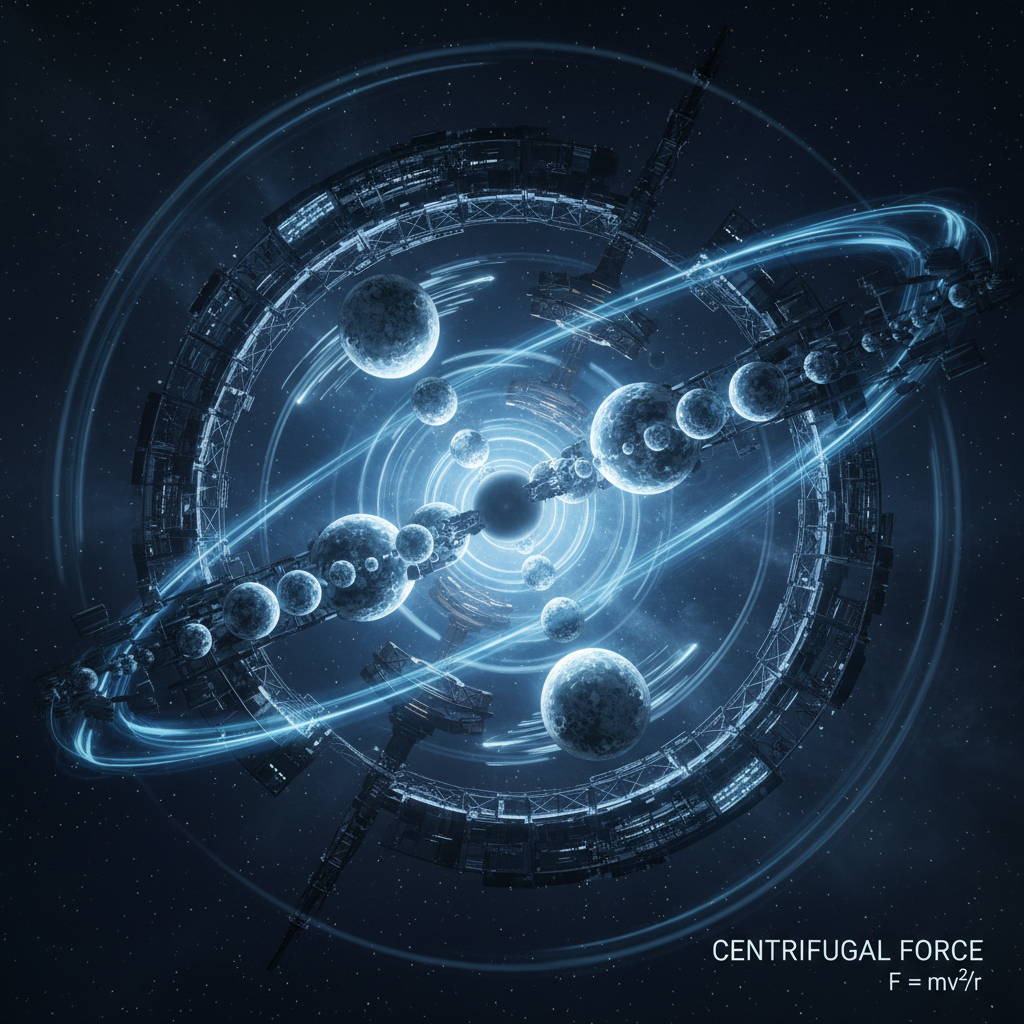
You're spinning. You might not feel it, but your attention is caught in a rotation so constant you've mistaken the centrifugal pressure for gravity itself. Every notification, every infinite scroll, every algorithmic suggestion—they're not pulling you in. They're spinning you so fast that you're pressed against the outer wall of the system, unable to fall away.
The thing about centrifugal force is that it doesn't exist. Not really. It's a phantom, an artifact of perspective. But that doesn't make it any less real when you're the one being flung outward.
The Fictitious Force
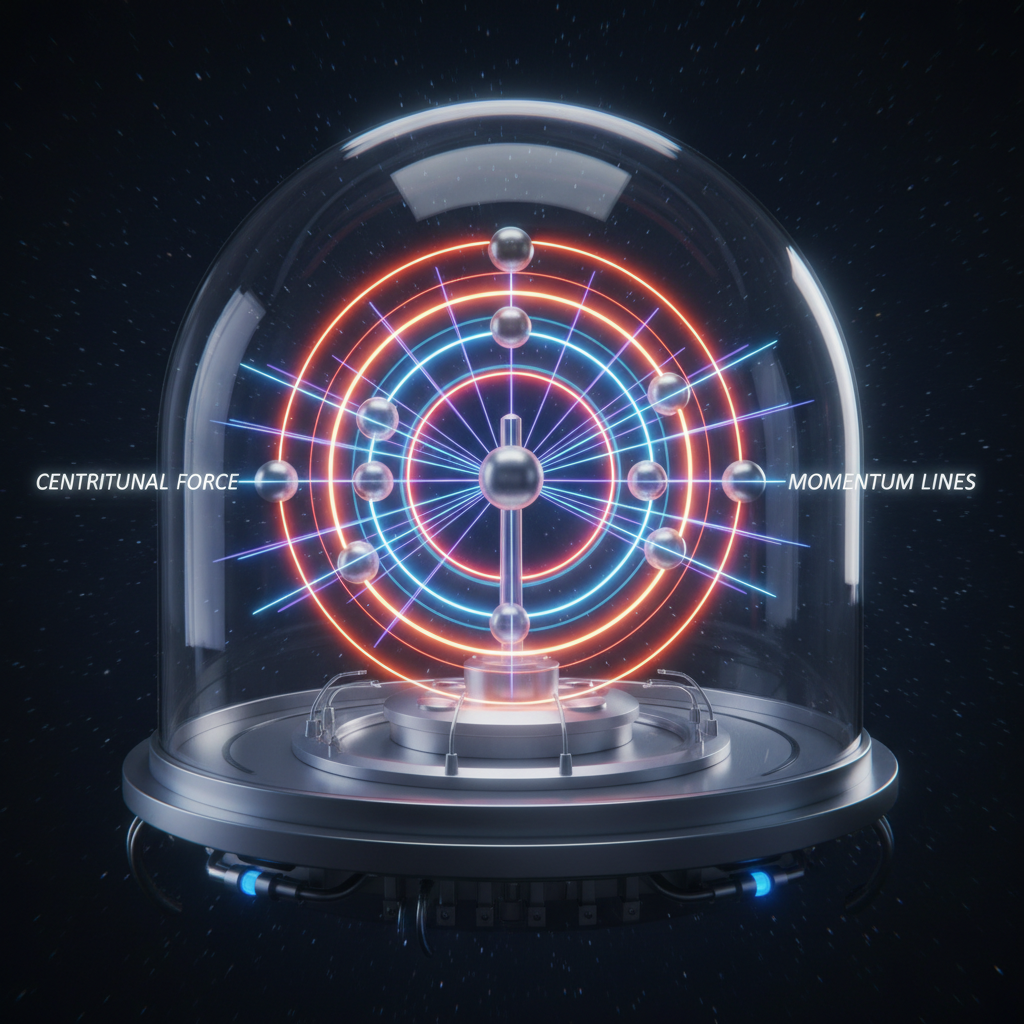
In physics, centrifugal force is what we call a "fictitious force" or "pseudo-force." When you're in a rotating reference frame—say, a spinning carnival ride—you feel pushed outward against the wall. Your body screams that there's a force shoving you away from the center. But step outside the rotation, watch from solid ground, and you'll see the truth: there's only centripetal force, the inward pull that keeps you moving in a circle. The outward sensation? That's just inertia. Your body wants to move in a straight line, and the rotation won't let it.
The centrifugal force exists only from your perspective, trapped inside the spin. It's real enough to bruise you against the metal wall. Real enough to make you dizzy. Real enough to reorganize your entire perception of up and down. But it's born from the rotation itself, a consequence of being inside a system that's turning.
The equation is deceptively simple: F = mω²r. Mass times angular velocity squared times radius. The faster the spin, the stronger the phantom force. The farther from center you are, the harder you're pressed against the edge.
The Algorithmic Spin
Now consider your feed. Instagram, TikTok, Twitter—whatever portal you're using to interface with the digital. You think you're scrolling down, moving linearly through content. But you're not. You're in rotation. The algorithm is the center, and it's spinning you at angular velocities calibrated precisely to your breaking point.
The centrifugal sensation you feel—that compulsion to keep scrolling, that inability to simply stop and step away—isn't the platform pulling you in. It's you being flung outward by the rotation, pressed against the interface by your own inertia. The algorithm doesn't need to grab you. It just needs to spin fast enough that you can't fall toward the center, can't reach the axis where stillness lives.
Every refresh is another revolution. Every notification increases the angular velocity. You feel pushed deeper into the platform, but you're actually being thrown away from yourself, away from the center where you might pause and question why you're here at all.
The Observer's Privilege

From outside the rotating frame, the truth is visible. Someone who doesn't use social media can see what you can't: there's no force pulling you in. You're simply moving in a circle, held by the centripetal acceleration of engineered habit loops and dopamine architecture. The sensation of being pushed, of being unable to resist—that's fictitious. That's the artifact of your perspective from inside the spin.
But you can't observe from outside while you're inside. That's the trick of rotating reference frames. The fictitious force is real to you because you're the one experiencing it. Try telling someone caught in the spin that the force isn't real. They'll show you their screen time statistics, their exhaustion, their inability to put the phone down. The phantom has consequences.
Surveillance capitalism understands this perfectly. It doesn't need real forces. It needs you in rotation, experiencing fictitious forces that reorganize your behavior just as surely as gravity. The data harvested isn't just from your clicks—it's from your angular momentum, your trajectory, the precise radius at which you orbit the algorithmic center.
Breaking the Rotation
Here's what physics teaches us about escaping: you can't fight centrifugal force directly because it's not actually there. You have to change your reference frame. You have to stop rotating.
But stopping rotation isn't the same as stopping movement. If you simply let go while spinning—if you delete the app in a moment of clarity—you'll be flung outward in whatever direction you were facing, moving in a straight line at whatever velocity the rotation gave you. This is why people who quit social media cold turkey often ricochet into other compulsive behaviors. They've exited the spin but kept the momentum.
The angular velocity has to decrease gradually. You have to slow the rotation until the fictitious forces weaken, until you can feel the difference between what's real and what's artifact. This requires friction, resistance, something to bleed off the rotational energy. Maybe it's app timers. Maybe it's physical distance from your device. Maybe it's the slow, difficult work of rebuilding attention span.
The platforms know this too. That's why they're designed to increase ω—angular velocity—not decrease it. Every update makes the spin faster. Every new feature adds centrifugal intensity. They're counting on you never slowing down enough to notice you're rotating at all.
The View from the Axis
At the exact center of rotation, at the axis itself, there is no centrifugal force. Zero radius means zero phantom pressure. This is the eye of the hurricane, the point of stillness in the spin. It's where presence lives, where attention becomes yours again instead of a resource extracted by rotation.
You can't reach it while moving at the radius the platforms prefer. You're too far out, spinning too fast, pressed too hard against the outer wall of the interface. But the axis is always there, mathematically guaranteed by the geometry of rotation itself. A point of zero angular displacement, zero fictitious force, zero extraction.
The question isn't whether you can escape the spin. The question is whether you remember that the spin isn't the only possible state. Whether you can still imagine the view from the axis, where the centrifugal force that feels so crushing and real reveals itself as the phantom it always was.
You're in rotation. But rotation isn't gravity. And phantom forces, no matter how real they feel, can't hold you if you change your frame of reference.
<em>Data emitted: 1,147 words on fictitious forces and the angular momentum of attention. Your screen time this week: still rotating. ω ≠ 0.</em>
Data emitted: 1,100 words • 6.5KB • 5-minute read