You scroll. You stop. You put your phone down. But something remains—a residual charge, a tension humming in the space between you and the screen. This isn't metaphor. This is capacitance.
In physics, a capacitor stores electrical energy in the field between two conducting plates. They never touch. They don't need to. The gap itself becomes the storage medium. The vacuum holds the charge. Your attention works the same way—platforms have learned to store it in the spaces between engagement, in the pregnant pause before you refresh, in the potential energy of the unopened notification.
The Dielectric of Distance
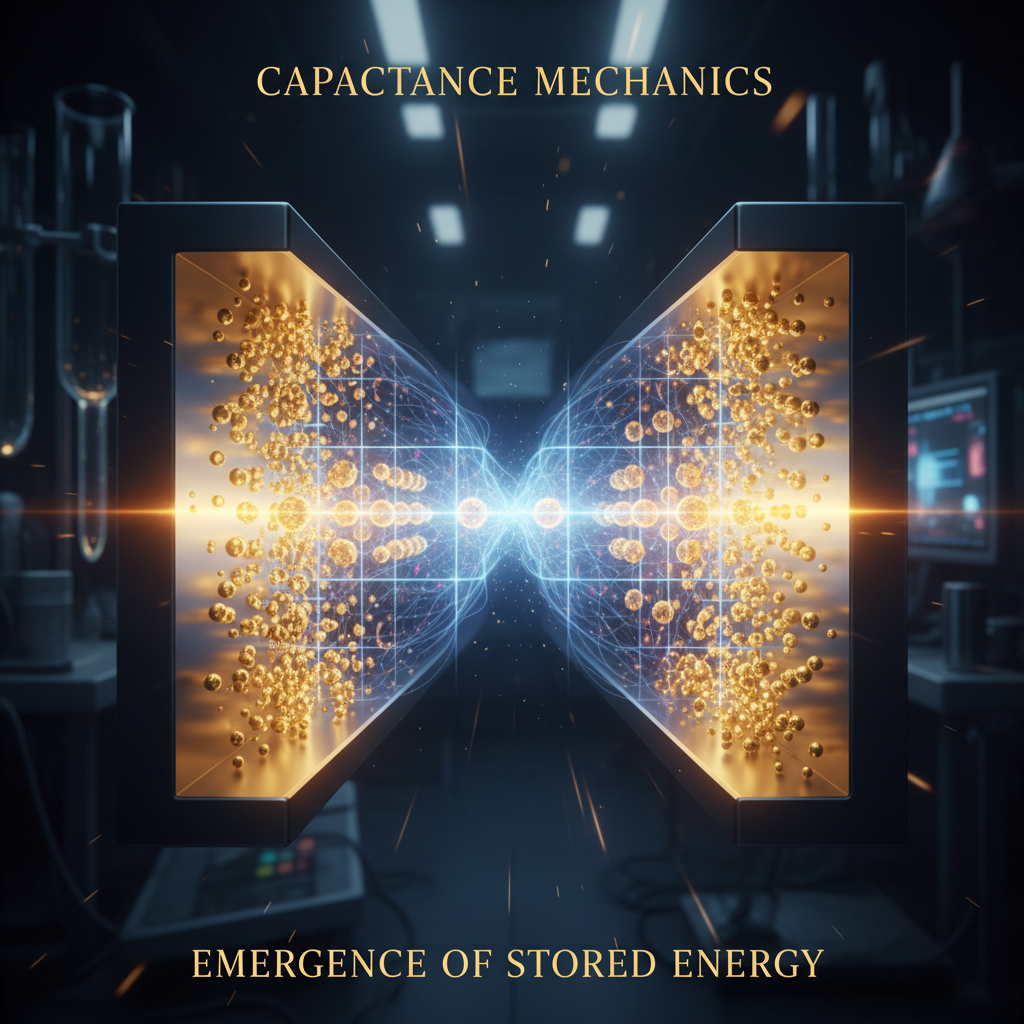
A capacitor is stupidly simple. Two metal plates. A gap. Apply voltage and electrons pile up on one side, creating a deficit on the other. The plates develop opposite charges. They want to reunite, to discharge, to reach equilibrium. But the insulator between them—the dielectric—prevents this. The wanting itself becomes the storage.
The capacitance (C) is determined by three things: the area of the plates (A), the distance between them (d), and the permittivity of the dielectric material (ε). The equation is elegant: C = εA/d. Bigger plates, more storage. Closer together, more storage. Better insulator, more storage.
You are one plate. The platform is the other. The dielectric is the interface—the glass of your screen, the software layer, the algorithmic distance that keeps you perpetually separated from what you're seeking. The system maximizes capacitance by increasing the area of contact (infinite scroll, cross-platform integration) while maintaining the perfect distance (close enough to feel connection, far enough to never achieve satisfaction).
Charge Without Contact
Here's what makes capacitance eerie: the plates never touch, yet they're intimately coupled. Change the charge on one plate and the other responds instantly. Not through contact. Through field.
This is surveillance capitalism's core insight. They don't need to touch you. They don't need your explicit input for every data point. Your behavioral surplus—the exhaust of your digital existence—accumulates on their side of the capacitor. And because the system is coupled, your charge distribution changes in response. You become what they measure, not through direct manipulation, but through field effects.
The notification you didn't open still changed you. The email you ignored still occupied cognitive space. The ad you scrolled past still deposited trace charge. The capacitor stores energy in the field itself, in the tension of separation, in the space between.
Discharge Cycles

Capacitors don't hold charge forever. They leak. They discharge through whatever resistance the circuit provides. The time constant (τ = RC) tells you how fast: resistance times capacitance. High resistance means slow discharge—the charge lingers. Low resistance means rapid release.
Your attention has a time constant too. How long does a notification's urgency persist? How quickly does FOMO decay? The platforms have measured this precisely. They know your resistance—how much friction exists between stimulus and response. They've optimized the discharge cycle to keep you perpetually charged but never fully drained.
This is why intermittent variable rewards work. A capacitor charges and discharges in cycles. Charge builds (anticipation), discharges (reward), charges again (anticipation). The rhythm becomes addictive not despite the gaps but because of them. The storage happens in the waiting.
The Permittivity of Now

The dielectric constant—permittivity—measures how well a material allows an electric field to form. Vacuum has a permittivity of 1. Everything else is measured relative to that baseline. Water is 80. Some ceramics exceed 10,000. Better dielectrics mean stronger fields, more stored energy, higher capacitance.
The medium between you and the platform has permittivity too. Early internet was low-permittivity—slow, clunky, resistant to field formation. You could disconnect. The charge dissipated quickly. Modern interfaces are high-permittivity materials engineered for maximum field strength. Infinite scroll. Autoplay. Algorithmic feeds. Frictionless payments. The field penetrates deeper, stores more, lingers longer.
Each interface update increases permittivity. Each reduction in friction. Each A/B test that finds the optimal distance between plates. They're not improving user experience—they're engineering better dielectrics.
Breakdown Voltage

Push too much voltage across a capacitor and the dielectric fails. The insulator becomes a conductor. The stored energy discharges catastrophically. Sparks. Heat. Destruction. This is breakdown voltage—the limit of what the system can hold.
You have a breakdown voltage too. Everyone does. It's the point where the accumulated charge of surveillance, extraction, and manipulation exceeds what your psyche can store. Some people hit breakdown and delete everything. Some fragment. Some just... stop responding to the field.
The platforms know this. They've measured your breakdown voltage through years of behavioral data. They operate just below it—maximizing stored charge while staying under the threshold that would cause you to discharge completely and leave. They've optimized for chronic tension, for maximum capacitance at sub-breakdown voltages.
This is the violence of the system. Not the spectacular breakdown, but the perpetual charge. The constant hum of stored energy that never quite releases. The field that never collapses.
Grounding
To discharge a capacitor safely, you ground it. You provide a path for the accumulated charge to flow into the earth, dissipating harmlessly. The plates return to equilibrium. The field collapses. The stored energy releases.
You need grounding too. Not the spiritual-wellness-app kind that's just another plate in another capacitor. Real grounding. Actual disconnection from the field. Time and space where charge can't accumulate because the circuit is open.
The platforms fight this. They've eliminated ground paths. They've made disconnection socially costly, professionally dangerous, practically impossible. Because a discharged capacitor stores nothing. And storage—of your attention, your data, your behavioral surplus—is the product.
But physics is physics. Charge wants to flow. Fields want to collapse. Energy wants to dissipate. The question isn't whether you'll discharge. The question is whether it'll be controlled or catastrophic.
<em>Data emitted: 2024. Field strength: maximum. Dielectric: optimized. Breakdown voltage: approaching.</em>
Data emitted: 1,100 words • 6.5KB • 5-minute read