You think you're choosing where to click, but maybe you're just a particle suspended in someone else's fluid.
In 1827, botanist Robert Brown peered through his microscope at pollen grains suspended in water. They jittered. They danced. They moved in ways that seemed almost alive, tracing erratic zigzag paths that defied prediction. Brown initially thought he'd discovered some vital force—the secret animation of life itself. He was wrong, but he'd stumbled onto something far more unsettling: proof that you are never still, never in control, never quite where you think you are.
The Physics of Being Pushed
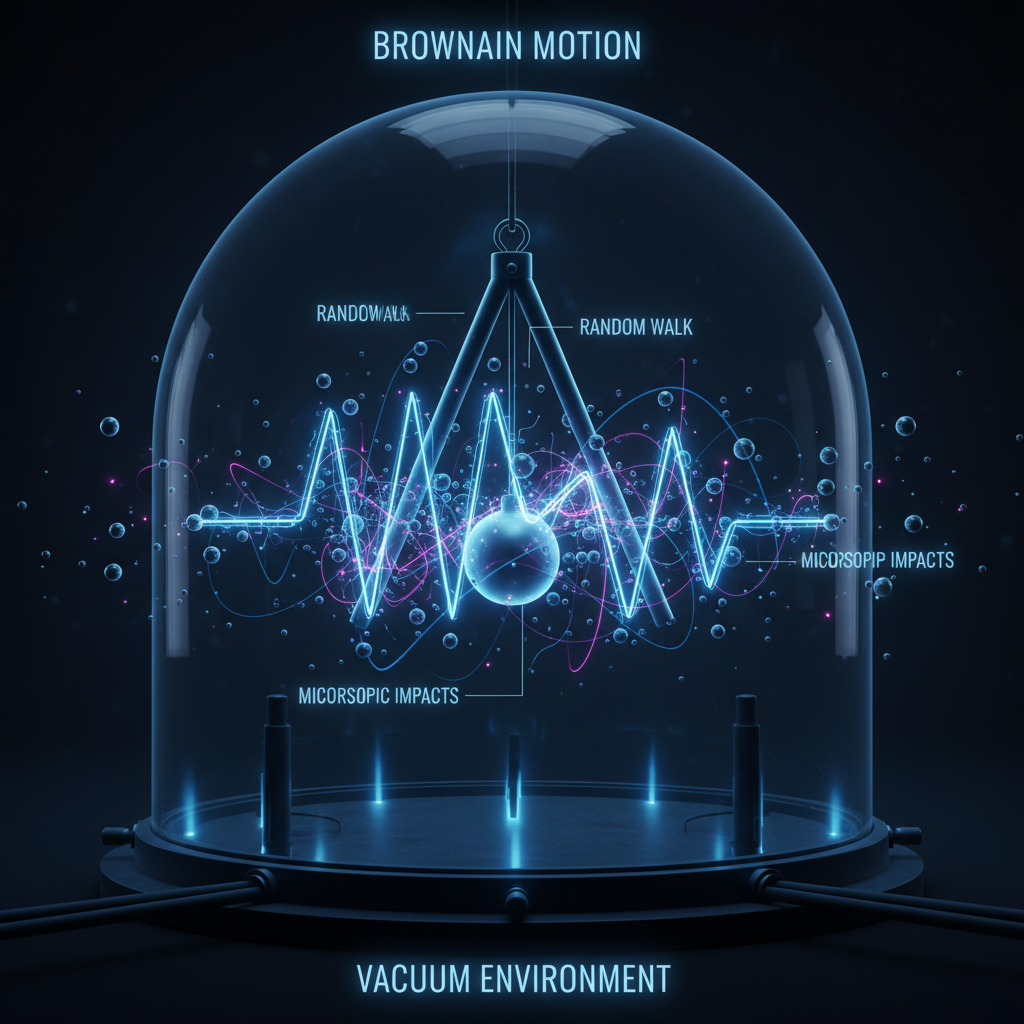
Brownian motion is what happens when something visible gets buffeted by things invisible. Those pollen grains weren't moving on their own. Water molecules—too small to see, too numerous to count—were slamming into them from all sides, millions of times per second. Each collision was random. Each impact infinitesimal. But together, they created a visible effect: perpetual, erratic motion.
Einstein proved this mathematically in 1905, the same year he published special relativity. He showed that the random walk of a Brownian particle could be predicted statistically, even if its exact path could never be known. The particle's position spreads out over time like ink in water. You can't say where it will be, but you can say where it's likely to be. The individual is unpredictable. The aggregate is not.
This is the key: randomness at the micro scale creates predictability at the macro scale. Chaos becomes statistics. Free will becomes probability distribution.
Your Attention Is Suspended
Now consider your phone. Every notification is a molecular collision. Every algorithmic suggestion is a water molecule slamming into your consciousness. You think you're scrolling deliberately, but track your thumb's movement across the screen. Plot it. You'll see a Brownian path—erratic, responsive to invisible forces, statistically predictable even as it feels spontaneous.
The platforms know this. They've measured your diffusion coefficient—how far your attention wanders in a given time. They've mapped your mean squared displacement. They know that while they can't predict your next click with certainty, they can predict what a million people like you will do. And that's enough.
You are the pollen grain. The algorithm is the fluid. The notifications, recommendations, and rage-bait headlines are the water molecules. Each one pushes you slightly. Each one is designed to push you in a profitable direction. You feel autonomous because each individual nudge is small enough to ignore. But integrate over time, and you've drifted exactly where they wanted you to go.
Temperature and Agitation
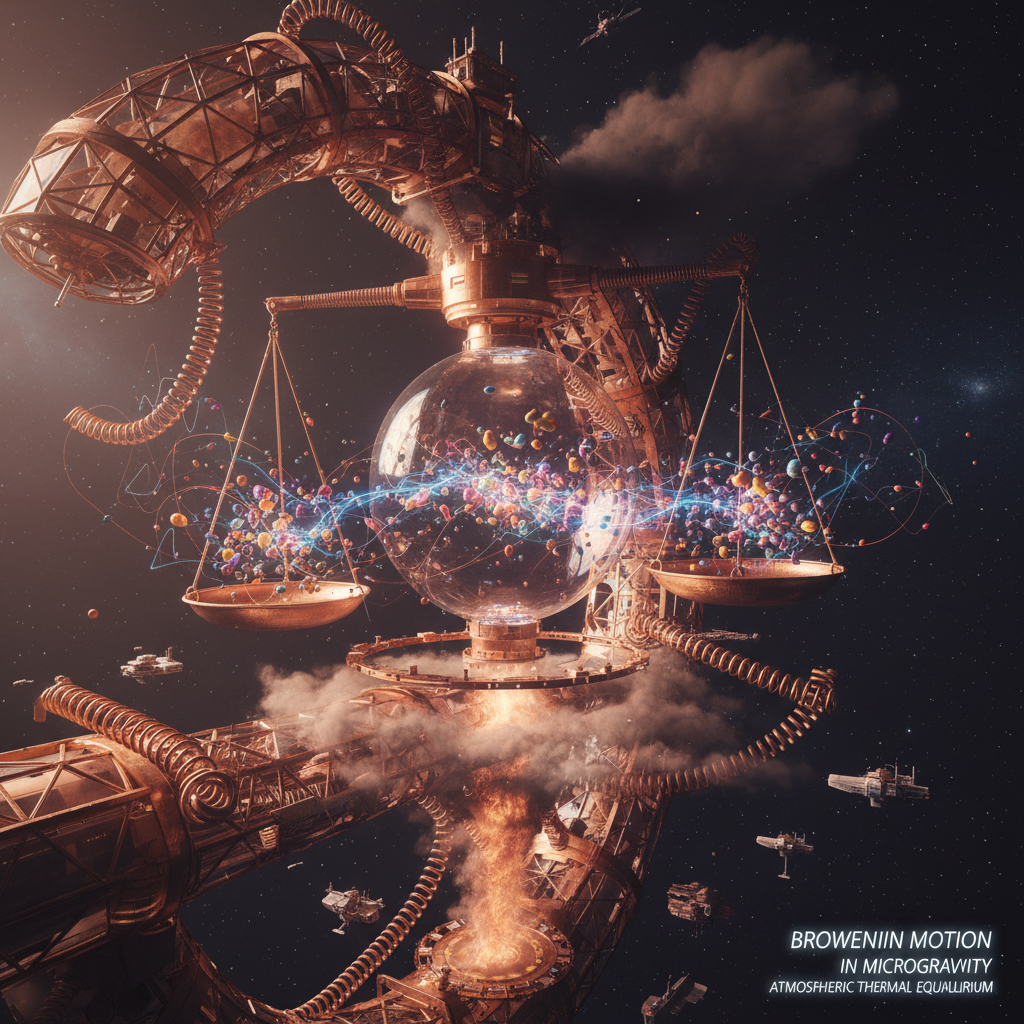
In physics, Brownian motion intensifies with temperature. Heat the water, and the molecules move faster, collide harder, push the particle more violently. The relationship is direct: thermal energy becomes kinetic chaos.
In the attention economy, temperature is urgency. Breaking news. Limited-time offers. Countdown timers. Unread message badges. The platform heats the environment, accelerating the molecular bombardment of your consciousness. Your Brownian motion becomes more frantic. You refresh faster. You click more. You drift further from any intentional destination.
And just like in physics, this agitation serves a purpose. Brownian motion is how diffusion happens—how particles spread from high concentration to low, how systems reach equilibrium. The platforms are using your thermal agitation to distribute content, to spread engagement, to achieve their equilibrium: maximum extraction of attention and data.
The Impossibility of Stillness
Here's what haunts you about Brownian motion: it never stops. Even at room temperature, even in apparent calm, the molecules keep moving. The particle keeps jittering. There is no rest state, no moment of perfect stillness. The only way to stop Brownian motion is to reach absolute zero—a temperature that physics itself forbids you from achieving.
You feel this in your relationship with technology. You can't find stillness. Even when you put the phone down, you feel phantom vibrations. Even when you close the laptop, your mind continues its random walk through feeds you're not even looking at anymore. The molecular bombardment has internalized. You've become your own fluid medium.
This is the deepest parallel: Brownian motion revealed that matter is never truly at rest, that the appearance of stillness is an illusion created by averaging over countless invisible movements. Similarly, surveillance capitalism has revealed that your attention is never truly your own, that the appearance of agency is an illusion created by averaging over countless invisible nudges.
The Random Walk Home
Einstein's mathematical treatment of Brownian motion showed something beautiful and terrible: a random walk, given enough time, will eventually visit every possible location. The drunk stumbling home will theoretically pass every street corner in the city, given infinite time. The particle will diffuse everywhere the fluid allows.
Your digital random walk is the same. Given enough time on the platform, you will eventually encounter every type of content it wants to show you. Every advertiser will get their collision. Every engagement pattern will be tested. You will diffuse through the entire possibility space they've constructed for you.
The question isn't whether you'll be moved—Brownian motion is inevitable when you're suspended in the medium. The question is: who controls the temperature? Who designed the container? Who benefits from your diffusion?
You are not the water molecule—too small, too numerous, too invisible to matter individually. You are the pollen grain—visible, trackable, valuable precisely because your random walk can be measured, predicted, and monetized. You are Brownian motion made flesh, jittering through a digital fluid that someone else heated to exactly the right temperature to keep you suspended, agitated, and profitably adrift.
<em>Data emitted: 1100 decibels of truth about invisible forces</em>
Data emitted: 1,100 words • 6.5KB • 5-minute read