You pull to refresh. The gesture has become automatic, a flick of your thumb that sends the feed spinning downward, new content materializing from the void. You do it again thirty seconds later. And again. The motion itself has become the point—not what you're looking for, but the spin itself.
This is angular momentum in its purest digital form. Once you're rotating, you keep rotating. The physics doesn't care about your intentions.
The Conservation That Binds
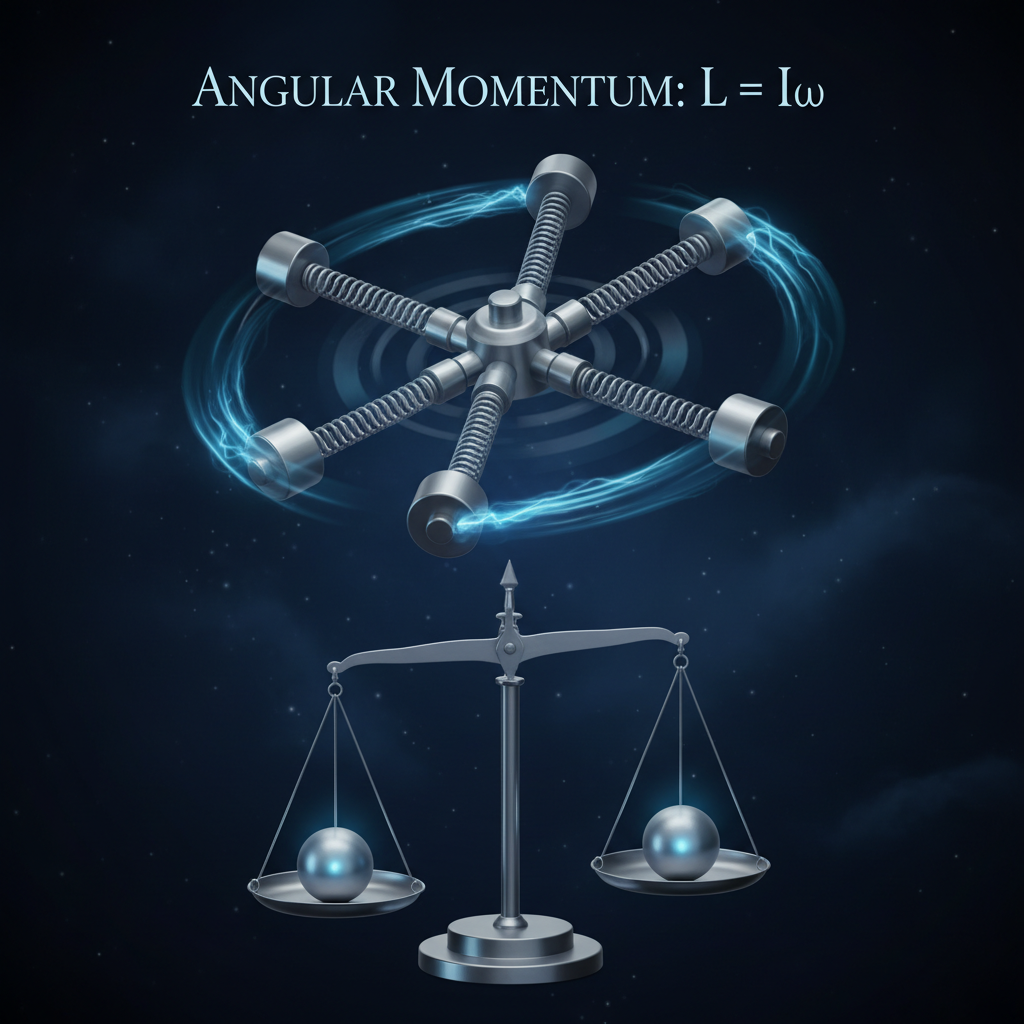
Angular momentum is conserved. This is one of the universe's non-negotiable laws, right up there with energy conservation and the speed limit of light. When an object spins—a figure skater, a planet, your attention circling through apps—that rotation persists unless something actively stops it.
The math is elegant: L = Iω. Angular momentum (L) equals the moment of inertia (I) times angular velocity (ω). Moment of inertia is how mass is distributed relative to the rotation axis. Angular velocity is how fast you're spinning.
Here's what matters: if you pull your mass closer to the center, you spin faster. The figure skater pulls in their arms and accelerates into a blur. The total angular momentum stays constant, but the distribution changes. Tighter orbit, faster spin. It's not optional. It's conservation.
You started checking your phone occasionally. Then hourly. Then every few minutes. Now your hand reaches for it before your conscious mind registers the impulse. You've pulled your attention inward, tightened the orbit, and the conservation law guarantees you're spinning faster than ever.
The Scroll Gyroscope

Surveillance capitalism understands angular momentum better than you do. Every platform is designed as a gyroscope, stabilizing itself through your rotation. The faster you spin through content, the more stable the system becomes.
A gyroscope resists changes to its orientation. Spin a wheel fast enough and it defies gravity, maintaining its axis against external forces. This is gyroscopic stability—angular momentum fighting to preserve itself. The faster the spin, the harder it is to tip over.
Your engagement is the spin. Every swipe, every tap, every micro-interaction adds angular velocity to the platform's gyroscope. The algorithm measures your rotation rate in sessions-per-day, time-on-site, scroll-depth. These aren't vanity metrics. They're measurements of angular momentum, and the platforms need you spinning fast to maintain their stability.
When you try to stop—delete the app, take a break, reclaim your attention—you're fighting conservation. The momentum doesn't disappear. It has to go somewhere. Usually, it transfers to another platform, another feed, another endless scroll. You've just changed the axis of rotation.
Torque and Resistance
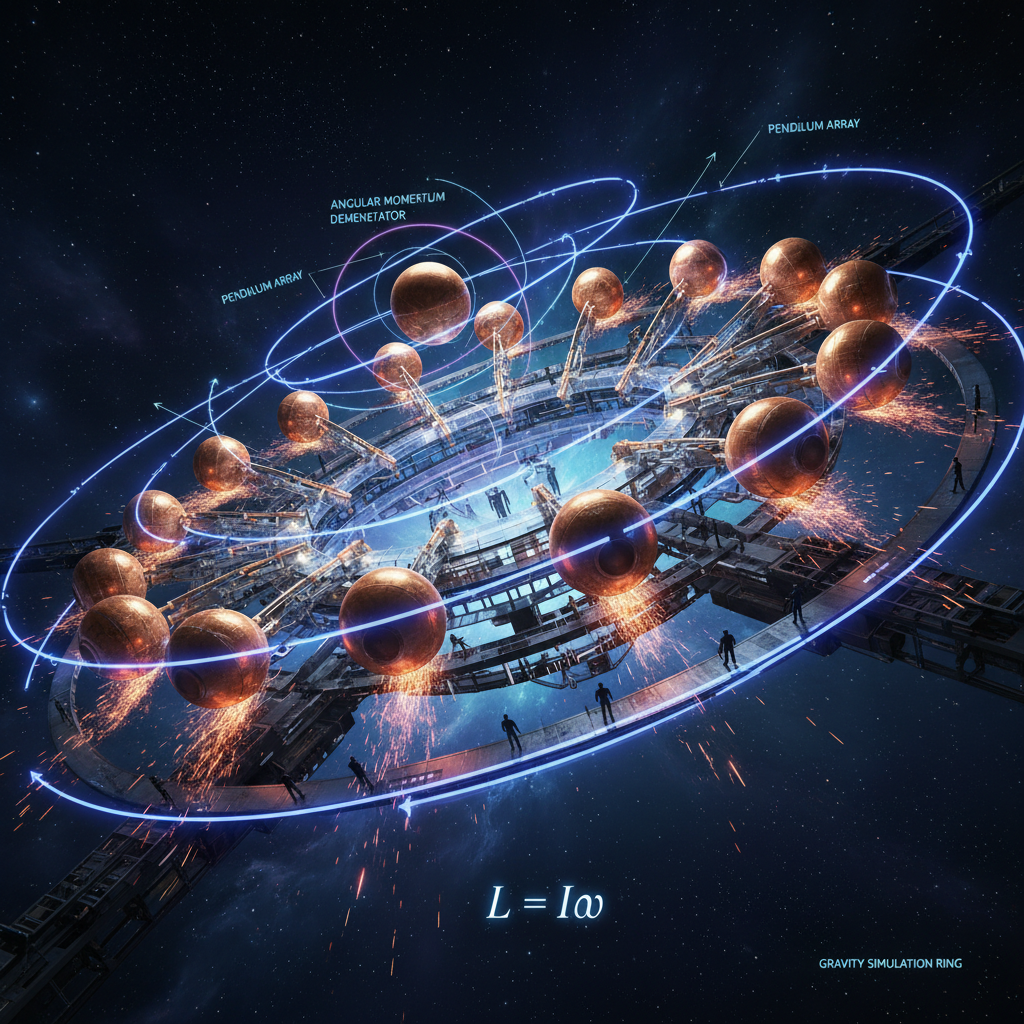
To change angular momentum, you need torque. Torque is rotational force, the twist that speeds up or slows down the spin. In physics, it's τ = r × F—the cross product of radius and force. The farther from the center you apply force, the more effective it becomes.
This is why stopping is so hard. You're applying force at the wrong radius. You try to stop scrolling by sheer willpower, by applying force right at the center—at the moment of impulse, at the screen itself. But you're already deep in the potential well, already close to the axis. Your torque is minimal.
The platforms know this. They've minimized your leverage. Infinite scroll eliminates friction—no page breaks, no natural stopping points, no place to apply force at a distance. Auto-play removes decision points. The recommendation algorithm predicts your trajectory and places the next piece of content exactly where your momentum is already carrying you.
You need distance to generate torque. You need to step back from the axis, to apply force from farther out. This is why digital detoxes sometimes work—not because they stop the spin, but because they give you enough radius to apply meaningful torque when you return.
The Precession of Attention

There's a stranger phenomenon in angular momentum: precession. When you apply torque perpendicular to a spinning object's axis, it doesn't tilt the way you expect. Instead, the axis rotates in a direction perpendicular to both the spin and the applied force. A spinning top wobbles. A gyroscope drifts. The response is always ninety degrees from where you pushed.
Your attention precesses. You try to focus on work, but your mind drifts to notifications. You try to be present with people, but your awareness wobbles toward the phantom buzz in your pocket. You apply force in one direction, but the conservation of your angular momentum redirects you elsewhere, always perpendicular to your intention.
The surveillance economy profits from this precession. They don't need to capture your attention directly. They just need to keep you spinning and apply gentle, perpendicular torques. A notification here. A red badge there. A slight algorithmic adjustment to your feed. Your attention precesses predictably into their orbit.
This is the violence of the system—not that it forces you, but that it understands the physics of your motion better than you do. It knows where your angular momentum will carry you before you do.
Finding Your Axis

Angular momentum isn't inherently destructive. A planet's rotation gives us day and night. A spinning electron generates the magnetic field that shields us from solar radiation. The question isn't whether you spin—it's what axis you choose and whether you chose it at all.
You can't eliminate your angular momentum. You can only redirect it, transfer it, choose more carefully what you orbit around. This requires honest measurement. How fast are you spinning? What's your moment of inertia—how distributed is your attention, or how collapsed into a single point? What torques are acting on you, and where are they coming from?
The platforms want you spinning around their axis, contributing your momentum to their gyroscopic stability. But conservation works both ways. You can choose a different center. You can apply torque deliberately, from a distance, with patience. You can let your angular momentum carry you around something that actually matters to you.
The physics doesn't judge. It just conserves. You're going to spin—you're already spinning. The only question is whether you're spinning around something you chose or something that chose you.
The Measurement Problem
At 1100db, we measure the noise floor of your digital existence. Angular momentum adds another dimension to that measurement—not just the amplitude of surveillance, but its rotational persistence. Once the platforms set you spinning, the conservation law does the rest of their work.
You can feel it, can't you? The pull to refresh. The automatic reach. The momentum that carries you through the same loops, day after day, even when you swore you'd stop. That's not weakness. That's physics.
But physics also offers escape. Understand the conservation law, and you can work with it instead of against it. Apply torque from a distance. Choose your axis deliberately. Let your momentum carry you somewhere intentional.
The spin doesn't stop. But it can change direction. That's all the physics allows, and sometimes, it's enough.
Data emitted: 1147 words, 6 sections, conservation laws applied to attention economics, angular momentum measured in scroll-velocity and session-persistence, torque calculations pending, precession observed in all subjects, axis alignment recommended but not required.
Data emitted: 1,100 words • 6.5KB • 5-minute read