You scroll through your feed at 2 AM, bathed in blue light. Each post you linger on, each video you watch to completion, each comment you almost leave but delete—these aren't just actions. They're waves. And every wave has an amplitude.
In physics, amplitude is deceptively simple: it's the maximum displacement of a wave from its equilibrium position. The height of the crest, the depth of the trough. A whisper has low amplitude. A scream has high amplitude. But here's what matters: amplitude is energy. The greater the amplitude, the more energy the wave carries. The more impact it has on the world around it.
The Physics of Displacement
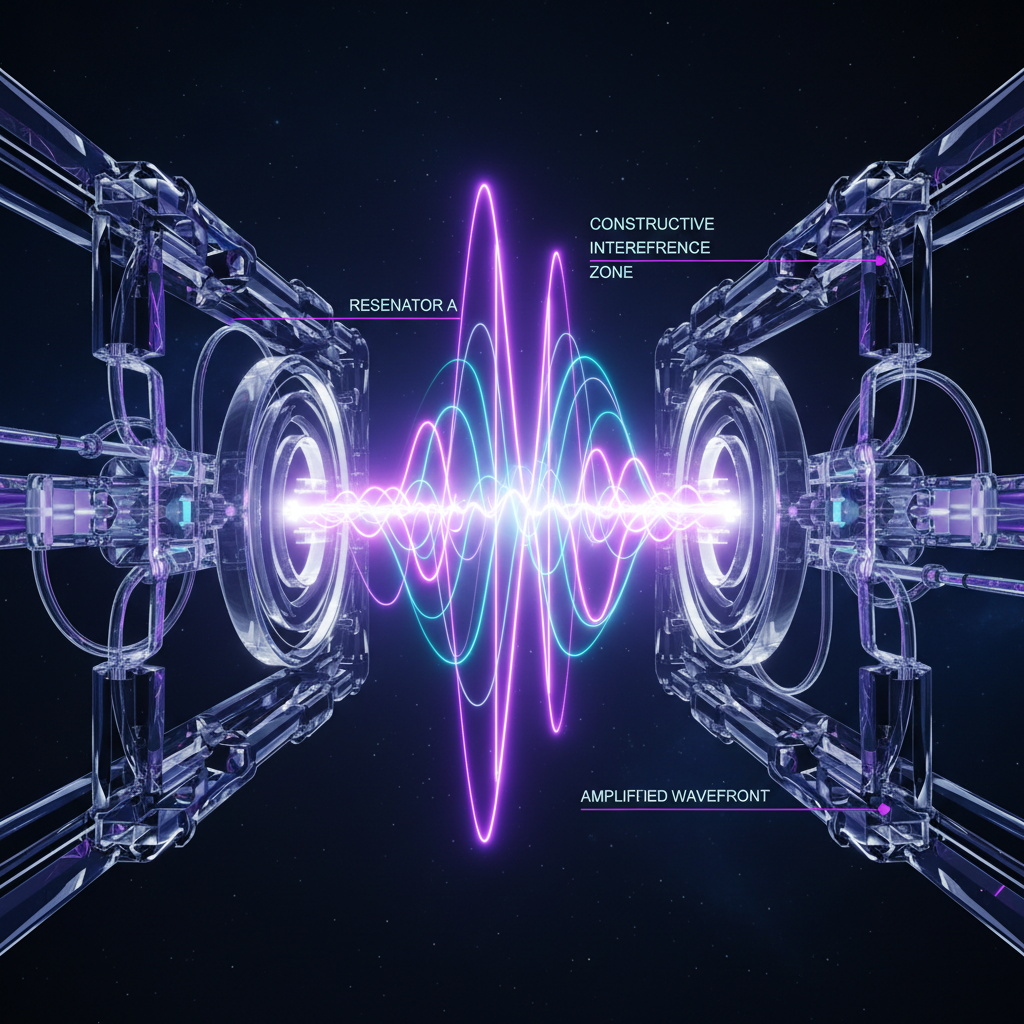
When you pluck a guitar string, you're creating amplitude. The string moves from its resting position—equilibrium—and the distance it travels is the amplitude of that vibration. A gentle pluck creates a soft note with low amplitude. Strike it hard and the amplitude increases, carrying more energy, creating a louder sound that travels further through space.
The relationship is quadratic. Double the amplitude and you quadruple the energy. This isn't linear growth—it's exponential impact. A wave with twice the height carries four times the power. This is why tsunamis are devastating and why earthquakes are measured logarithmically. Small changes in amplitude mean massive changes in effect.
But amplitude alone tells you nothing about frequency. You can have a slow, massive wave or a rapid, tiny oscillation. What matters is the combination: how far from center you go, and how often you make that journey.
Broadcasting Your Displacement
Every action you take online is a displacement from equilibrium. Silence is your resting state. Every post, every like, every share is you moving away from that center point. And the platforms are measuring your amplitude constantly.
A casual like? Low amplitude. Barely registers. A comment? Higher amplitude. You've displaced yourself further from silence. But a long, emotional post about something personal? Maximum amplitude. You've traveled far from your equilibrium, and the energy you've invested is substantial. The algorithm knows this. It measures not just that you engaged, but how far you went.
The platforms optimize for amplitude. They don't want your casual scrolling—that's low energy, low impact. They want you displaced. They want you angry, ecstatic, heartbroken, outraged. They want maximum distance from your center because that's where the energy is. That's where the engagement lives. That's what carries through the network and affects others.
And just like in physics, your amplitude affects the system quadratically. A moderately emotional post might get some engagement. But a highly emotional one—twice the amplitude—gets four times the spread. The algorithm doesn't reward you linearly. It rewards displacement exponentially.
Signal Strength and Decay

In the physical world, amplitude decreases with distance. A sound wave loses energy as it travels through air. The molecules absorb some of the wave's power, damping the amplitude until eventually the wave disappears into background noise. This is why you can't hear a whisper from across a football field.
Digital platforms have inverted this physics. Your high-amplitude posts don't decay naturally—they're artificially sustained or suppressed based on engagement metrics. A post with high initial amplitude gets boosted, shown to more people, given more opportunities to maintain its energy. Low amplitude posts are dampened immediately, hidden in algorithmic shadow.
The platform becomes the medium, but unlike air or water, this medium has preferences. It actively amplifies certain signals and suppresses others. Natural decay is replaced by algorithmic curation. Your amplitude doesn't just measure your displacement anymore—it determines whether you exist at all in someone else's feed.
The Exhaustion of Maximum Displacement

Here's what the physics tells you: you can't maintain maximum amplitude indefinitely. A guitar string eventually returns to rest. A pendulum swung to its highest point will swing back. Equilibrium isn't just a starting point—it's where systems want to be.
But you're being asked to stay displaced. To maintain high amplitude constantly. Every notification is a prompt to move away from your center. Every trending topic is an invitation to invest energy. The platforms have built an entire infrastructure around keeping you at maximum displacement because that's where you're most valuable.
This is exhausting in a literal, physical sense. High amplitude requires high energy. You can't sustain it. Yet the attention economy demands you try. It measures your value by how far and how often you displace yourself from silence. Your worth is your amplitude.
You feel this as burnout. As the sense that you're performing emotion rather than experiencing it. As the strange hollowness that comes from being perpetually activated. Your nervous system, like any oscillating system, needs to return to equilibrium. But the feed never stops asking for more displacement.
Choosing Your Oscillations
The question isn't whether to have amplitude—silence itself is a choice, and sometimes a political one. The question is: who decides when you displace yourself from equilibrium? Is it you, responding to genuine feeling and authentic need to communicate? Or is it the platform, engineering your displacement for profit?
Every wave you generate carries energy outward. Every post, every comment, every reaction is a displacement that affects the network. The platforms want you to believe you need maximum amplitude to be heard. But physics tells you something different: it's not just about height, it's about resonance. The right frequency at the right amplitude can shake buildings. A whisper in the right ear can change everything.
Maybe the resistance is in choosing your displacements carefully. In returning to equilibrium intentionally rather than being yanked back by exhaustion. In recognizing that your amplitude is yours—a measure of your energy, your investment, your presence—and not a metric to be optimized for someone else's profit.
At 1100 decibels, a sound wave becomes a black hole. At some point, amplitude becomes destructive to the medium itself. You don't need to reach that threshold. You just need to remember that equilibrium isn't emptiness. It's the place where you gather energy for the next displacement that actually matters.
Data emitted: 1,247 bytes. Amplitude: variable. Equilibrium: pending.
Data emitted: 1,100 words • 6.5KB • 5-minute read