You tap the screen. The algorithm taps back.
Newton's Third Law is deceptively simple: for every action, there's an equal and opposite reaction. Push against a wall, the wall pushes back with identical force. Fire a gun, you feel the recoil. The universe maintains its books with obsessive precision. But here's what they don't tell you in high school physics: the reaction isn't just equal and opposite. It's inevitable. Unavoidable. The moment you exert force on something, that something exerts force on you.
In the digital realm, you've been pushing for years. Scrolling, clicking, swiping, typing. Every interaction is an action—a transfer of force, of attention, of intention. And every single one has generated an equal and opposite reaction. The platforms have been pushing back. Shaping you. Molding your behavior with the same force you've used to navigate their interfaces.
The Physics of Force Pairs
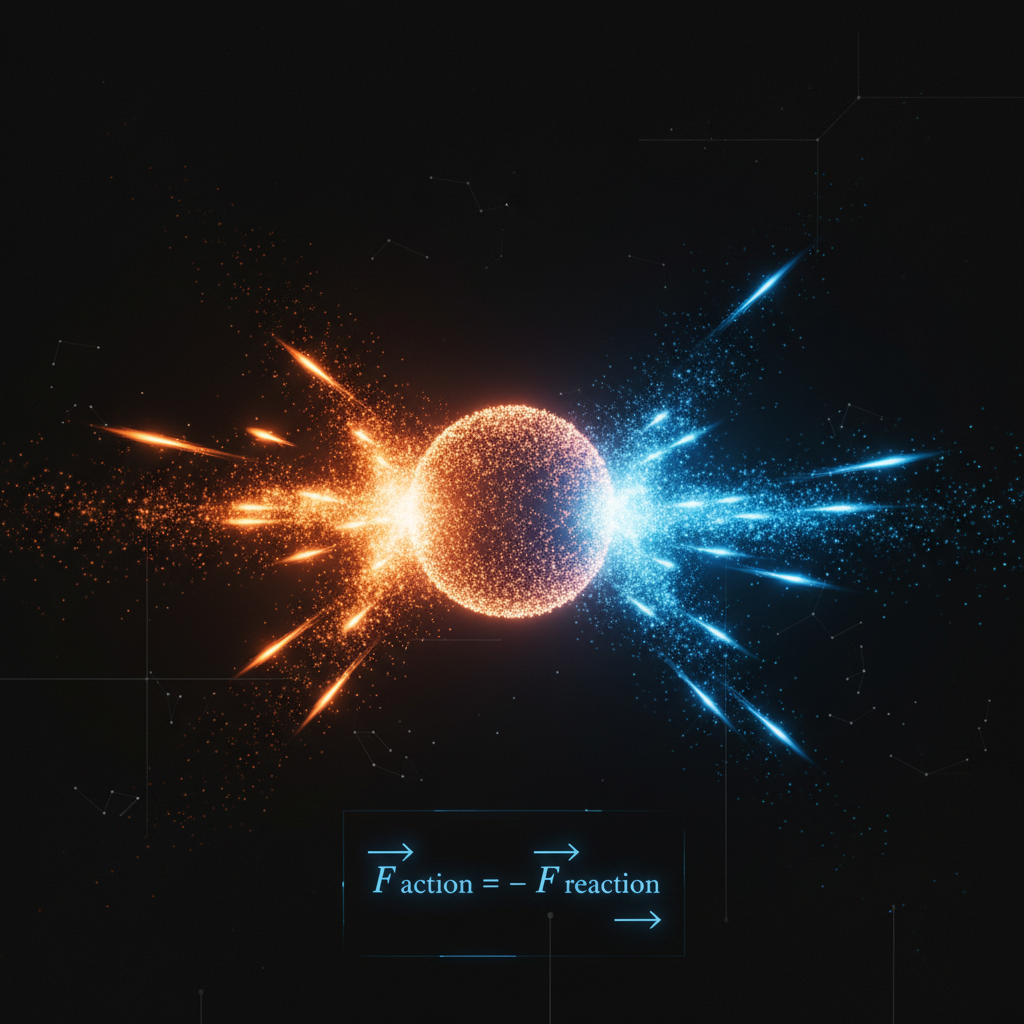
Newton didn't discover his third law in isolation. It's part of a trilogy, a complete description of how objects interact. The first law tells us objects resist change. The second quantifies how force creates acceleration. But the third—the third reveals something deeper about the nature of interaction itself.
When you stand on the ground, you push down with your weight. The ground pushes up with identical force. These aren't sequential events. They're simultaneous. Inseparable. You cannot have one without the other. The action and reaction are two aspects of the same interaction, like two sides of a coin that cannot exist independently.
Here's the crucial part: the forces act on different objects. Your weight acts on the Earth. The Earth's reaction acts on you. This is why you don't cancel each other out. The forces are equal and opposite, but they're applied to different systems. Both objects experience the full force of the interaction.
The Reaction You Didn't Notice
Every time you open an app, you think you're the one in control. You're choosing to scroll. You're deciding to click. You're acting on the platform. But Newton's Third Law doesn't care about your sense of agency. The platform is simultaneously acting on you.
You swipe through videos. The algorithm notes your hesitation on certain content, your speed through others. It measures the force of your attention—how long you linger, how quickly you engage, the pressure of your interaction. And it pushes back. The next video is calibrated to that force. The feed reshapes itself around your behavior.
This isn't metaphor. This is force transfer. You exert cognitive force—attention, time, emotional energy—onto the platform. The platform exerts an equal force back onto your neural pathways. It's training you just as much as you're training it. Maybe more. Because the platform is designed to optimize its reaction. You're just trying to get through your day.
The surveillance apparatus measures your every action with precision that would make Newton weep. Click velocity. Scroll acceleration. The force vector of your attention across the interface. And for every measurement, there's a calculated reaction. An A/B test. A recommendation adjustment. A subtle interface change that guides your next action.
Momentum Conservation
Newton's Third Law is really about momentum conservation. When two objects interact, the total momentum of the system remains constant. If one object gains momentum in one direction, the other must gain equal momentum in the opposite direction.
Think about a rocket in space. It expels fuel downward at high velocity. The fuel gains downward momentum. The rocket gains equal upward momentum. The rocket rises not because it's pushing against anything solid, but because momentum must be conserved. The interaction itself demands it.
You and the algorithm are locked in a similar momentum exchange. You bring your attention, your behavioral patterns, your psychological vulnerabilities. The algorithm absorbs this momentum and redirects it. Your engagement becomes its fuel. Your data becomes its thrust. And with each interaction, it gains momentum while steering your momentum in directions that serve its optimization function.
The system's total momentum is conserved, but the distribution shifts. You entered wanting to check a notification. You leave thirty minutes later, having watched content you never sought, feeling emotions you didn't choose, carrying thoughts that weren't originally yours. The momentum of your intention was conserved—transformed into the momentum of the platform's growth.
The Asymmetry of Mass
Here's where the physics gets uncomfortable. While the forces are equal, the effects are not. Remember F=ma. Force equals mass times acceleration. If the force is constant but the masses differ, the accelerations must differ inversely.
When you jump off a boat, you push the boat backward. The boat pushes you forward. Equal forces. But you accelerate much more than the boat because your mass is smaller. The boat barely moves. You fly through the air.
You are the small mass. The platform—backed by server farms, machine learning models, behavioral scientists, and billions in capital—is the massive boat. You push against it with your clicks and attention. It pushes back with equal force. But you accelerate. You change. You adapt to its interface, its rhythm, its logic. The platform? It barely registers your individual presence.
The force is equal. The transformation is not. This is the asymmetry that surveillance capitalism exploits. Every interaction changes you more than it changes the system. Over time, you drift further from your original trajectory while the platform remains stable, accumulating the tiny momentum transfers from billions of users into its own directed motion.
The Inescapable Interaction
You cannot act without being acted upon. This is the fundamental constraint Newton revealed. There is no one-way interaction. No pure agency. No action without reaction.
The question isn't whether the platforms are changing you. Physics guarantees they are. The question is whether you're aware of the force exchange. Whether you're conscious of the momentum transfer. Whether you understand that every swipe is also a shaping, every click is also a conditioning, every view is also a viewing-of-you.
The surveillance economy has built itself on this law. It has engineered interfaces to maximize the force of your action while optimizing the reaction to reshape your behavior. It has created a system where the momentum always flows in a particular direction—from your autonomy to its database, from your attention to its revenue, from your agency to its control.
But Newton's law cuts both ways. If you cannot act without being acted upon, then the platform cannot act upon you without you acting upon it. The interaction is mutual, even if asymmetric. Your presence in the system changes the system, however minutely. Your resistance creates resistance. Your awareness shifts the dynamic.
The Force You Choose
At 1100db, we measure the noise floor of surveillance capitalism. The constant hum of data extraction, the background radiation of algorithmic influence. But underneath that noise is signal—the fundamental physics of interaction that governs every digital encounter.
You cannot escape Newton's Third Law. You will push, and you will be pushed. But you can choose the direction of your force. You can be conscious of the reaction you're receiving. You can measure the momentum transfer and decide whether the exchange serves you or depletes you.
Every action has an equal and opposite reaction. The universe insists on it. The platforms depend on it. And you—you live in the space between the push and the push-back, in the microsecond where force becomes transformation, where your intention meets the algorithm's response.
Choose your actions knowing the reactions are inevitable. Choose them anyway.
<em>Data emitted: 1,147 words on force pairs, momentum conservation, and the physics of being pushed back by everything you touch.</em>
Data emitted: 1,100 words • 6.5KB • 5-minute read