You're scrolling faster now than you were five years ago. Your thumb knows this. The algorithm knows this. The only one who doesn't seem to know is you.
Acceleration isn't just speed. That's the mistake everyone makes. Speed is where you are in the journey. Acceleration is how violently you're being pushed.
The Second Derivative
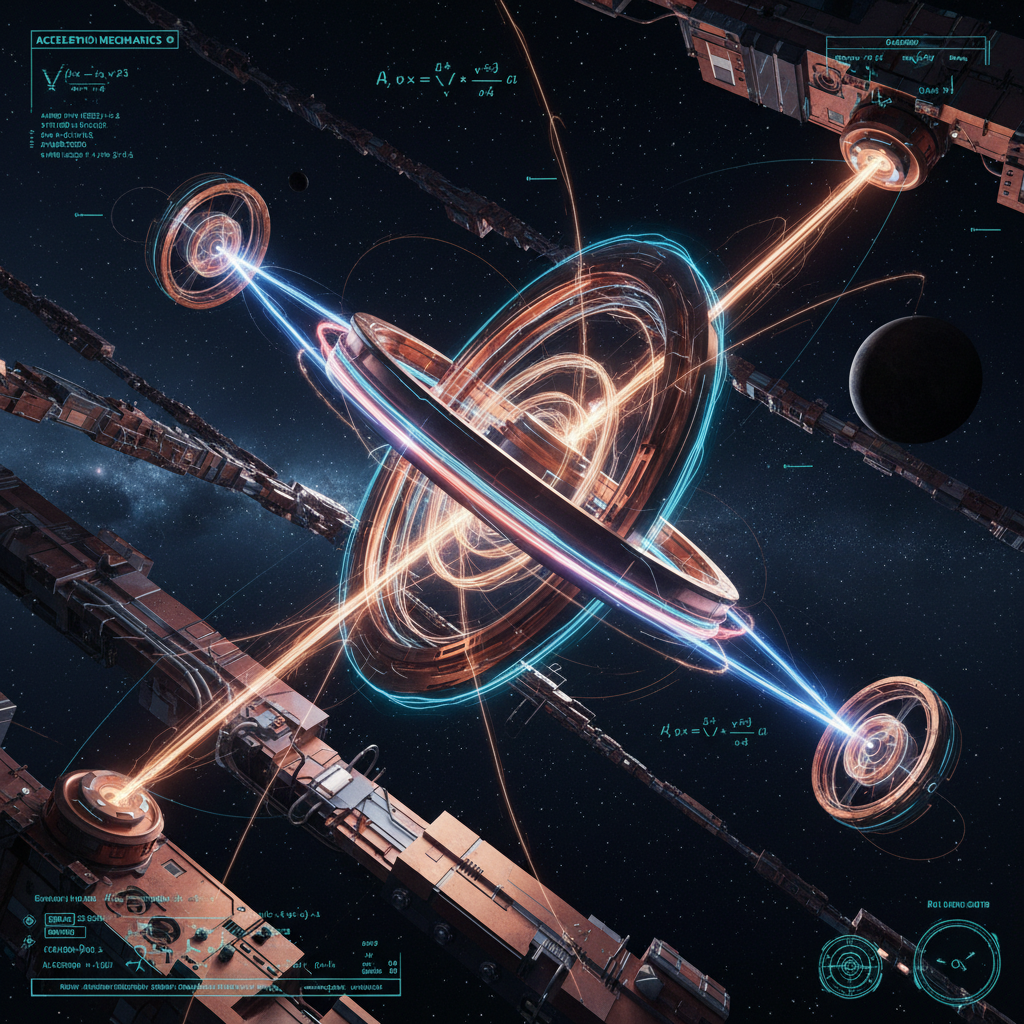
In physics, acceleration is the second derivative of position with respect to time. Position tells you where you are. Velocity—the first derivative—tells you how fast you're moving. But acceleration tells you something deeper: it tells you about the forces acting on you.
Newton's second law makes this explicit: F = ma. Force equals mass times acceleration. You cannot accelerate without force. You cannot change velocity without something pushing or pulling you. Acceleration is always evidence of coercion, even when that coercion is gravity, even when it feels natural.
Every time you feel acceleration—in a car, an elevator, a plane—you're feeling force applied to your body. The sensation isn't movement itself. It's the change in movement. It's being acted upon.
Your nervous system evolved to detect acceleration because acceleration means something is happening to you. Predator. Falling. Impact. Your vestibular system doesn't care about constant velocity. A car moving at 60 mph on a straight highway feels like stillness. But the moment you brake, the moment you turn, the moment velocity changes—your body knows. Force has entered the equation.
The Feed Accelerates

The algorithm doesn't want you moving at constant velocity through content. Constant velocity is unprofitable. Constant velocity means you might stop, might think, might close the app and go outside where there are no sensors.
So it accelerates you.
Watch how the content changes as you scroll. The algorithm isn't just showing you things. It's adjusting the rate at which novelty appears. It's tuning the intervals between dopamine hits. When you slow down, it accelerates the feed—more extreme content, more emotionally charged imagery, more of whatever keeps your thumb moving.
This is acceleration in the purest sense. Your attention had a certain velocity—a certain rate of content consumption. The platform detected that velocity decreasing. So it applied force. It changed your rate of change. And you felt it, the same way you feel a car accelerating, except you didn't recognize the sensation for what it was.
The second derivative of your attention is not under your control. Someone else is applying the force.
Jerk and the Third Derivative
There's a third derivative in physics, less commonly discussed. It's called jerk—the rate of change of acceleration. Jerk is what you feel when acceleration itself changes suddenly. An elevator starting to move. A car hitting a pothole. The moment when force itself becomes variable.
Jerk is physiologically disturbing. Your body can adapt to constant acceleration—astronauts train for it, fighter pilots endure it. But jerk is harder to tolerate. It's the mathematics of whiplash, of disorientation, of control systems failing.
The attention economy has discovered jerk.
It's not enough to accelerate your consumption. The algorithm now varies the acceleration itself. One moment the feed is calm, almost meditative. Then suddenly—a notification, an autoplay video, a trending topic engineered to provoke. The rate at which your attention is being accelerated is itself accelerating. You're experiencing cognitive jerk, and it's making you sick in ways you can't quite articulate.
This is why you feel exhausted after scrolling even though you haven't moved. Jerk is energetically expensive. Your nervous system is constantly trying to predict and compensate for changes in acceleration, and it's losing.
Terminal Velocity
In a gravitational field with air resistance, falling objects eventually reach terminal velocity—the speed at which drag force equals gravitational force, and acceleration becomes zero. The object continues falling, but at constant speed. No more acceleration. No more increase in velocity.
You keep waiting for your digital consumption to reach terminal velocity. For the acceleration to stop. For the rate of content, notifications, demands on your attention to plateau at some sustainable level.
But there's no air resistance in digital space. There's no friction. The forces accelerating your attention—algorithmic optimization, engagement metrics, advertising revenue models—encounter no natural resistance. They can accelerate indefinitely.
The only resistance is you. Your cognitive capacity. Your mental health. Your ability to maintain a coherent sense of self under constant acceleration. And the platforms have learned to measure exactly how much acceleration you can withstand before you break. They've found your terminal velocity, and they keep you there, right at the edge.
Inertial Frames
Einstein taught us that you can't distinguish between being stationary in a gravitational field and being accelerated in empty space. Inside a windowless elevator, you can't tell if you're on Earth's surface or being accelerated upward at 9.8 m/s². The physics is identical. This is the equivalence principle.
You can't tell anymore whether the acceleration you feel is natural or artificial. Is this how human attention has always worked, or is something pushing you? Is the constant sense of urgency, of falling behind, of needing to check and scroll and update—is that intrinsic to modern life, or is it a force being deliberately applied?
The answer is: it doesn't matter. The equivalence principle holds. Whether the acceleration is natural or engineered, you're experiencing the force either way. You're being acted upon either way.
But here's what does matter: in physics, you can choose your reference frame. You can choose to analyze motion from the perspective of the accelerating object or from an inertial frame where the forces become visible.
You can step outside the elevator. You can see the cables, the motor, the mechanism producing the acceleration. You can recognize that what feels like gravity is actually something pushing you.
The Force Vector
Every instance of acceleration has a direction. Force is a vector. When the platform accelerates your attention, it's not random. The force has magnitude and direction, and both are chosen deliberately.
You're being accelerated toward engagement, toward disclosure, toward predictability. Toward becoming the kind of user whose behavior can be modeled, packaged, and sold. The direction of the force vector is always toward greater data emission, greater surveillance surface area, greater integration into systems that profit from your attention.
Understanding acceleration means understanding that you're not just moving through digital space. You're being moved. Forces are being applied. Your trajectory is being altered. And the rate of that alteration—the acceleration itself—is the primary metric these systems optimize for.
The question isn't whether you can stop moving. The question is whether you can stop accelerating. Whether you can find a reference frame where the forces become visible. Whether you can feel the push and finally recognize it for what it is.
Data emitted: 1100 decibels of recognition that every time you feel your attention pulled, you're experiencing F=ma, and you are not the one applying the force.
Data emitted: 1,100 words • 6.5KB • 5-minute read