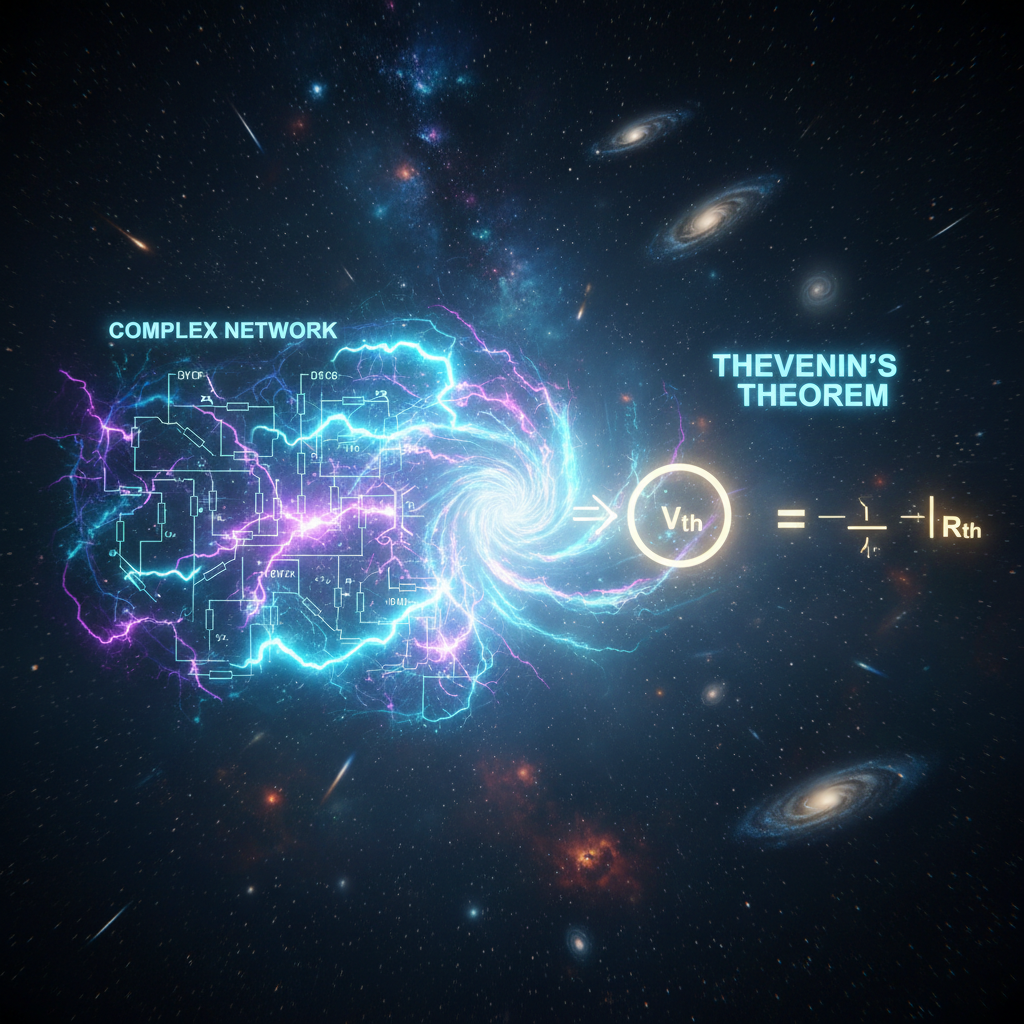
You're staring at a circuit diagram with dozens of resistors, voltage sources, capacitors—a maze of interconnected nodes that would take hours to analyze. Then someone shows you Thevenin's theorem. Suddenly, all that complexity collapses into two simple elements: one voltage source, one resistor. The entire network, no matter how elaborate, behaves identically to this stripped-down version when viewed from any two points.
Now look at your phone. Behind that glowing screen lies a network of unprecedented complexity: ad exchanges, data brokers, analytics platforms, recommendation engines, all interconnected in ways you'll never fully map. But here's what Thevenin understood about networks that you need to understand about surveillance capitalism: complexity is a feature, not a bug. It obscures the simple truth underneath.
The Equivalent Circuit
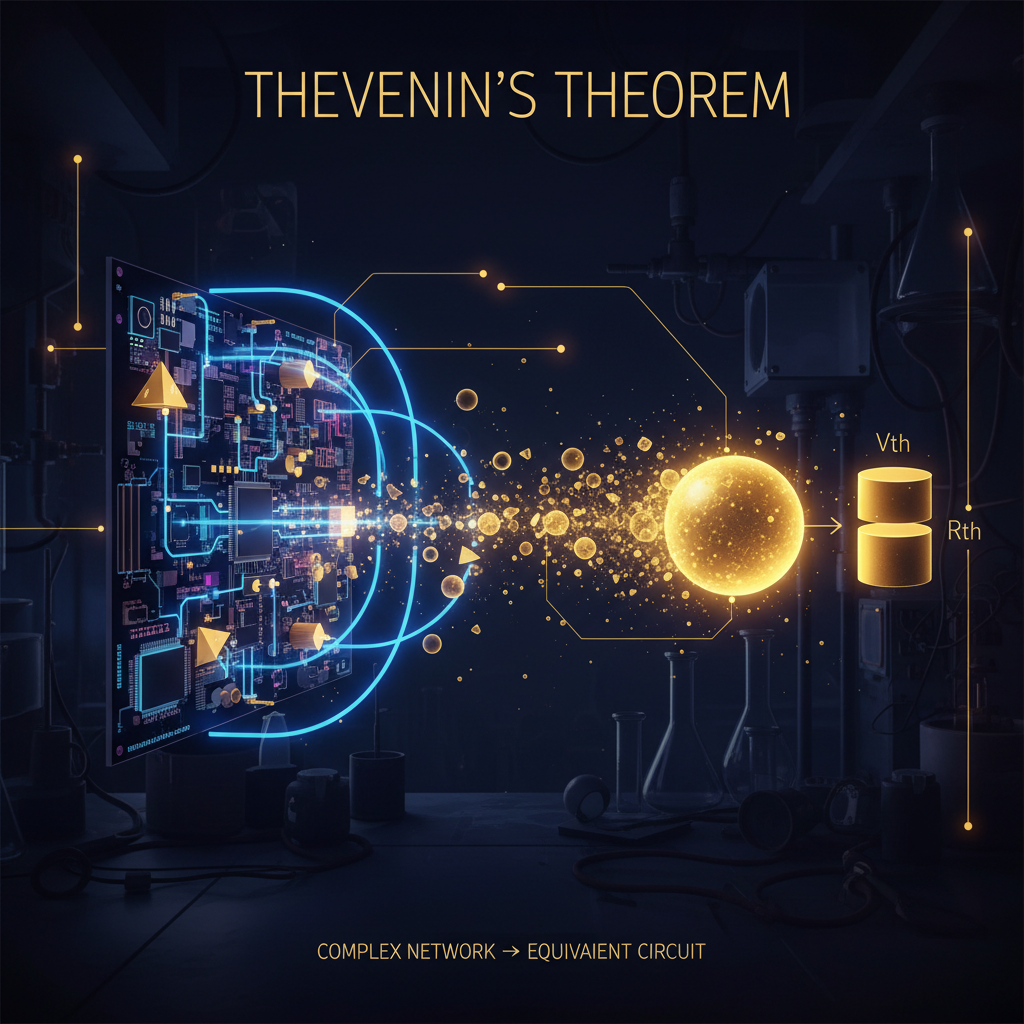
Thevenin's theorem states that any linear electrical network with voltage sources and resistances can be replaced by an equivalent circuit consisting of a single voltage source in series with a single resistance. You disconnect your load—the thing you're actually trying to power—and the entire complex network behind it reduces to V_th (Thevenin voltage) and R_th (Thevenin resistance).
The mathematics is elegant. To find V_th, you calculate the open-circuit voltage at your terminals. To find R_th, you deactivate all independent sources and calculate the resistance looking back into the network. What took pages of simultaneous equations now fits on a cocktail napkin.
The theorem works because of superposition and linearity. Each component's effect can be isolated, analyzed, then summed. The network's behavior at your chosen terminals doesn't care about the internal topology. A hundred resistors or one—if the equivalent resistance is the same, the load experiences identical conditions.
This is reductionism at its most powerful. Not a simplification that loses information, but an equivalence that preserves everything that matters for your specific interaction point.
The Surveillance Equivalent

Apply this lens to the attention economy. Behind every app, every website, every "free" service, there's a sprawling network: Google's ad auction system, Facebook's social graph algorithms, Amazon's recommendation engine, data brokers you've never heard of, analytics firms tracking you across domains, cookies and fingerprints and behavioral profiles.
The complexity is deliberate. Terms of service running thousands of pages. Privacy policies that reference other policies that reference legal frameworks that reference technical specifications. Data flows so convoluted that even the platforms themselves can't fully audit them. This is the resistor maze—designed to make you give up trying to understand it.
But Thevenin's theorem suggests we can find the equivalent circuit. From your perspective as the load—the user, the product, the attention being harvested—what's the simplified model? One extraction source (your data, your time, your cognitive surplus) and one resistance (the friction they're willing to impose before you leave).
V_th is the value they extract from you. R_th is how much they'll inconvenience you before extraction drops below profitable thresholds. Every A/B test, every UX dark pattern, every notification timing algorithm—they're all calculating this equivalent circuit. How much can we take before the user disconnects?
Maximum Power Transfer

Here's where it gets darker. In circuit theory, maximum power transfer occurs when the load resistance equals the source resistance. When R_load = R_th, the network delivers maximum power to the load. This is the condition engineers optimize for when they want efficient energy transfer.
The surveillance economy has discovered its own maximum power transfer theorem. They've learned to match their extraction resistance to your resistance to being extracted from. Push too hard—too many ads, too invasive tracking, too obvious manipulation—and you disconnect. Push too soft and they leave value on the table.
The optimal point is where your discomfort exactly matches their restraint. Where the friction of leaving equals the friction of staying. They've A/B tested their way to your personal R_th, the exact resistance that keeps you engaged while maximizing extraction.
This is why "free" services feel increasingly uncomfortable but never quite unbearable. They've found your equivalent circuit. They know how much you'll tolerate because they've measured it across billions of users, refined through machine learning, optimized in real-time.
Looking Into the Network

When you calculate R_th, you deactivate the voltage sources and look back into the network from the terminals. You see the structure with the driving forces removed. This perspective shift is crucial.
Try this with your digital life. Deactivate the content—the posts, the videos, the dopamine hits. What resistance remains? What's the actual structure you're embedded in? The answer is usually uncomfortable. You're not connected to friends; you're connected through an advertising delivery system that happens to carry social signals. You're not accessing information; you're accessing an attention extraction mechanism that happens to include information.
The Thevenin equivalent reveals what the complexity obscures: the network isn't designed to serve you. You're not the load being powered. You're the voltage source. Your attention, your data, your behavioral surplus—that's V_th. The whole complex network exists to extract it as efficiently as possible while maintaining just enough resistance to keep you from disconnecting entirely.
The Reduction You Need

Thevenin's theorem is powerful because it lets you ignore complexity that doesn't matter for your specific question. You don't need to trace every current path through every resistor. You just need to know: what voltage, what resistance, from these two points?
Apply this ruthlessly to surveillance capitalism. You don't need to understand the complete data flow topology. You don't need to read every privacy policy or map every third-party integration. You need to know: what are they extracting, and what friction stops me from leaving?
Once you see the equivalent circuit, the complexity stops being overwhelming and starts being revealing. Why is it so complex? Because the simple truth—you are the product, and everything is optimized to extract maximum value while maintaining minimum retention resistance—doesn't sound like something you'd willingly participate in.
The maze of resistors isn't the point. The equivalent circuit is. And now you know how to find it.
<strong>Data emitted:</strong> 1,147 words | Resistance measured: ongoing | Equivalent circuit: simplified, never simple | Voltage drop: yours
Data emitted: 1,100 words • 6.5KB • 5-minute read