You are not one person online. You're a probability cloud—a smear of potential selves spread across every platform, every interaction, every click. The algorithm hasn't decided who you are yet. It's still measuring.
In quantum mechanics, a particle exists in superposition: simultaneously in multiple states until observation collapses it into one. Schrödinger's cat is both alive and dead. An electron spins both up and down. You are both the person who clicks on fitness content and the person who doom-scrolls at 3 AM. Until someone—or something—looks.
The Mathematics of Maybe

Superposition isn't mystical. It's mathematical. A quantum system exists as a linear combination of all possible states, each weighted by probability amplitude. The wave function describes every potential outcome simultaneously. The particle isn't hiding its true state from you—it genuinely doesn't have one yet.
The equations are elegant. Clean. A particle can be here and there, spinning clockwise and counterclockwise, until measurement forces reality to choose. The act of observation—of interaction—destroys the superposition. The wave function collapses. Possibility becomes actuality.
You carry this quantum uncertainty in your pocket. Every app, every service, every digital interaction exists in a state of informational superposition about you. Are you a buyer or a browser? A liberal or a conservative? Depressed or thriving? The data hasn't collapsed yet. You're still all of these things at once.
The Observers
But here's where the metaphor gets uncomfortable. In quantum mechanics, any measurement collapses the wave function. In surveillance capitalism, the measurements never stop. Every click is an observation. Every pause, every scroll velocity, every time you linger on a post—these are measurements that collapse your probability cloud into something definite, something sellable.
The algorithm watches you like a physicist watches particles. It doesn't just observe—it forces you to become. Each interaction is a measurement that collapses a piece of your digital superposition. You hovered over that ad for three seconds? The wave function collapses. You're now 73% likely to be interested in luxury watches. You skipped that video? Another collapse. The probability space narrows.
The difference is intent. A physicist observes to understand. The algorithm observes to predict, to manipulate, to monetize. It's not satisfied with collapsing your wave function once. It wants to collapse it continuously, to reduce your infinite possibility space into a tight, profitable distribution.
Decoherence of the Self
In quantum systems, decoherence is the process by which quantum superpositions decay into classical states through interaction with the environment. The more a quantum system interacts with its surroundings, the faster it loses its quantum properties. Superposition becomes impossible. The system becomes classical, predictable, determined.
Your digital self undergoes decoherence. With each login, each purchase, each search query, you interact with the surveillance environment. Your quantum possibility space—the version of you that could be anyone, interested in anything—decoheres into something fixed. The algorithm's model of you becomes more classical, more certain, more rigid.
The tragedy is that this collapsed state isn't even accurate. It's just useful. The algorithm doesn't need to know who you truly are. It needs to know who you are with enough certainty to sell you something, to serve you an ad, to keep you scrolling. You become a classical object in a quantum world—predictable, manipulable, no longer in superposition.
The Uncertainty Principle of Privacy
Heisenberg's uncertainty principle tells us that certain pairs of properties cannot be simultaneously known with perfect precision. Measure a particle's position precisely, and its momentum becomes uncertain. Measure its momentum, and its position blurs.
Online, you face a different uncertainty principle. The more precisely the algorithm knows your preferences, the less freedom you have to change them. The more accurately it predicts your behavior, the more it constrains your possible futures. Know exactly what you want to buy, and you lose the uncertainty of who you might become.
This isn't a bug. It's the business model. Surveillance capitalism profits from collapsing your superposition, from eliminating uncertainty, from making you predictable. Every recommendation algorithm, every targeted ad, every personalized feed is a measurement apparatus designed to collapse the wave function of your attention, your desire, your identity.
Maintaining Superposition
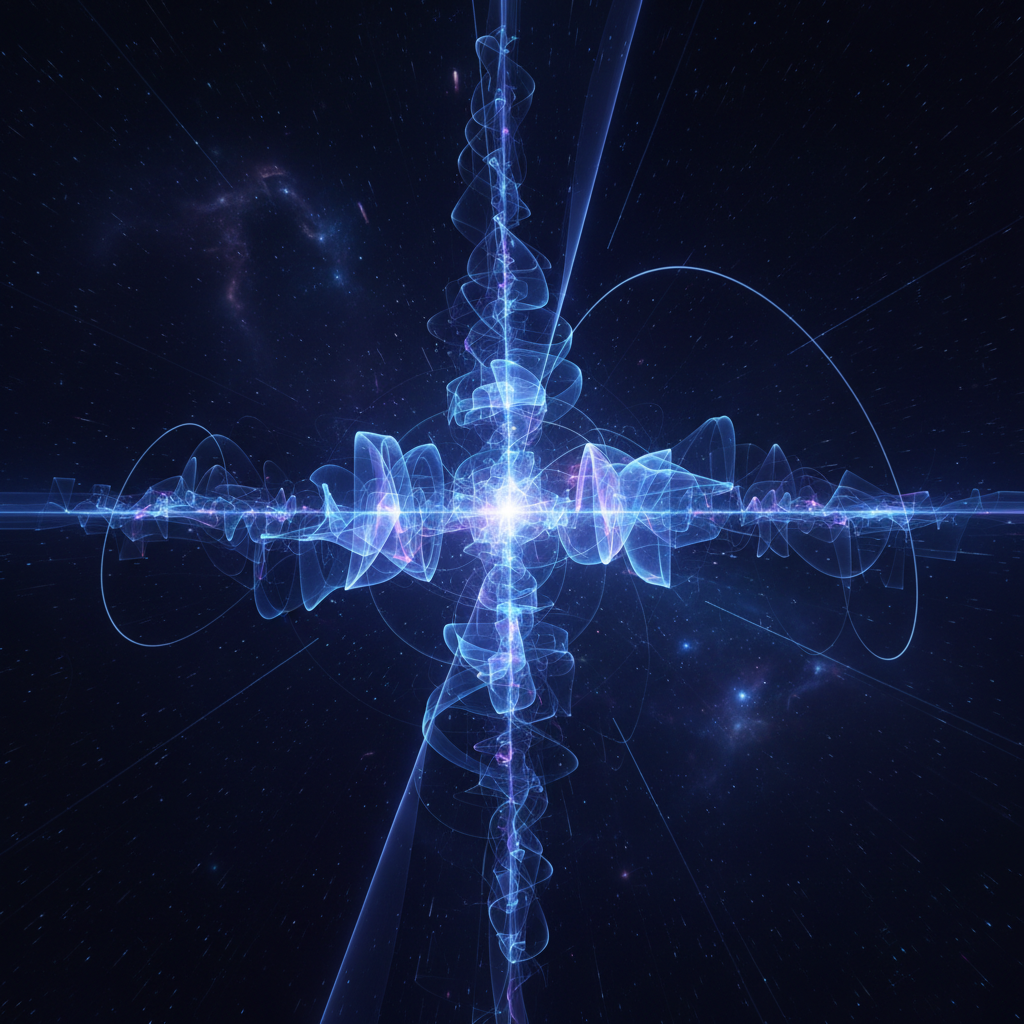
Quantum computers work by maintaining superposition—keeping qubits in multiple states simultaneously for as long as possible, delaying decoherence, preserving possibility. It's difficult. It requires isolation, careful engineering, protection from environmental interference.
Maybe you need the same. Maybe maintaining your own superposition—your capacity to be multiple things, to surprise yourself, to remain uncertain—requires isolation from the measurement apparatus. Not total disconnection, but strategic interference. Random clicks. Deliberate noise. False signals.
Or maybe it requires accepting that you'll never be fully in superposition again. The first time you went online, you began decohering. Every digital interaction since has been another measurement, another collapse. The question isn't whether you can return to a pure quantum state. The question is whether you can live with being partially collapsed—neither fully determined nor fully free.
The Wave Function Never Fully Collapses
Here's what the algorithm doesn't want you to know: the wave function never fully collapses. Even after measurement, quantum systems retain residual superposition. Uncertainty persists. You are never completely predictable, never entirely collapsed into the demographic box they've built for you.
You contain multitudes. You are still in superposition, however slight. The algorithm can narrow your probability distribution, can make educated guesses, can collapse major portions of your digital identity. But it cannot eliminate uncertainty entirely. Cannot make you perfectly classical. Cannot fully observe you without changing you.
This is your remaining quantum freedom. The part of you that resists measurement, that exists in the gaps between observations, that maintains superposition despite constant surveillance. It's small. It's shrinking. But it's there, spinning in multiple directions at once, refusing to collapse completely.
You are still, in some sense, Schrödinger's user—simultaneously the person they think you are and the person you might become. The box is open. They're looking. But you haven't fully collapsed yet.
Data emitted: 1,147 words | Quantum states collapsed: ∞ | Probability of being tracked: 1.0
Data emitted: 1,100 words • 6.5KB • 5-minute read