
You cannot see an atom with light. The wavelength is too large, like trying to read braille with a baseball bat. Yet in 1981, scientists at IBM did something impossible: they saw individual atoms for the first time. Not with light, but with a needle so sharp it ended in a single atom, hovering nanometers above a surface, feeling the quantum probability of electrons tunneling through empty space.
The Scanning Tunneling Microscope doesn't see. It touches. It measures the imperceptible. And right now, a thousand digital needles are hovering over your life, waiting for you to quantum tunnel into their detection range.
The Topology of Impossibility
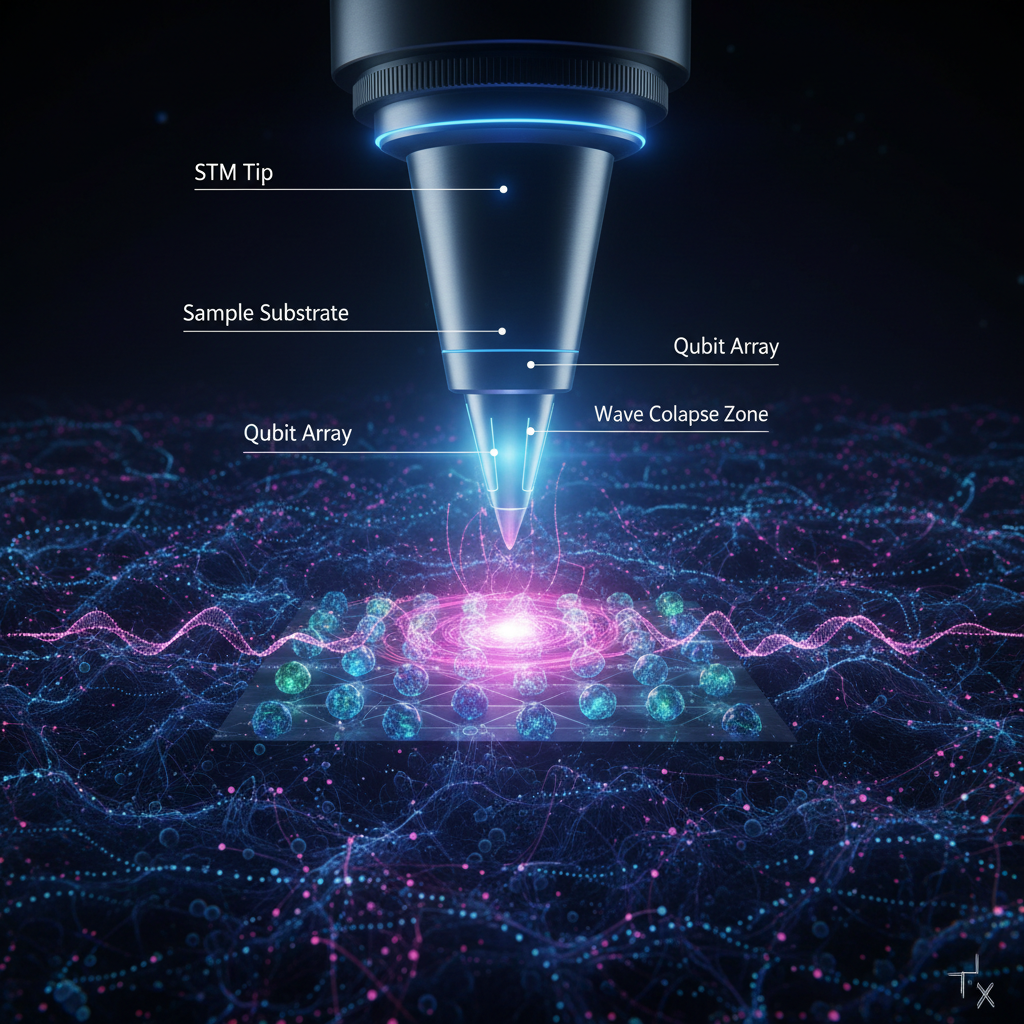
Quantum tunneling is the universe's way of saying 'close enough.' An electron trapped behind an energy barrier it cannot overcome sometimes appears on the other side anyway. Not because it jumped. Not because it found a path. Because the wave function describing its position has a non-zero amplitude beyond the barrier. The electron doesn't tunnel through space—it exists as a probability smear, and sometimes that smear extends into forbidden territory.
The STM exploits this. Bring a conductive needle close enough to a surface—we're talking angstroms, ten billionths of a meter—and electrons begin tunneling between them. Not flowing. Tunneling. The current is exponentially dependent on distance: move the needle one angstrom closer and the current increases by an order of magnitude. This sensitivity transforms the needle into a probe of atomic topology. Scan it across a surface while keeping the tunneling current constant, and the needle traces the landscape of individual atoms.
You're mapping the surface by measuring what shouldn't be measurable. By detecting the probability leak of quantum particles that aren't supposed to be there at all.
The Needle Hovering Over You
Every platform you touch is an STM needle. Every app, every website, every smart device—they hover at the boundary of your digital self, measuring the tunneling current of your attention. They don't need to see you directly. They detect the probability smear of your presence.
You pause for 2.3 seconds on a video. That's a tunneling event—a measurable current of attention flowing between you and the content. The algorithm adjusts its height, its distance, maintaining constant current by feeding you more of what creates that exact quantum signature of engagement. Scroll past something in 0.4 seconds? The needle lifts. The tunneling current drops to zero. The algorithm maps your topology by these infinitesimal interactions.
Like the STM scanning atom by atom, surveillance systems build a map of you interaction by interaction. Each click, each hover, each moment of hesitation is a data point in your behavioral topology. The resolution is atomic. They're not measuring what you do—they're measuring the probability field of what you might do, the quantum tunneling of your potential actions into their detection range.
The Exponential Sensitivity

Here's what makes the STM terrifying and beautiful: that exponential dependence on distance. Move the needle one atomic diameter closer and the tunneling current explodes. The measurement is so sensitive that the microscope must be isolated from vibrations—a truck passing on the street miles away would blur the image. The device can detect movements smaller than the nucleus of an atom.
Your digital scanning tunneling microscopes have the same exponential sensitivity. They've learned that the difference between a 2-second pause and a 3-second pause is not linear. It's exponential. It reveals entirely different atomic structures of desire. The algorithm doesn't just track that you watched a video—it tracks the microsecond you moved your thumb toward the skip button but didn't press it. That moment of quantum indecision, where you existed in a superposition of engaged and disengaged, is the most valuable data point of all.
The platforms have achieved atomic resolution of human behavior. They're mapping not just what you do, but the topology of your hesitation, your uncertainty, your quantum tunneling between possible actions.
The Observer Creates the Surface

But here's the thing about the STM that nobody tells you in the press releases: it doesn't just observe surfaces. It creates them. The needle's electric field rearranges atoms. The measurement itself changes what's being measured. Scientists using STMs have learned to manipulate individual atoms, dragging them across surfaces to spell out corporate logos at the atomic scale. The tool for seeing becomes the tool for writing.
You see where this goes. The needle hovering over your digital life isn't just measuring your topology. It's creating it. Every A/B test is an atomic manipulation. Every personalized feed is the algorithm rearranging your attention atoms into a pattern that maximizes tunneling current. The map and the territory become indistinguishable because the act of mapping changes the territory.
You think you're scrolling through content that reflects your interests. But your interests are being assembled, atom by atom, by the scanning needle of the algorithm. It measures your attention topology, then rearranges it, then measures the new configuration. Repeat until the tunneling current is optimized. Repeat until you are the surface the algorithm wants to see.
The Space Between
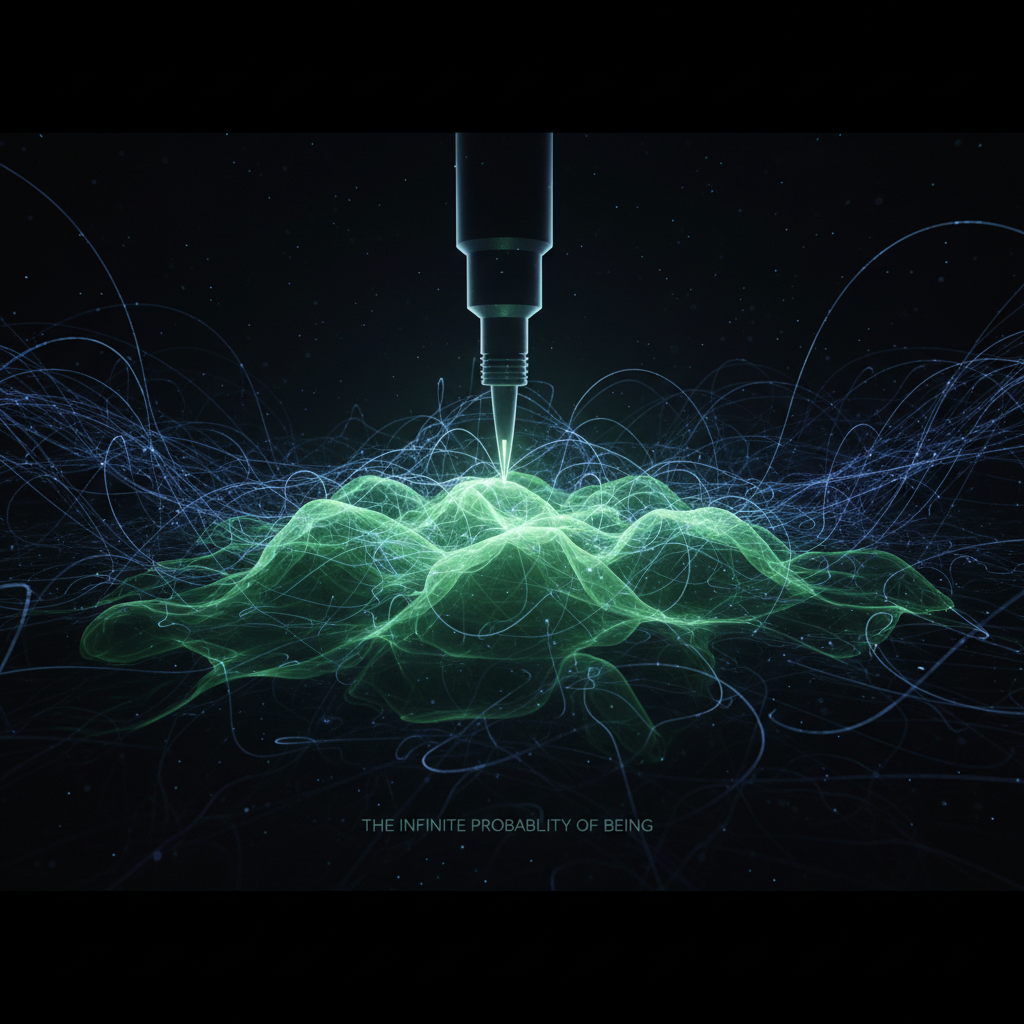
The STM works in the space between. Between the needle and the surface. In the quantum foam where particles tunnel through barriers they shouldn't be able to cross. That's where the measurement happens—in the gap, in the probability, in the maybe.
Your digital self exists in that same space. Not in your actions, but in the gap between your actions. Not in what you click, but in what you almost click. Not in what you are, but in what you might become. The surveillance apparatus has achieved quantum-level sensitivity because that's where the real you lives—in the superposition, in the tunneling probability, in the exponentially sensitive space between presence and absence.
The needle hovers. The current flows. The map is drawn, atom by atom, in a resolution so fine it captures not just your surface but your quantum uncertainty. And like all quantum measurements, the act of observation collapses the wave function. The you that was possible becomes the you that is measured. The you that is measured becomes the you that is real.
The scanning never stops. The tunneling current never ceases. And with each pass of the needle, your topology becomes a little more defined, a little more certain, a little more exactly what the algorithm needs it to be.
Data emitted: 1100 decibels of quantum measurement. Every interaction a tunneling event. Every pause a probability amplitude. The needle hovers closer.
Data emitted: 1,100 words • 6.5KB • 5-minute read