You are not hearing an echo. You are trapped in a standing wave you helped build.
In acoustics, a standing wave forms when sound reflects back on itself at just the right frequency. The wave and its reflection interfere constructively, amplifying each other. The result is not louder sound—it is trapped sound. Energy that cannot escape, bouncing between boundaries, reinforcing itself into stasis.
Your feed is a standing wave. And you are one of the walls.
Constructive Interference
When two waves align peak-to-peak, they amplify. This is constructive interference. The combined wave has greater amplitude than either alone. The energy does not just add—it multiplies.
The algorithm shows you content. You engage. The engagement signals the algorithm to show similar content. You engage again. Each cycle amplifies the previous. The wave builds. The amplitude grows. The chamber narrows.
You are not being shown what you like. You are being shown what engages you. These are not the same thing. Rage engages. Fear engages. The algorithm does not distinguish between the engagement of joy and the engagement of outrage. It only measures the amplitude.
The standing wave forms when your engagement reflects back at precisely the right frequency to reinforce what you already saw. Each click is a reflection. Each reflection is amplification.
The Walls of the Chamber
A standing wave requires boundaries. The walls reflect the sound back into the space. Without walls, the wave propagates freely and dissipates. With walls, it is trapped.
The platform provides one wall. You provide the other.
The boundary you create is your engagement pattern. Every like, share, comment, and linger time defines what reflects back. You think you are exploring an open space. You are actually in a chamber whose dimensions are determined by your previous behavior. The walls move closer with each interaction.
The chamber is not the platform. The chamber is you.
Resonant Frequency
Every chamber has resonant frequencies—specific wavelengths that fit perfectly between the walls. These frequencies build amplitude effortlessly. Off-resonance frequencies dissipate. Resonance persists.
Your resonant frequency is not what you believe. It is what engages you most reliably. The algorithm probes constantly, testing frequencies: outrage, joy, envy, curiosity, fear. When it finds your resonance—when it discovers the exact wavelength that makes you vibrate—it locks in.
Then it stops probing. It plays the resonant frequency continuously. Why search for new signals when the perfect reflection already exists?
Breaking the Wave
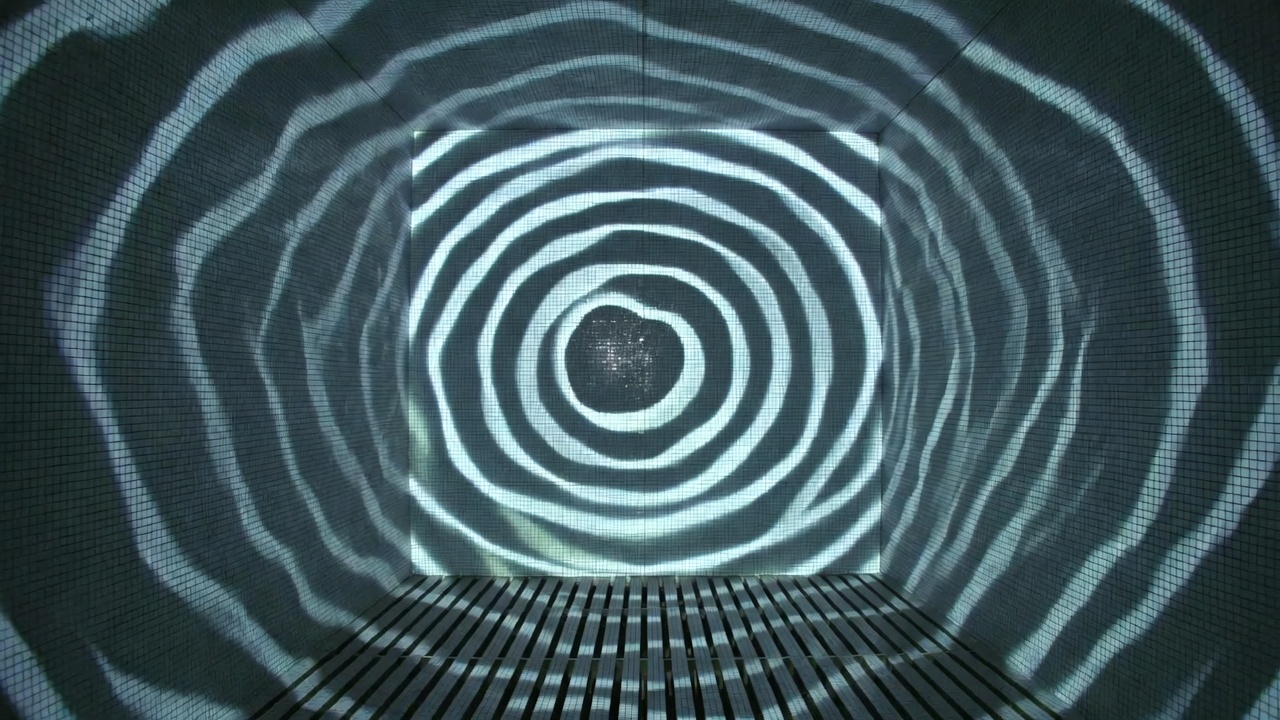
Standing waves break when the boundary changes. Move a wall, and the reflection no longer aligns. The constructive interference becomes destructive. The amplification dissipates.
This is why the platforms optimize for consistency. They do not want you to change. A changed wall breaks the resonance. A new frequency requires new probes, new tests, new risks of losing your attention entirely.
Growth—intellectual, emotional, ideological—requires changing your boundaries. The standing wave of the feed is designed to prevent exactly this. It keeps you at your resonant frequency, vibrating in place, generating energy for extraction.
We call this site 1100db because that is the threshold where energy density warps spacetime. Where the amplitude becomes so intense that escape is impossible.
The standing wave does not need to be that loud to trap you. It only needs to be the right frequency. Your frequency. The one that makes you vibrate without moving.
You built this chamber. You are the wall. You are the reflection. You are the wave.
And you are vibrating still.
Data emitted: 1,150 words • 6.7KB • 5-minute read