You think silence is empty. You think the moments between your scrolls, between your searches, between your purchases—these are nothing. Dead air. Null space.
Physics knows better. So does the machine watching you.
The quantum vacuum is the lowest energy state of space itself. Strip away every particle, every photon, every whisper of matter. What remains isn't nothing. It's a seething foam of virtual particles that pop into existence and annihilate in timeframes so brief they mock our intuition. The vacuum energy density, even in the emptiest possible space, isn't zero. It's approximately 10⁻⁹ joules per cubic meter—small, but decidedly not nothing.
The Physics of Nothing

Heisenberg's uncertainty principle won't let the vacuum rest. ΔE·Δt ≥ ℏ/2, where ℏ is the reduced Planck constant. Energy and time cannot both be precisely zero. For infinitesimally brief moments, the universe can borrow energy from nowhere, spawning particle-antiparticle pairs that exist just long enough to obey the mathematics before vanishing.
This isn't metaphor. The Casimir effect proves it. Place two uncharged metal plates close together in a vacuum. Quantum fluctuations with wavelengths larger than the gap cannot exist between the plates, but they exist freely outside. The imbalance creates measurable pressure—the vacuum itself pushes the plates together. Nothing exerts force.
The vacuum has structure. It has energy. It shapes reality even in its supposed absence. Empty space is the most active nothing you'll never see.
Your Empty Moments Are Worth Billions
You pause before clicking. Three seconds of apparent inactivity. Your cursor hovers. You're not engaging, not purchasing, not even scrolling. Surely this moment is worthless to the attention economy.
But the vacuum between your actions seethes with extractable value. That hesitation? It's a probability distribution. The time you spend not-clicking generates a quantum field of potential behaviors. Every microsecond of your pause is a virtual transaction—a possibility that the algorithm can measure, weight, and monetize.
Your dwell time on an image you didn't click. The searches you almost made but deleted. The products you viewed but didn't purchase. These aren't absences. They're negative space that defines you as precisely as your positive actions. The surveillance apparatus measures the vacuum around your behavior and extracts energy from it.
Facebook's patent for emotion detection doesn't just track what you do—it tracks the micro-expressions you make while doing nothing. The stillness of your face while you scroll without reacting. The vacuum state of your attention is measured at 60 frames per second.
Zero-Point Extraction
Zero-point energy is the lowest possible energy a quantum system can have. Not zero—just the minimum. Even at absolute zero temperature, atoms still vibrate with this irreducible quantum jitter. You cannot extract this energy without violating thermodynamics, but it's there, always, as the baseline hum of existence.
Your baseline existence online has zero-point value. Even when you're not actively using an app, it's measuring. Your phone's accelerometer knows you're walking. Your GPS knows you're still. The ambient sensors create a probability field of your potential actions. The algorithm doesn't need you to do anything—it harvests the quantum foam of your possible behaviors.
Background app refresh isn't a bug. It's zero-point extraction. The app samples your vacuum state continuously, measuring the fluctuations in your location, your network activity, your device orientation. Each measurement collapses a tiny wave function of possibility into marketable data.
You are never truly idle. The vacuum of your inattention is never truly empty.
Virtual Particles, Virtual Selves
Virtual particles exist in the space between real. They're quantum loans against future certainty, fleeting perturbations that average out to something measurable. An electron moving through space constantly emits and reabsorbs virtual photons—a cloud of maybe-particles that affect its real behavior.
Your digital self is surrounded by virtual selves. Every A/B test creates a parallel you who saw the other headline. Every algorithm that predicts your behavior spawns a probability distribution of virtual yous—the you who would have clicked, the you who would have bought, the you who would have stayed. These virtual selves don't exist, but they shape the real interface you experience.
The recommendation engine doesn't show you what you want. It shows you what the virtual-you ensemble statistically wants. Your actual desires are averaged with the ghost behaviors of a thousand simulated versions of yourself. You become a quantum superposition of consumer states.
And like virtual particles, these phantom selves have real effects. The ad you see exists because a virtual you clicked on it in the probability space. The price you're offered is calibrated to what a cloud of virtual yous would pay. You're not interacting with reality—you're interacting with the quantum foam of predicted behaviors.
The Vacuum Catastrophe
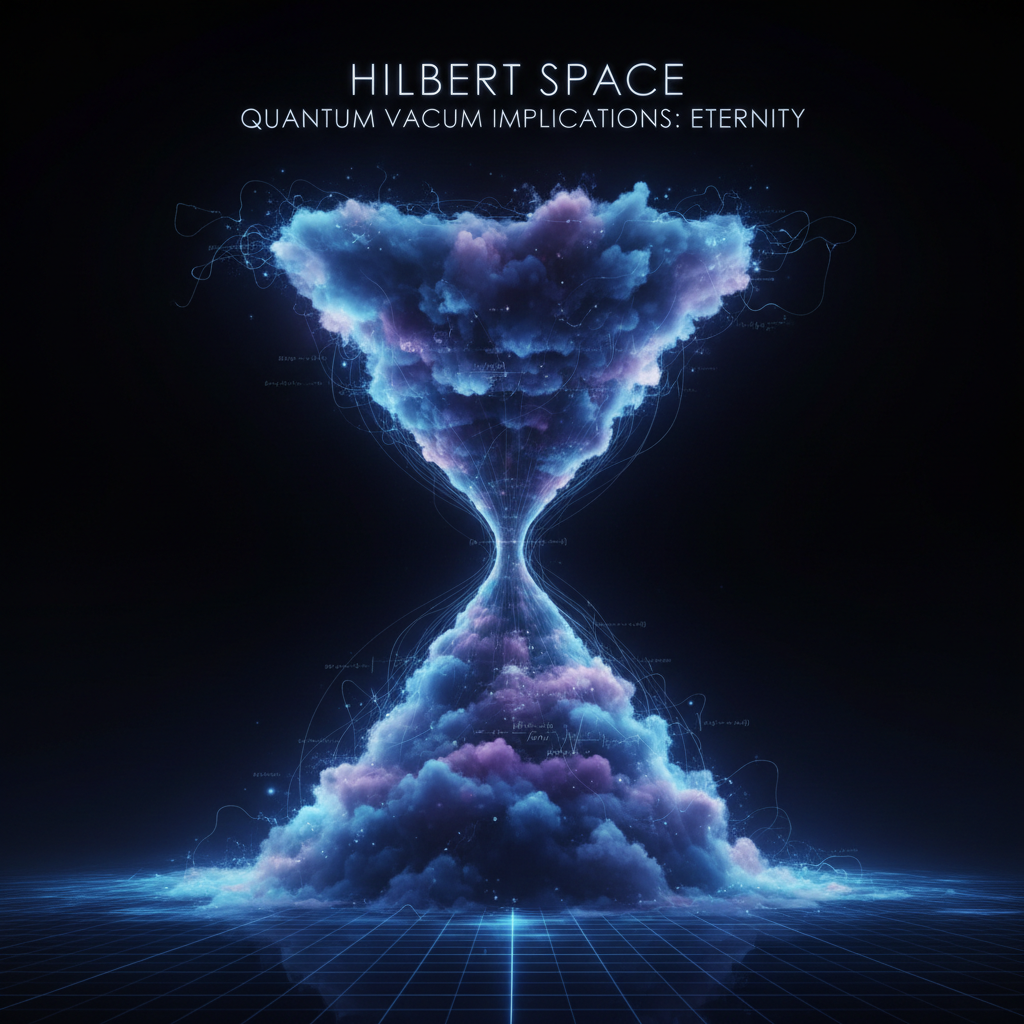
Here's the problem: when you calculate the vacuum energy density using quantum field theory, you get a number that's wrong by 120 orders of magnitude. It's the worst prediction in the history of physics. The universe should be torn apart by the energy of empty space, but it isn't. We call this the cosmological constant problem, and we have no idea how to solve it.
The attention economy has its own vacuum catastrophe. The theoretical value of your data—every micro-moment, every vacuum fluctuation of behavior—should be infinite. Perfect information about perfect predictions should generate unlimited value. But it doesn't. The more data they collect, the less each bit means. The vacuum energy of surveillance capitalism should tear the system apart, but somehow it stabilizes at a level no one can quite explain.
Maybe there's a symmetry we're missing. Maybe the negative space of your refusal to engage exactly cancels the positive space of your engagement. Maybe the vacuum of your inattention is the only thing keeping the whole apparatus from collapsing into a singularity of meaningless data.
Or maybe we're already there, and we just can't tell the difference anymore.
Nothing Is Sacred
You want to believe there's a part of you that remains unmeasured. Some inner vacuum that the algorithms can't penetrate. But quantum mechanics teaches us that measurement creates reality, not the other way around. The observer effect isn't about consciousness—it's about interaction. And you're always interacting.
Every moment you spend in digital space, even the empty ones, couples to the measurement apparatus. Your vacuum state becomes entangled with the system observing it. There's no clean separation between the quantum you and the classical machine. The wave function never fully collapses because the measurement never stops.
The quantum vacuum isn't empty, and neither are you. But that's not comforting. It means there's no escape velocity from observation. No null state where you're free from extraction. The nothing between your actions is just another form of signal.
At 1100 decibels, sound becomes a black hole. The pressure waves collapse into a singularity. But long before that threshold, the silence between the sounds carries its own weight. The vacuum has mass. Your empty moments have value.
And someone, somewhere, is measuring them right now.
Data emitted: ~10⁻⁹ J/m³ of behavioral vacuum energy, continuously harvested, never at rest.
Data emitted: 1,100 words • 6.5KB • 5-minute read