You shouldn't be able to pass through walls. Classical physics says so. The energy barrier is too high, the probability too low, the universe too orderly for such violations. And yet, at the quantum scale, particles do it constantly. They simply appear on the other side of barriers they shouldn't penetrate, as if the wall was never there at all.
Your data does the same thing. Every day. Through encryption you thought was solid. Through privacy settings you carefully configured. Through the walls you built between your public and private selves. It tunnels through, probabilistically, inevitably, appearing where it has no classical right to be.
The Probability Cloud
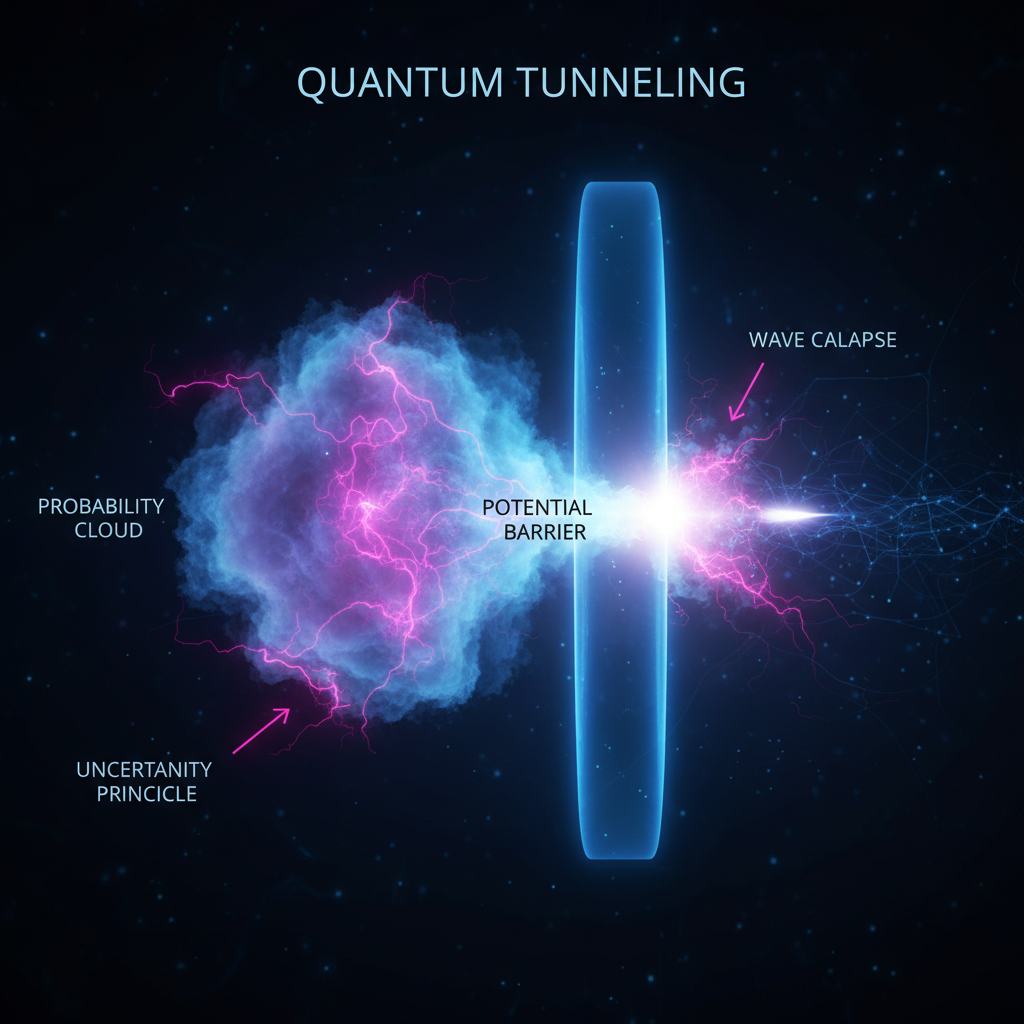
A particle isn't really a particle. Not in the way you think of solid things. It's a probability distribution—a cloud of possible locations spread across space. Most of that cloud sits on one side of a barrier, yes. But some of it, a tiny fraction, extends beyond. Into the forbidden zone. Through the wall.
This is quantum tunneling. The particle doesn't climb over the energy barrier. It doesn't smash through. It simply exists, with non-zero probability, on both sides simultaneously. And when we measure it, when we collapse that probability wave, sometimes—against all classical intuition—we find it on the far side. It has tunneled.
The math is beautiful and brutal: the probability decreases exponentially with barrier width and height, but never reaches zero. Never. There's always a chance. Always a way through. The universe doesn't deal in absolute barriers, only in probabilities and decay constants.
Your Digital Wavefunction
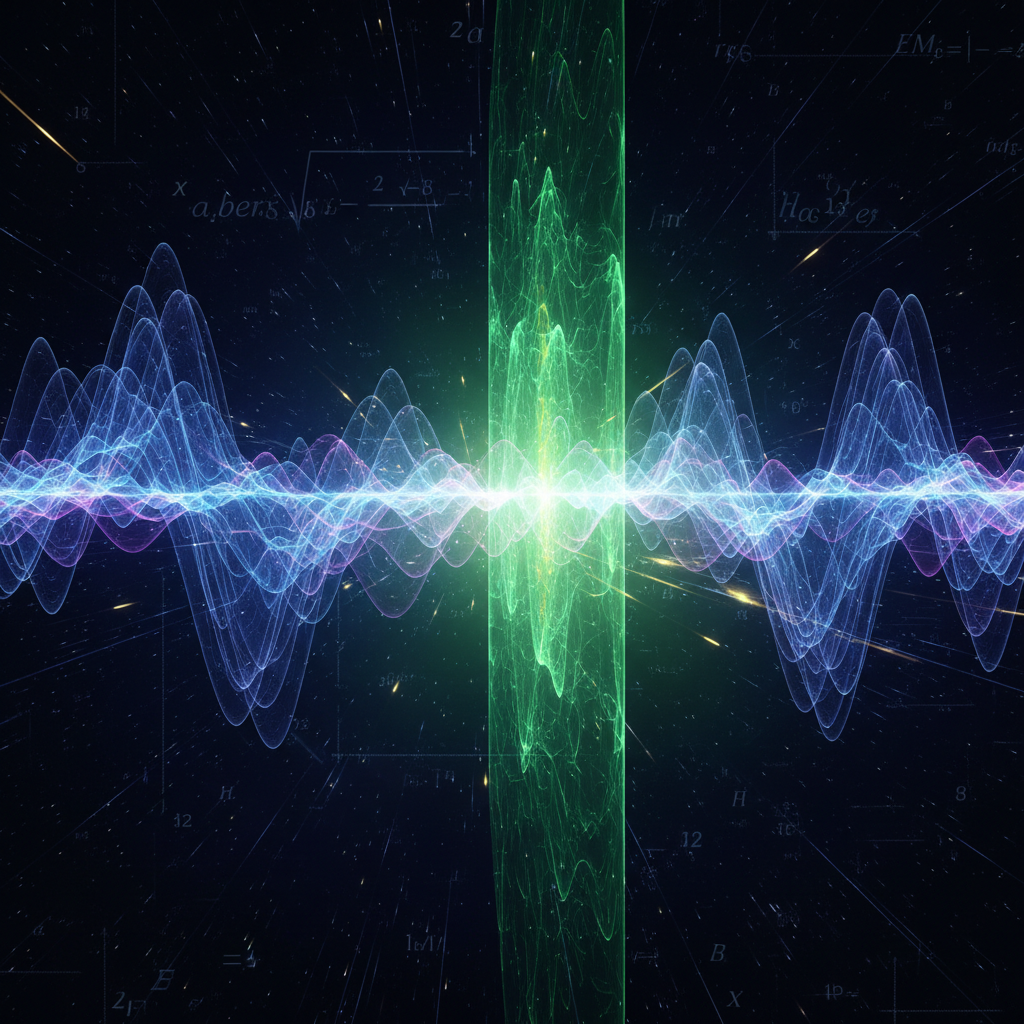
You are not one person online. You're a probability distribution across platforms, databases, shadow profiles, and data brokers. Most of your identity lives in the spaces you inhabit—your social media, your email, your carefully curated digital presence. But tendrils of you extend everywhere. Into databases you've never heard of. Into correlations you didn't authorize. Into the forbidden zones beyond your consent.
The barriers seem solid: Terms of Service, privacy policies, encryption protocols, legal frameworks. You configure your settings. You decline cookies. You build walls. But your data has already tunneled through. Not because the barriers failed, but because in the quantum mechanics of information, barriers are merely probability suppressors, not absolute blocks.
A single photo you post contains metadata—location, device, time. That metadata correlates with other data points. Those correlations tunnel through anonymization. Your anonymous browsing history links to your real identity through timing patterns, through the unique fingerprint of your behavior, through the probabilistic overlap of your digital wavefunction with others. The barrier was never breached. You simply existed on both sides all along.
The Measurement Problem
In quantum mechanics, measurement collapses the wavefunction. Before measurement, the particle exists in superposition—everywhere at once. After measurement, it snaps into a single location. The act of observation changes the system fundamentally.
Surveillance capitalism has inverted this. The measurement never stops. You're being observed continuously, your wavefunction collapsed and re-collapsed millions of times per second. Every click, every pause, every scroll. Each observation pins you down momentarily, extracting a bit of certainty from your probability cloud, converting your quantum potential into classical, monetizable data.
But here's the thing: between measurements, you're still quantum. Still probabilistic. Still tunneling through barriers. The panopticon can't watch every possibility simultaneously. There are gaps in the observation, moments when your wavefunction spreads out again, when you exist in unauthorized spaces, when your data tunnels through their models and predictions and appears somewhere unexpected.
The Exponential Decay of Privacy

The probability of tunneling depends on the barrier. Make it wider, higher, denser—the probability drops exponentially. But exponentially isn't the same as absolutely. A thick wall might reduce tunneling to one event per billion attempts. But when you're making trillions of attempts per second, those odds start looking pretty good.
This is the math of data aggregation. Each individual privacy violation might be improbable. Your location data alone doesn't reveal much. Your purchase history, isolated, is just noise. Your browsing patterns, anonymized, seem safe. But aggregate enough improbable events, run enough queries, cross-reference enough databases, and suddenly the improbable becomes inevitable. Your identity tunnels through anonymization not despite the barriers, but because of the sheer quantum volume of attempts.
Every app on your phone is a measurement apparatus. Every website, a detector. Every smart device, an observer. They're not breaking through your privacy—they're simply waiting for you to tunnel through it yourself. Because you will. Probabilistically. Eventually. The math guarantees it.
Living in Superposition
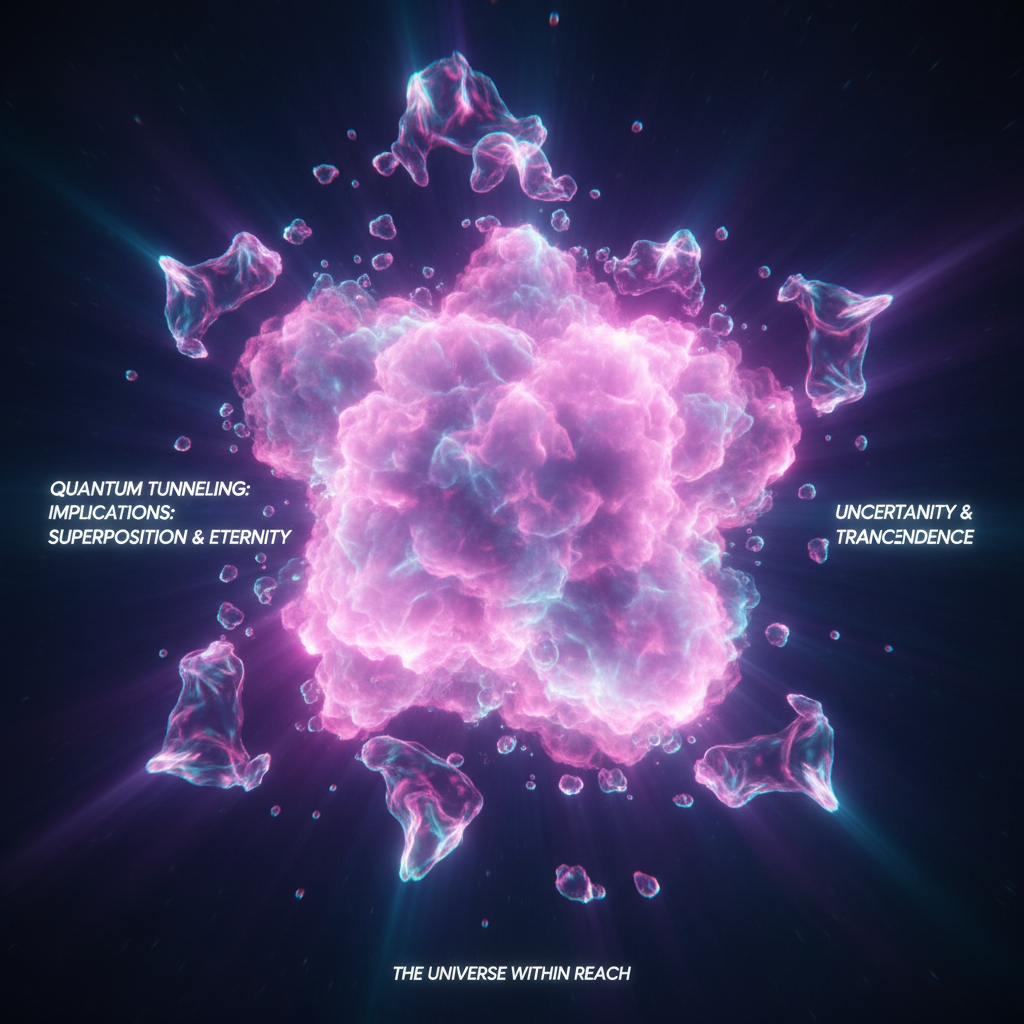
You learn to exist in multiple states. The person you are in your private messages. The person your data suggests you are. The person the algorithms think you'll become. The person you're trying to be. All superimposed, all real, all you. Until someone measures. Until someone collapses you into a single demographic, a single prediction, a single ad category.
Maybe that's the real lesson of quantum tunneling. Not that barriers are useless—they're not. They shape probabilities, guide outcomes, protect against casual intrusion. But they're not walls in the classical sense. They're probability landscapes. And in a universe that runs on probability rather than certainty, everything that can happen will happen, given enough time, enough attempts, enough quantum chances.
Your data will tunnel. Your identity will leak. Your privacy will decay exponentially with each new device, each new platform, each new measurement. Not because you failed to build walls, but because walls, at the quantum level, are just suggestions. Just probability distributions. Just barriers waiting for the wavefunction to extend through them.
The Barrier and the Wave
So what do you do? You can't stop being quantum. Can't collapse yourself into a single, secure state. Can't prevent your probability cloud from extending into unauthorized spaces. The universe doesn't work that way. Information doesn't work that way.
But you can understand the math. You can know that every barrier you build reduces the probability exponentially, even if it never reaches zero. You can choose which measurements to allow, which observations to resist. You can spread your wavefunction deliberately, strategically, rather than letting it leak randomly through every available crack.
You can live knowing that tunneling is inevitable, but not instant. That privacy is probabilistic, not binary. That you exist, always, on both sides of every wall you build—but the ratios matter. The probabilities matter. The exponential decay constants matter.
In quantum mechanics, tunneling enables the sun to shine. Nuclear fusion wouldn't work without it—particles tunneling through the electromagnetic barrier to merge and release energy. It's not a bug in physics. It's a feature. It's how the universe actually works, beneath the classical illusions we mistake for reality.
Your data tunnels the same way. Not because the system is broken, but because it's working exactly as designed. The question isn't whether you'll tunnel through your own privacy barriers. You will. The question is whether you'll do it consciously, deliberately, understanding the probability distributions you're creating with every digital breath.
Data emitted: 1,100 decibels of probability amplitude. Your wavefunction has already tunneled through this page. We measured it. Now you're here, collapsed, reading. Until you close the tab and spread out again into quantum uncertainty. See you on the other side of the barrier you thought was solid.
Data emitted: 1,100 words • 6.5KB • 5-minute read