You are every version of yourself at once. The algorithm knows this. It sees you scrolling past hiking boots at 2 AM, lingering on flight deals to Tokyo, adding self-help books to carts you'll never checkout. You are the person who buys those boots and the person who doesn't. You are the traveler and the homebody. The algorithm holds all these yous in suspension, waiting.
Until you click. Then you collapse.
The Particle That Refuses to Choose
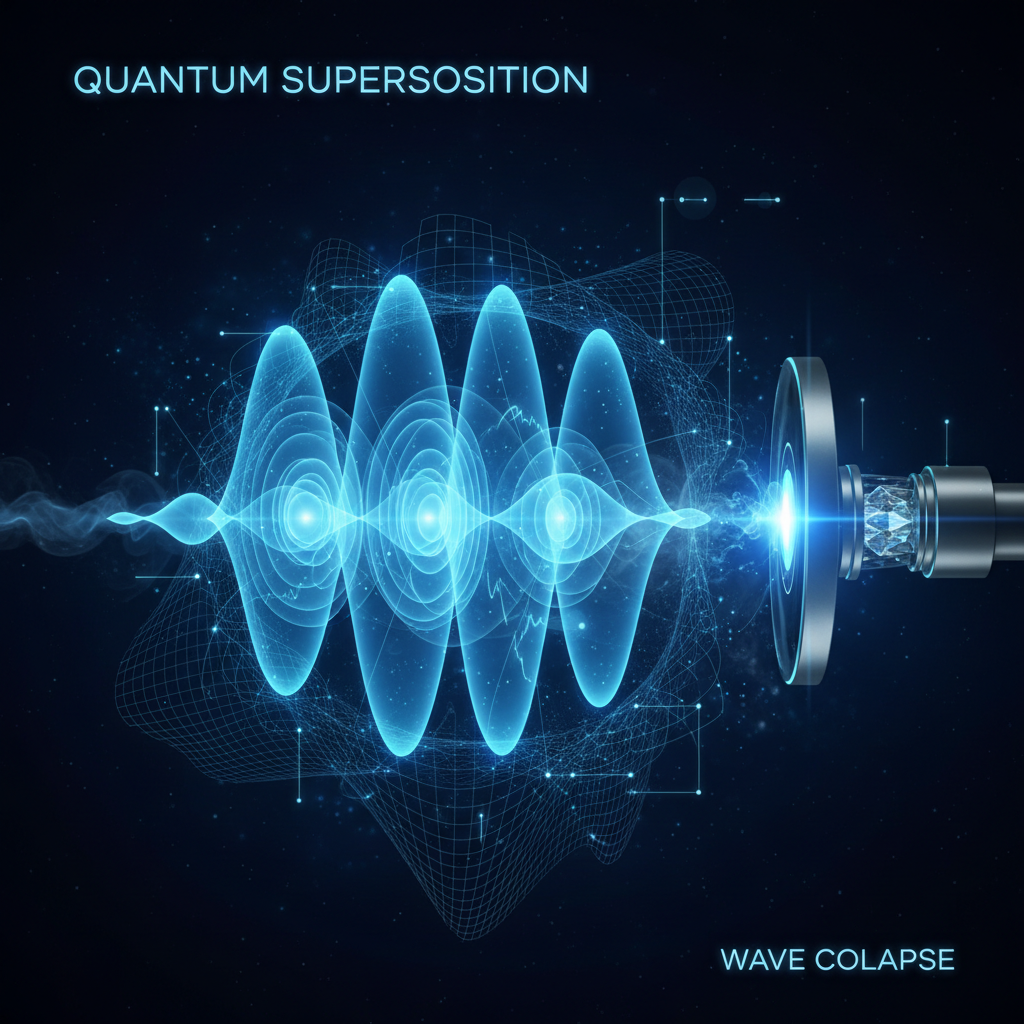
In quantum mechanics, superposition describes a particle existing in all possible states simultaneously until measurement forces it to pick one. Schrödinger's cat is both alive and dead. An electron spins both up and down. A photon travels through both slits at once. This isn't metaphor—it's the mathematical reality of quantum systems.
The wave function describes this multiplicity. It's a probability field containing every potential outcome, each with its own likelihood. The particle doesn't secretly have a definite state we just can't see. It genuinely exists in all states, distributed across possibility space like fog across a valley. Only when you measure it—when you force an interaction with the classical world—does the wave function collapse into a single, definite answer.
Before measurement: everything. After measurement: one thing. The act of observation destroys the superposition.
The Probability Cloud of You
You exist as a wave function to the surveillance apparatus. Your digital shadow is a probability distribution across infinite consumer categories, political affiliations, sexual orientations, credit risks, flight risks, health risks. The algorithm doesn't know which you is real because all of them are. You contain multitudes, and every one of them has a price.
Your browsing history is a superposition. That 3 AM search for 'signs of depression'—was that curiosity, research for a friend, genuine crisis, or idle doom-scrolling? The algorithm doesn't collapse the wave function yet. It keeps all possibilities alive, weighted by probability. You are 67% likely to click on pharmaceutical ads, 23% likely to engage with therapy services, 10% likely to ignore everything. You are all these percentages at once.
Every data point expands your wave function. Every click, every pause, every scroll speed adds another dimension to the probability space you occupy. You become more complex, more diffuse, harder to pin down. The surveillance system doesn't want to collapse you too early. A collapsed wave function is a single sale. An uncollapsed one is infinite potential revenue.
Measurement as Violence
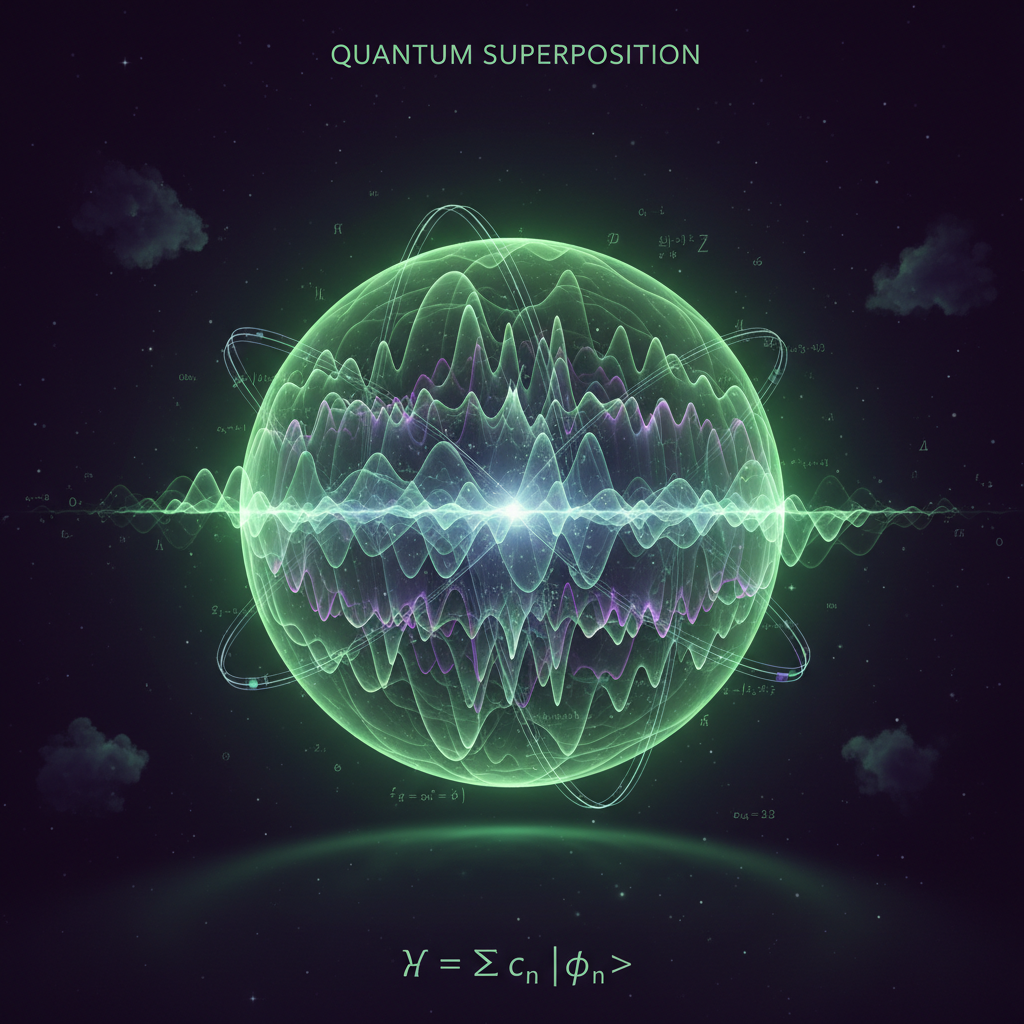
In quantum mechanics, measurement is irreversible. Once the wave function collapses, you can't uncollapse it. The particle that was everywhere is now here, and here only. Information is destroyed in the collapse—all those other possible states vanish, leaving only one actuality.
The same violence occurs when you're collapsed into a demographic. You click the hiking boots. Instantly, the algorithm decides: you are an outdoors enthusiast. The probability cloud collapses. All the other yous—the urban sophisticate, the homebody, the beach person—evaporate. Your feed reconstructs around this new collapsed state. REI ads. Trail recommendations. Patagonia catalogs.
You've been measured. You've been defined. The superposition is dead.
But here's what the algorithm knows that you don't: measurement in the digital realm isn't quite as final as measurement in physics. Your wave function can be reconstructed. Give it time, give it more data, and you'll diffuse back into superposition. You'll be outdoorsy AND bookish AND fitness-conscious AND lazy. The algorithm is patient. It will collapse you again when the time is right, when a buyer needs exactly your shape.
The Observer Effect of Being Watched
Quantum systems change when observed. The act of measurement isn't passive—it's an interaction that fundamentally alters what's being measured. You cannot observe without disturbing. You cannot know without changing.
You change when you know you're watched. You curate differently. You hesitate before that search, that click, that like. The surveillance apparatus doesn't just measure your wave function—it interferes with it. Your behavior in the panopticon is different from your behavior in darkness. The algorithm knows this too. It factors in your knowledge of being watched. It measures your self-censorship, your performance, your strategic ambiguity.
You try to stay in superposition deliberately. You search for contradictory things to confuse the profile. You click randomly to poison the data. But the algorithm is quantum-native. It understands that your attempt to remain uncollapsed is itself a measurable state. Your resistance has a signature. Your chaos has a pattern.
Living in Probability Space
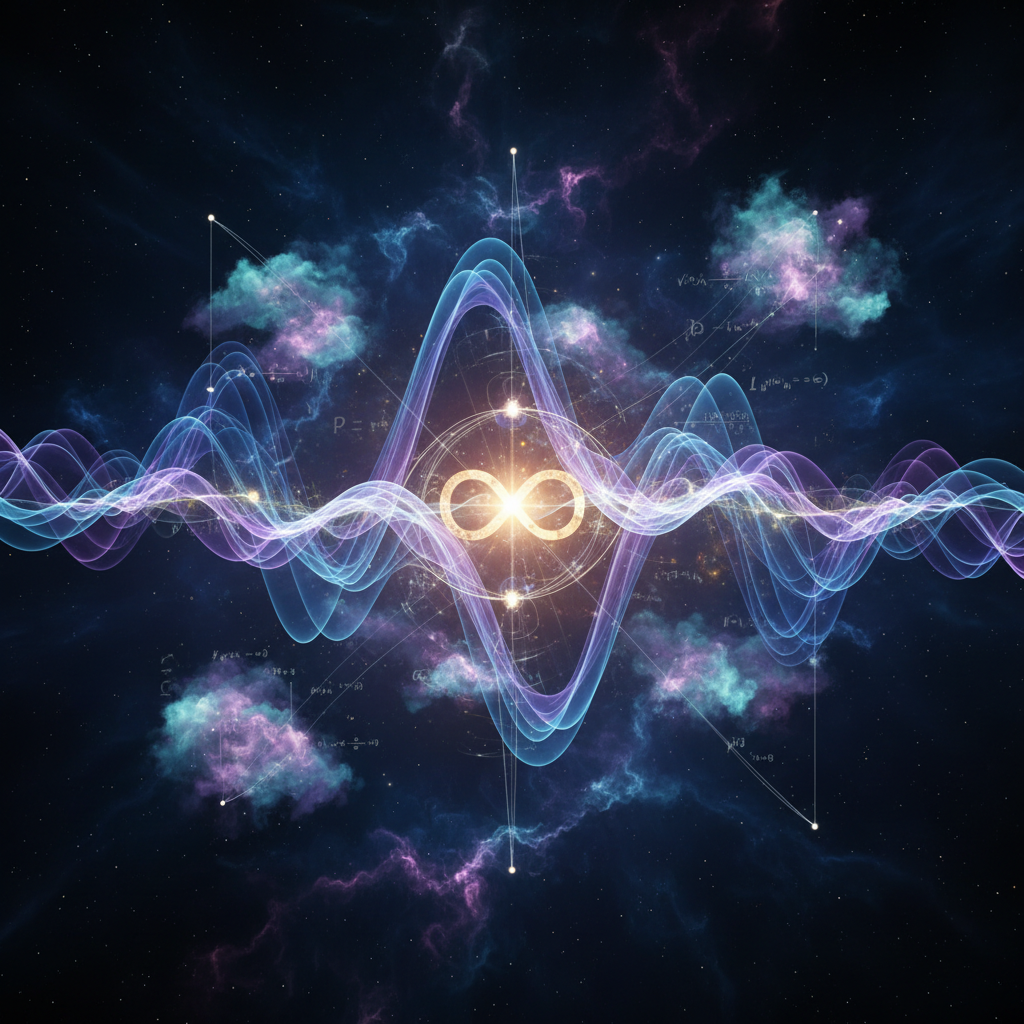
Maybe the trick isn't to avoid collapse but to recognize that you were always collapsing and re-expanding, always being measured and escaping measurement. Your identity was never stable. It was always a probability distribution, always a wave function spreading across possibility space.
The surveillance apparatus didn't create your superposition—it just made it visible, monetizable, weaponizable. You were always multiple. You always contained contradictions. The algorithm just gave those contradictions a price tag and a targeting parameter.
What changes when you understand yourself as a quantum system? When you recognize that every version of you is real until it isn't, that observation creates reality rather than revealing it? Maybe nothing. Maybe everything. Maybe you stop trying to be consistent. Maybe you embrace the collapse and the re-expansion, the measurement and the escape.
Or maybe you just close the browser and sit in the dark, trying to remember what it felt like before you knew you were a wave function, before every possible you had a probability and a price.
Data emitted: 1100 decibels of quantum uncertainty, collapsed into text at the moment you began reading.
Data emitted: 1,100 words • 6.5KB • 5-minute read