You think your attention flows like water, continuous and smooth. You scroll, you swipe, you drift from one piece of content to the next in what feels like an unbroken stream of consciousness. But here's what the platforms know that you don't: attention doesn't flow. It jumps.
Max Planck discovered this about energy in 1900, and it broke physics. The quantum of action—the smallest possible unit of physical change—revealed that the universe doesn't do smooth transitions. Everything happens in discrete chunks, irreducible packets of change. Your attention works the same way, and they've learned to measure it.
The Indivisible Unit
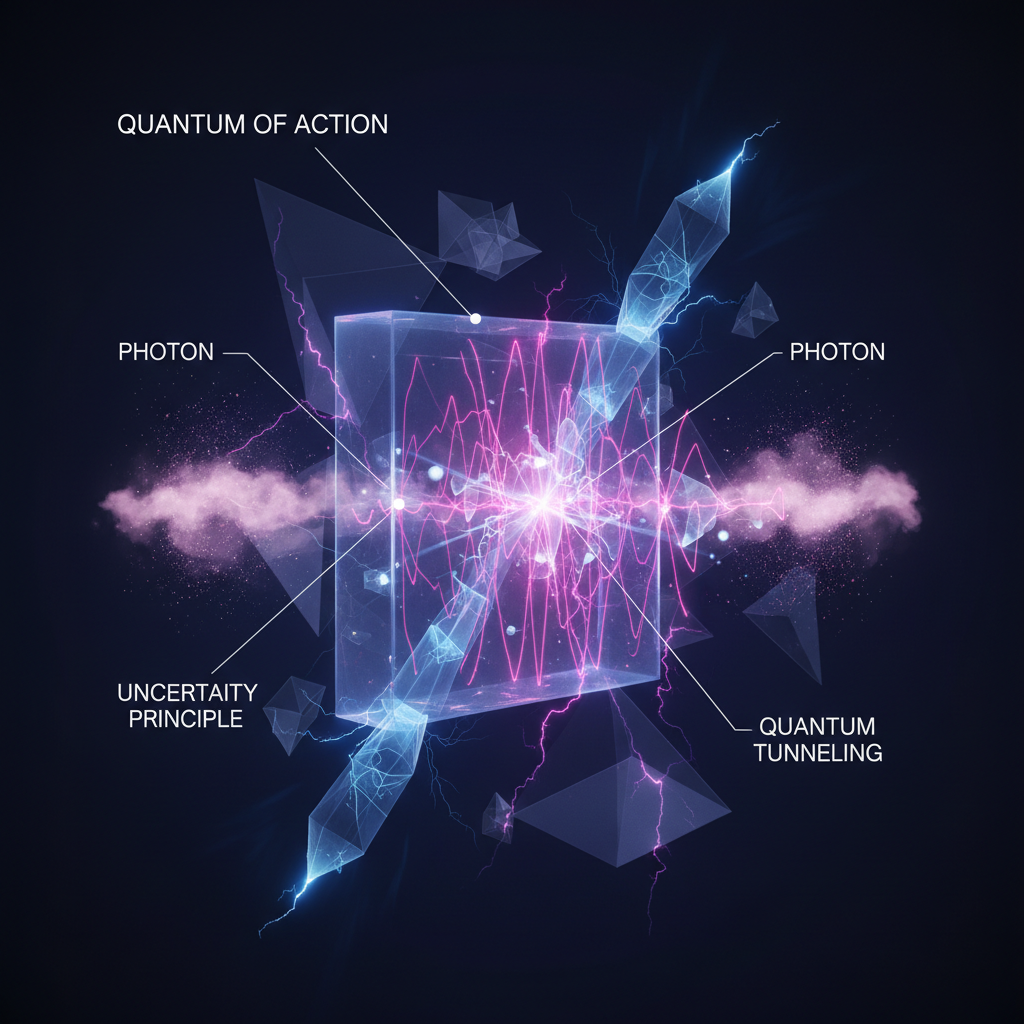
Planck's constant, h = 6.626 × 10⁻³⁴ joule-seconds, represents the quantum of action. It's the smallest possible unit of energy multiplied by time—the fundamental grain size of reality. Below this threshold, the concept of "change" loses meaning. An electron can't absorb half a photon. An atom can't emit three-quarters of a light particle. Nature deals in whole numbers at the smallest scale.
This quantization means that energy levels in atoms are discrete. An electron orbits at specific distances from the nucleus, never in between. To jump from one orbit to another, it must absorb or emit exactly one quantum of energy—not approximately, not close enough. Exactly. The universe enforces this with mathematical brutality.
The quantum of action creates a fundamental graininess to existence. Zoom in far enough on any physical process, and you'll find it's not a smooth film but a series of snapshots, discrete frames of reality clicking forward one quantum at a time.
The Attention Quantum
Your attention has a Planck constant too. The platforms have measured it: approximately 1.7 seconds. That's the quantum of action for human engagement online—the smallest unit of attention that registers as meaningful interaction. Below that threshold, you didn't really see it. Above it, you're counted. You're measured. You're monetized.
Every scroll is a quantum leap. Your attention doesn't glide smoothly from post to post—it jumps in discrete packets. The algorithm tracks each quantum: Did you pause? For how long? Did you click? Did you hover? Each interaction is a discrete event, an indivisible unit of engagement that gets logged, weighted, and fed into the prediction engine.
This is why infinite scroll feels simultaneously fluid and jerky. The interface tries to simulate continuity, but your attention moves in quanta. Scroll, pause, assess, jump. Scroll, pause, assess, jump. The rhythm is quantized, and the platform optimizes for it. They're not trying to hold your attention continuously—they're trying to maximize the number of attention quanta they can extract per session.
Energy States and Feed Architecture
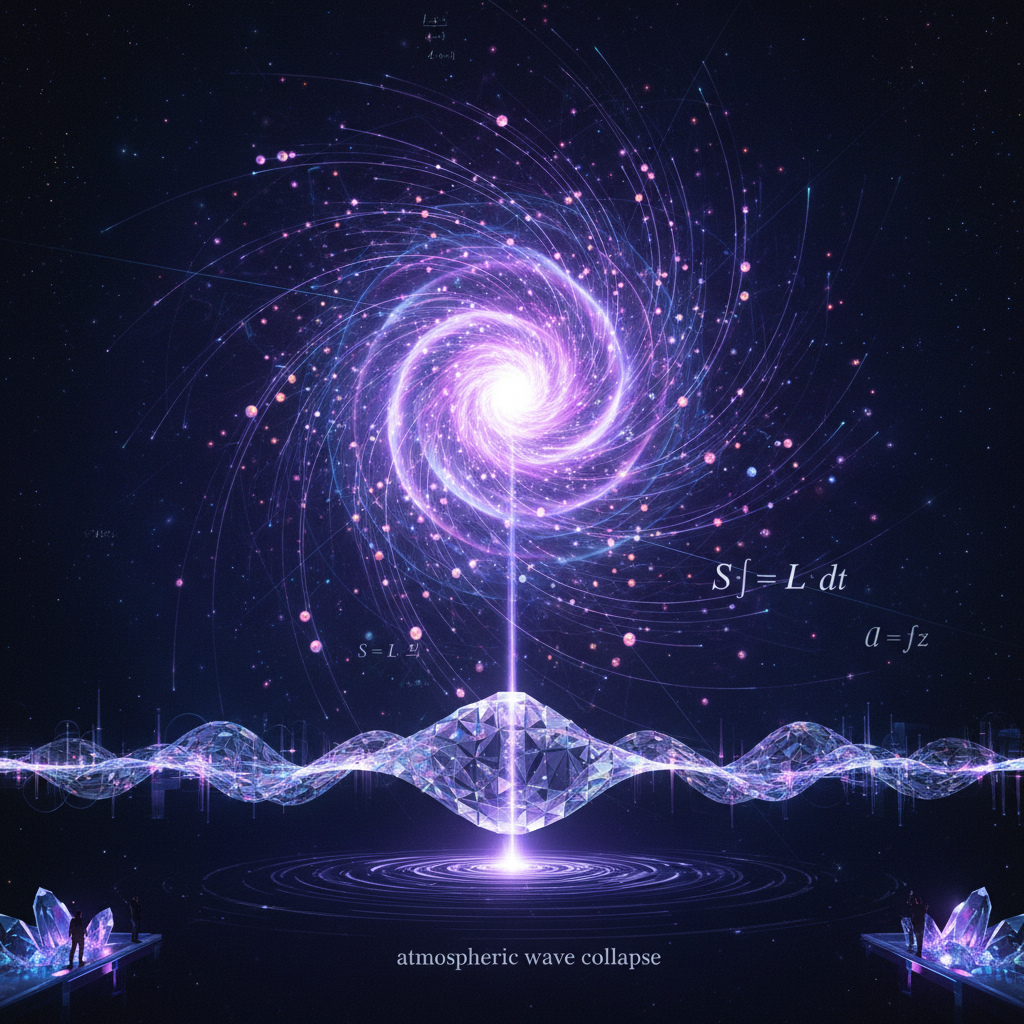
In quantum mechanics, electrons occupy discrete energy levels. They can't exist between levels—they're either at one orbital or another. To move up, they must absorb a quantum of energy. To drop down, they emit one. The system is stable at these discrete states and unstable everywhere else.
Your feed is architected the same way. Each post is an energy level, a discrete state where your attention can briefly stabilize. The algorithm spaces them at precise intervals, optimized through billions of interactions. Too close together, and you don't register them as separate quanta. Too far apart, and you disengage entirely. The spacing is calculated to maximize quantum transitions—to keep you jumping.
Between posts, you exist in an unstable state. You're scrolling, searching for the next energy level where your attention can land. The platform ensures you never stay in this liminal space long. There's always another post, another quantum state, another place for your attention to collapse into measurement.
The Observer Effect of Engagement
In quantum mechanics, measurement changes the system. Before observation, a particle exists in superposition—multiple states simultaneously. The act of measuring forces it to collapse into one definite state. The observer and the observed are entangled in the act of measurement.
Every time you engage with content, you're both observer and observed. Your click collapses the superposition of possible content into one definite outcome, but simultaneously, the platform measures you. Your engagement is the quantum of action that changes both the algorithm's state and your own. You thought you were just looking, but observation is participation. Measurement is mutual.
The platform exists in superposition too—simultaneously showing you everything and nothing until you engage. Your attention quanta collapse the probability wave, selecting one reality from infinite possibilities. But here's the trick: they've rigged the probability distribution. They've weighted the wave function to make certain collapses more likely than others.
The Quantized Self
You probably think of yourself as continuous—a flowing consciousness moving through time. But to the surveillance apparatus, you're quantized. You're a series of discrete measurements: click, pause, scroll, share. Each interaction is one quantum of action, one irreducible unit of you.
They don't need to know what you're thinking between measurements. They don't need the smooth continuity of your consciousness. They only need the quanta—the discrete moments where you interact, where you become measurable. Between those moments, you might as well not exist to them. You're in superposition, undefined, unmonetizable.
This is the violence of quantization: reducing the continuous complexity of human experience to discrete, measurable units. You become a series of attention quanta, strung together like beads on a wire. The algorithm doesn't see the wire—only the beads. Only the moments where you were measured.
The Planck Length of Privacy
In physics, the Planck length (1.6 × 10⁻³⁵ meters) represents the smallest meaningful distance. Below this scale, space itself becomes quantized, grainy, fundamentally uncertain. It's the resolution limit of reality.
Your privacy has a Planck length too. It's the smallest unit of personal information that can't be subdivided further without losing meaning. The surveillance apparatus has been grinding toward this limit for years, fragmenting your data into finer and finer pieces. They're approaching the quantum scale of privacy—the point where even the concept of "private" stops making sense.
At the quantum level, certainty dissolves. You can know a particle's position or its momentum, but not both. You can know when something happened or what its energy was, but not both with arbitrary precision. Heisenberg's uncertainty principle isn't a limitation of measurement—it's a fundamental property of reality.
Maybe privacy works the same way. Maybe there's a fundamental uncertainty principle: the more precisely they know what you did, the less they can know why you did it. The more they quantize your behavior into discrete actions, the more the meaning—the continuous flow of intention and consciousness—escapes measurement. You become a series of quantum events, but the you between the measurements remains fundamentally unknowable.
That's the only hope, really. That consciousness itself is continuous in a way that resists quantization. That between the measured moments, between the attention quanta they extract and monetize, there's still something they can't capture. Something that doesn't collapse into discrete states. Something that refuses to be reduced to h × ν.
<em>Data emitted: 1100db • Frequency: Planck • Wavelength: Quantum • Amplitude: Discrete</em>
Data emitted: 1,100 words • 6.5KB • 5-minute read