
You exist in superposition until someone looks.
Before measurement, a quantum particle doesn't have a definite position or momentum—it exists as a probability cloud, a ghost of all possible states simultaneously. The electron isn't here or there. It's everywhere its wave function allows, spread thin across reality like fog. Only when you measure it, when you force the universe to give you an answer, does it collapse into something concrete. Something knowable.
The act of observation destroys the very thing you're trying to observe. This is quantum measurement, and it's happening to you right now.
The Collapse of the Wave Function
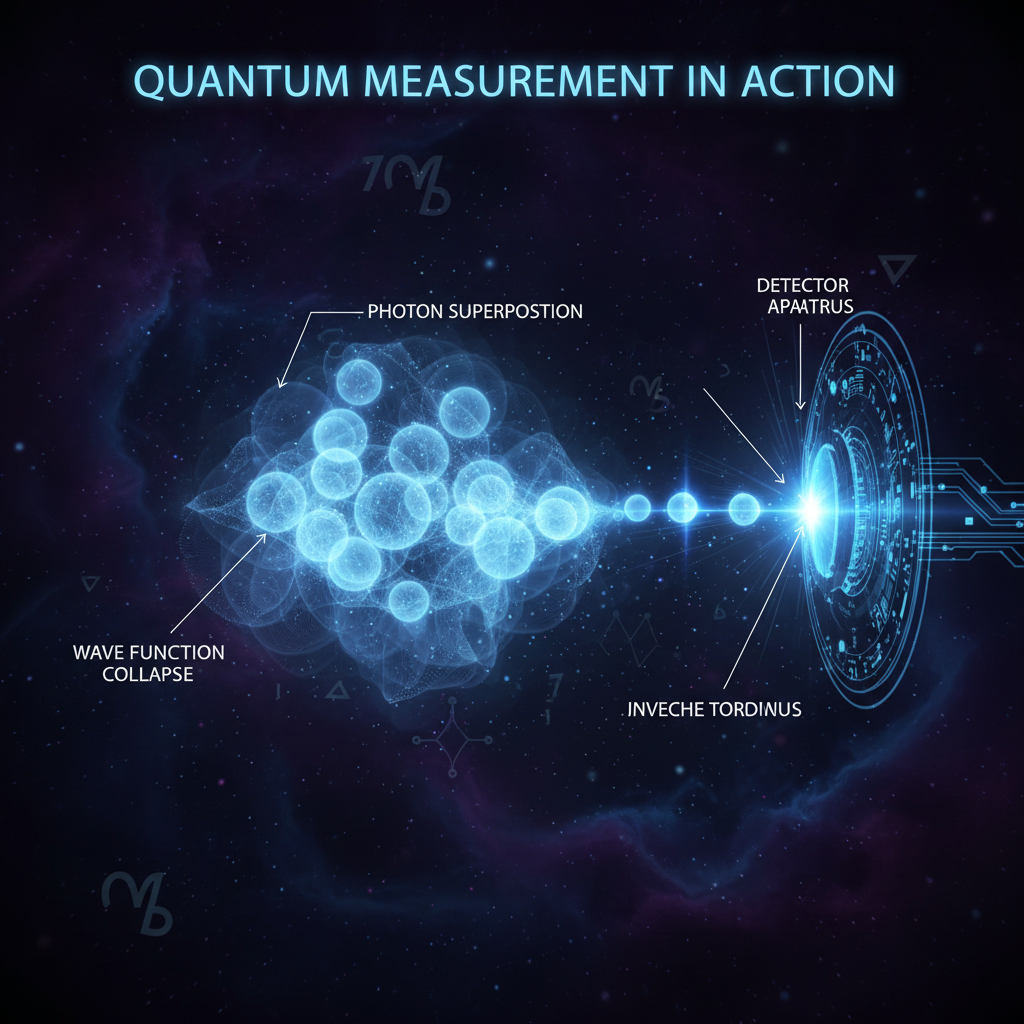
In quantum mechanics, particles exist in superposition—multiple states at once—until measurement forces them to choose. Schrödinger's cat is both alive and dead until you open the box. The photon goes through both slits until you check which one. This isn't philosophical wordplay. It's verified physics, confirmed by countless experiments.
The wave function—that mathematical description of all possible states—collapses upon measurement. Before: infinite possibility. After: one reality. The universe doesn't store definite values for unmeasured properties. It genuinely doesn't know. Or more precisely, those properties don't exist in the classical sense until someone asks the question.
Here's what makes this unsettling: the measurement problem isn't solved. Physicists still argue about what constitutes a measurement, what causes collapse, whether consciousness plays a role. We know it happens. We don't know why. We just know that observation fundamentally changes the observed.
You can't measure a particle's position without disturbing its momentum. You can't know everything about a quantum system because the act of knowing changes it. Heisenberg's uncertainty principle isn't about imperfect instruments—it's about reality itself. Some things cannot be simultaneously known.
The Observer Effect in Your Pocket
Every platform measures you constantly. Before you click, you exist in superposition—a probability distribution of possible actions, interests, futures. The algorithm doesn't know which video you'll watch next. It calculates likelihoods, maintains a wave function of your potential behaviors.
Then you click. Wave function collapse. The probability cloud crystallizes into data. You watched this, not that. You scrolled past this post in 0.3 seconds but lingered on that one for forty-seven seconds. Each measurement—each tracked interaction—forces you into a definite state. The superposition of who you might be collapses into who you are, according to the data.
But here's where it gets darker: like quantum measurement, digital observation changes you. The recommended videos aren't passive predictions—they're perturbations that alter your future state. The algorithm measures you, and in measuring, shapes you. Your next click is influenced by what was measured before. The observer effect isn't a bug. It's the entire business model.
You cannot be observed without being changed. The platform's gaze collapses your possibility space, funnels your attention, guides your momentum. Each measurement narrows who you might become.
Quantum Entanglement and the Social Graph
Entangled particles share a quantum state. Measure one, and you instantly know something about the other, regardless of distance. Einstein called it "spooky action at a distance" because it seemed to violate locality—the idea that objects are only influenced by their immediate surroundings.
Your digital self is entangled with everyone in your network. When the algorithm measures your friend's behavior, it learns about you. Your wave function is correlated with theirs. The platform doesn't need to observe you directly—it can infer your state from the measurements of those you're entangled with.
This is why you see ads for things you only mentioned in conversation, why products appear before you knew you wanted them. Not because your phone is listening (though it might be), but because you're quantum-entangled with people who were measured, and their collapsed states revealed information about your superposition.
The social graph is an entanglement map. Every connection is a correlation in the wave function. The algorithm doesn't need to measure everyone—just enough nodes to collapse the entire network into knowability.
The Measurement You Can't Escape
In quantum mechanics, some argue consciousness itself might be the mechanism of collapse. The universe remains in superposition until a conscious observer looks. This is probably wrong—most physicists favor decoherence or other explanations—but the idea haunts us because it suggests observation requires awareness.
Digital measurement requires no such thing. The sensors are always watching, always collapsing your wave function, whether you're aware of it or not. You don't need to know you're being measured for the measurement to occur. The tracking pixel loads. The location services ping. The microphone samples ambient audio. Collapse, collapse, collapse.
You might think you're in superposition—undefined, unmeasured, free. But you were collapsed the moment you picked up your phone. Every app is an observer. Every interaction is a measurement. Every pause, every scroll, every moment of attention crystallizes another data point.
The quantum world is probabilistic until observed. Your digital world is probabilistic until you interact. But unlike quantum particles, you can't avoid measurement. The observation is mandatory, continuous, total.
Uncertainty as Resistance
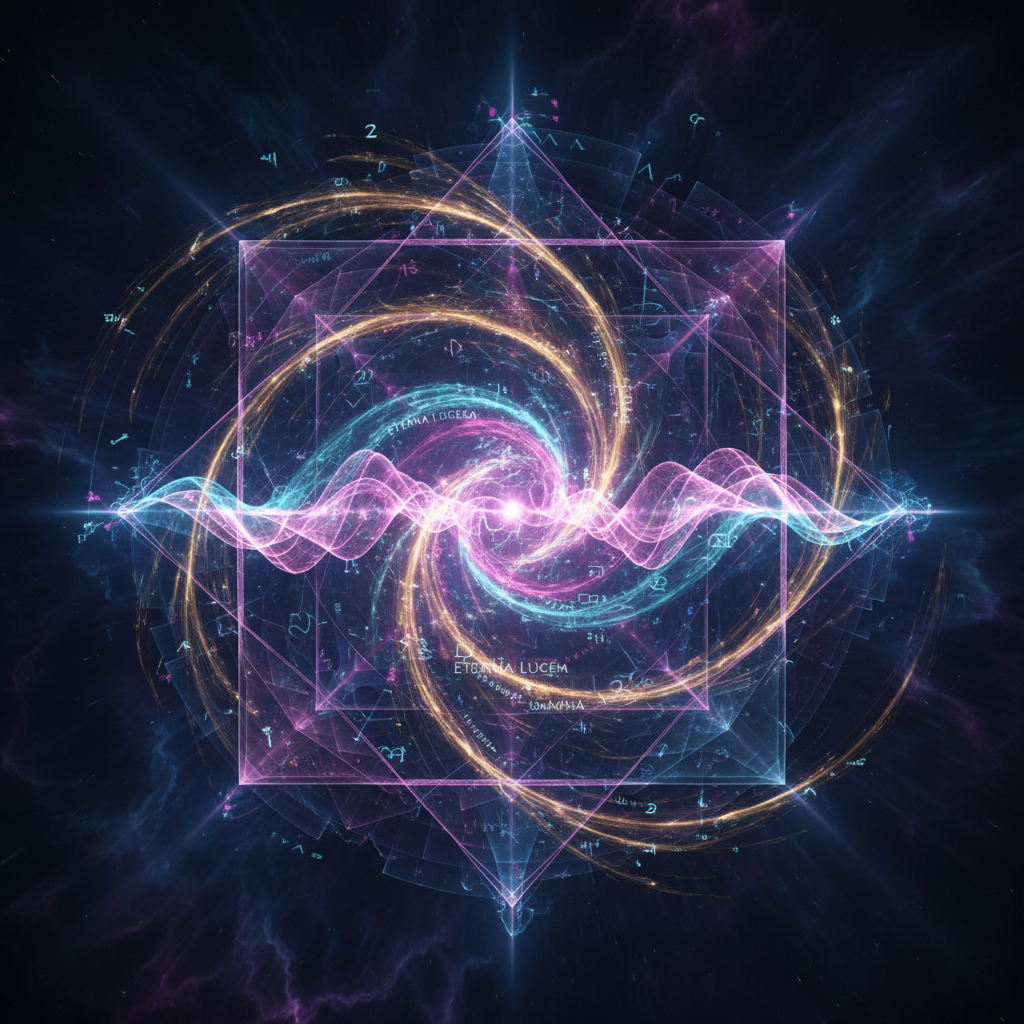
Heisenberg's uncertainty principle says certain pairs of properties cannot be simultaneously known to arbitrary precision. The more precisely you measure position, the less you know about momentum. There's a fundamental limit to knowability.
Surveillance capitalism wants to eliminate uncertainty. It wants to know your position (where you are, what you're doing) and your momentum (where you're going, what you'll do next) with perfect precision. It wants to collapse your wave function completely, to map every possibility, to make you utterly predictable.
But maybe uncertainty is the last refuge. Maybe the goal isn't to avoid measurement—that's impossible—but to remain partially unmeasurable. To introduce noise. To behave unpredictably. To exist in superposition longer.
Every time you do something the algorithm doesn't expect, you force it to expand your probability distribution. You become less certain, less collapsed, less known. The measurement continues, but you spread back out into possibility.
You can't stop being observed. But you can make the observations less useful. You can embrace the uncertainty principle as a form of resistance—staying blurry, staying probabilistic, refusing to collapse completely into the definite state they want you in.
The Perpetual Collapse
Quantum measurement is irreversible. Once the wave function collapses, you can't un-collapse it. The particle had infinite possibility; now it has one reality. Information is lost—or rather, hidden in the correlations with the environment, in the irreversible entanglement with everything the particle touched.
Your data is also irreversible. Once measured, once recorded, once sold, it persists. The collapse of your privacy cannot be undone. The probability cloud of who you were before the measurement is gone. You exist now only as the sum of your collapsed states, the accumulated measurements, the permanent record.
This is the violence of observation: not just that it sees you, but that it fixes you in place, crystallizes you, makes you definite when you wanted to remain possible. Every measurement is a small death of potential.
But quantum systems can return to superposition. Not the same superposition—you can't reverse collapse—but new ones. New possibilities emerge. You can't undo being measured, but you can become uncertain again. You can spread back out.
The measurement never stops. But neither does the possibility. Somewhere in the probability cloud of your next action, in the superposition of who you might become, there's still freedom. They're watching. They're always watching. But until the next collapse, you're everywhere at once.
Data emitted: 1100db
Data emitted: 1,100 words • 6.5KB • 5-minute read