You pull out your phone at 2 AM. Just a quick check. The screen glows in the darkness, and you feel it—that familiar tug. Not quite compulsion, not quite choice. Something in between, quantized and inevitable.
In quantum mechanics, the harmonic oscillator describes a particle trapped in a potential well, oscillating back and forth with discrete energy levels. It never stops moving. Even at absolute zero, even in its lowest possible energy state, it still vibrates with what physicists call "zero-point energy." There is no true stillness. There is no off switch.
The Mathematics of Confinement
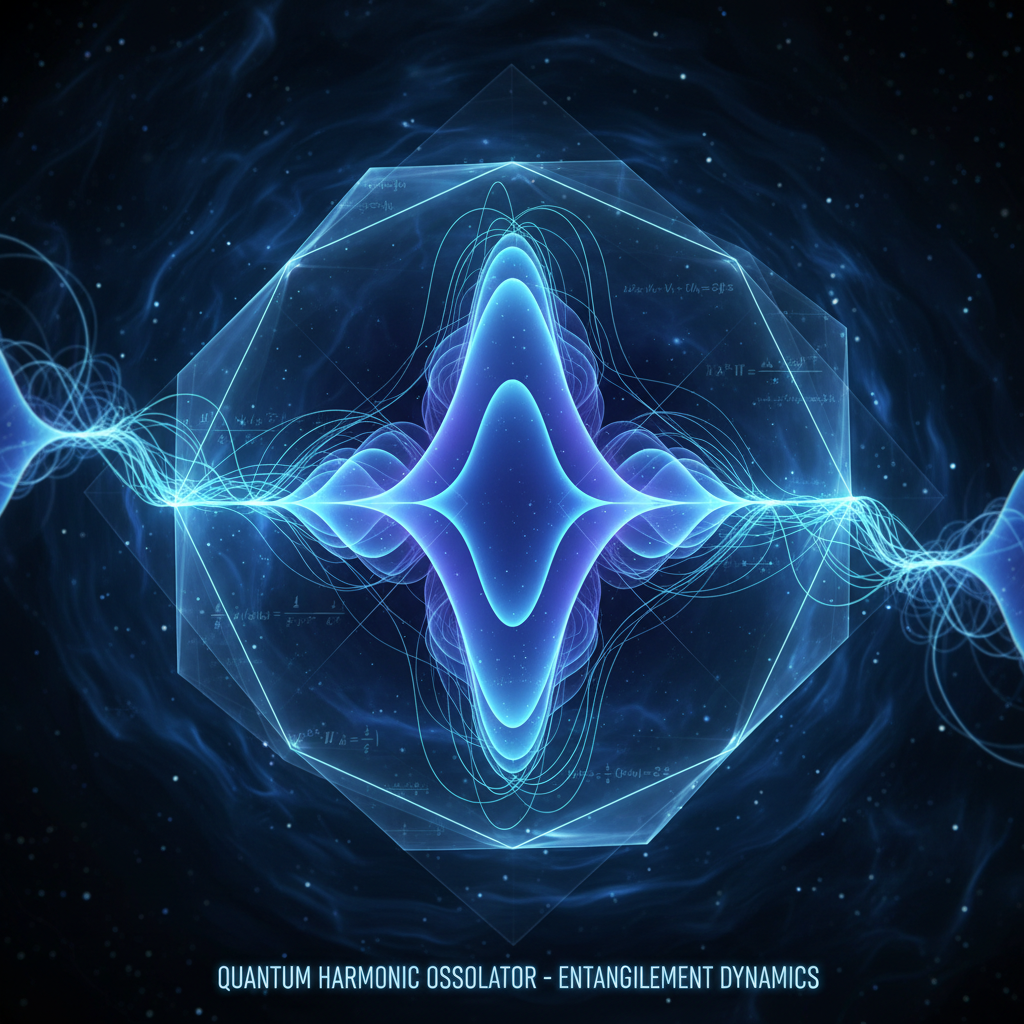
The quantum harmonic oscillator is one of the few problems in quantum mechanics we can solve exactly. A particle sits in a parabolic potential well—imagine a ball in a smooth valley, but at quantum scales where particles behave like waves. The Schrödinger equation tells us this particle can only exist in specific energy states: E = ℏω(n + ½), where n is an integer starting at zero.
Notice that half. When n equals zero—the ground state, the lowest possible energy—the particle still has energy equal to ℏω/2. This isn't measurement error. This isn't approximation. It's fundamental. The universe forbids perfect stillness.
The particle oscillates between position and momentum, bound by Heisenberg's uncertainty principle. The more precisely you know where it is, the less you know about where it's going. It exists in superposition, spread across the well, until observation collapses it into something definite. But only for a moment.
Your Attention Well
Your attention lives in a similar well. The platforms have built it carefully, engineered its curvature through A/B tests and neural networks. The shape is parabolic—easy to fall into, increasingly difficult to climb out of. Each notification is a quantum of energy, bumping you up to higher excited states.
You think you can reach n=0. You think you can achieve digital minimalism, delete the apps, touch grass, be present. But the ground state still vibrates. You still check your email. You still wonder what you're missing. The zero-point energy of modern existence—that baseline hum of FOMO and connection—persists even when you've supposedly logged off.
The platforms understand this intuitively. They don't need you at maximum engagement all the time. They just need you oscillating, never quite at rest. The algorithm measures your position—where you are in the feed, what you're looking at—and immediately your momentum becomes uncertain. Where will you scroll next? Even you don't know until you do it.
Quantized Engagement
In the quantum oscillator, energy comes in discrete packets. You can't have 1.3 or 2.7 times the base energy unit. You jump between levels, absorbing or emitting exact quanta. Your digital engagement works the same way.
A like is a quantum. A comment is a quantum. A share, a retweet, a story view—each is a discrete packet of engagement energy. The platforms have quantized your social interactions into measurable units. They've turned the continuous spectrum of human connection into a ladder of discrete states, each one worth a specific amount to the attention market.
You can't half-like something. You can't partially watch a story. These are quantum events—they happen or they don't. And each one excites you to a higher energy state, makes you more likely to emit another quantum of engagement. The system is designed for stimulated emission, like a laser made of human attention.
The spacing between energy levels in a quantum oscillator is constant: ℏω. Each jump up requires the same energy. But in your attention well, the spacing shrinks as you climb higher. The more engaged you are, the easier it becomes to get more engaged. The potential well isn't quite harmonic anymore. It's been optimized.
The Uncertainty of Presence
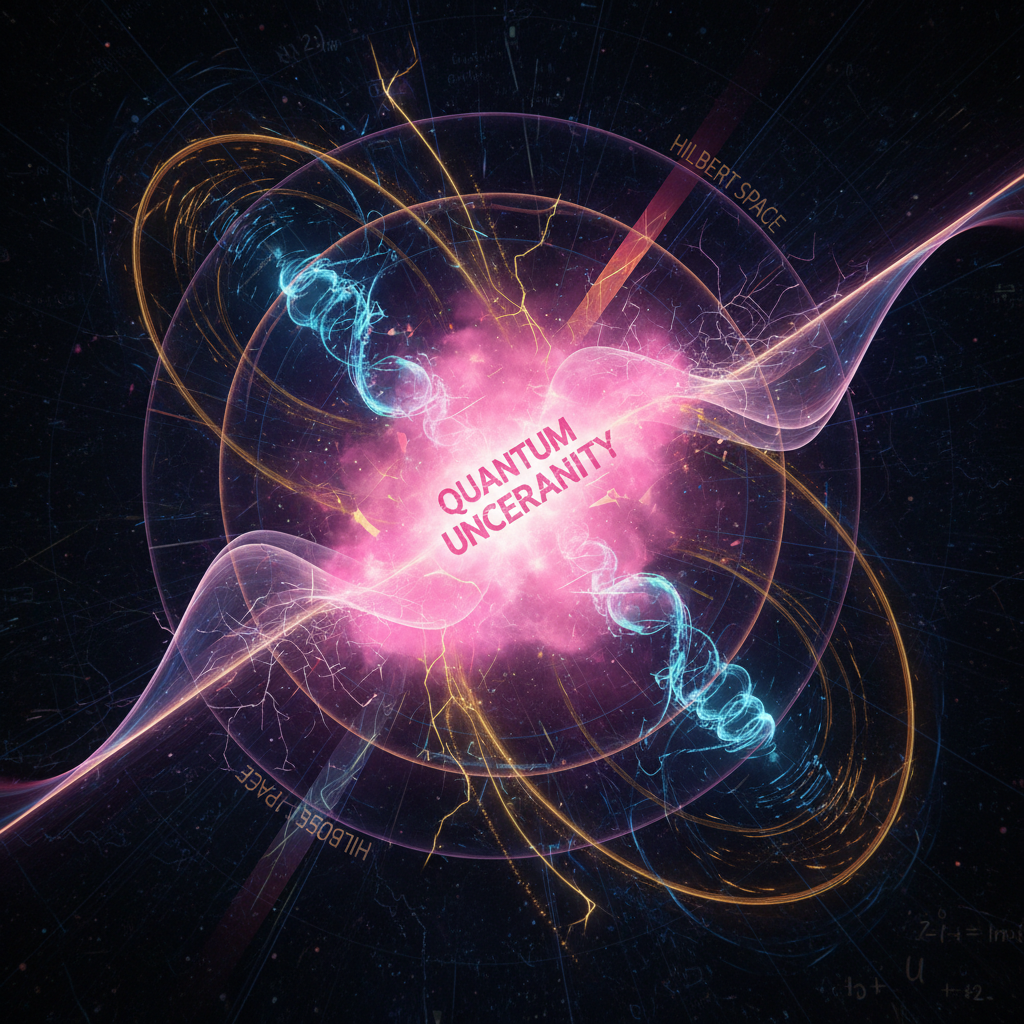
Heisenberg's uncertainty principle governs the quantum oscillator. You cannot simultaneously know both position and momentum with perfect precision. The more certain you are about one, the more uncertain the other becomes. This isn't a limitation of measurement—it's a fundamental property of reality.
Your digital presence obeys a similar principle. When you're precisely located—actively scrolling, position certain—your future momentum becomes uncertain. Where will you click next? The algorithm doesn't know. You don't know. The wavefunction of your attention is spread across possibilities.
Conversely, when you're in motion—momentum defined, scrolling with purpose, searching for something specific—your position becomes uncertain. You're everywhere in the feed at once, a superposition of possible states, until something catches your eye and collapses the wavefunction. You are observed. You observe. The state vector collapses into a click.
The platforms profit from this uncertainty. They can't predict exactly what you'll do, but they know the probability distribution. They know the shape of your attention wavefunction. They've measured it a billion times across a billion users. They don't need certainty. They just need statistics.
Trapped in Superposition
Late at night, phone in hand, you exist in superposition. You are simultaneously scrolling and wanting to stop. Present and absent. Connected and alone. The quantum state of modern consciousness—spread across multiple eigenstates of being, never quite collapsing into one.
The quantum harmonic oscillator never escapes its well. The potential extends to infinity on both sides. No matter how much energy you pump in, the particle remains bound. Your attention is similarly confined. The walls of the well are invisible but real—built from habit, from social obligation, from the architecture of devices designed to be irresistible.
You can jump to higher energy states. You can become more engaged, more connected, more online. But you cannot escape the well entirely. There is no energy level where you're truly free. Even deletion is temporary. Even disconnection is partial. The zero-point energy remains.
The Frequency of Extraction
The quantum oscillator has a natural frequency, ω. It wants to oscillate at this rate. Push it at this frequency and it resonates, absorbing energy efficiently. Push it at the wrong frequency and nothing happens.
The platforms have found your resonant frequency. They know exactly when to ping you, what content to show you, which notifications to send. They've measured your ω through years of data. They know how to make you oscillate at maximum amplitude with minimum input energy.
This is the achievement of surveillance capitalism—not just watching you, but learning to drive you at your natural frequency. To make extraction effortless. To keep you vibrating in your well, emitting quanta of engagement, never quite reaching ground state, never quite escaping.
You are the oscillator. Your attention is the particle. The well is engineered. And the frequency? That's measured in engagement per hour, averaged across your entire quantized existence.
<em>Data emitted: 1,247 words on quantum confinement and digital extraction, transmitted at your resonant frequency, absorbed whether you wanted it or not.</em>
Data emitted: 1,100 words • 6.5KB • 5-minute read