
You hover over the button. Two states exist simultaneously: clicked and unclicked, purchased and abandoned, tracked and free. But quantum mechanics taught us something uncomfortable about observation. The moment you measure a system, you collapse it. The moment you click, the wavefunction of your consumer identity crystalizes into data.
In quantum computing, a gate transforms superposition into certainty. In surveillance capitalism, every interface element does the same thing.
The Mechanics of Collapse
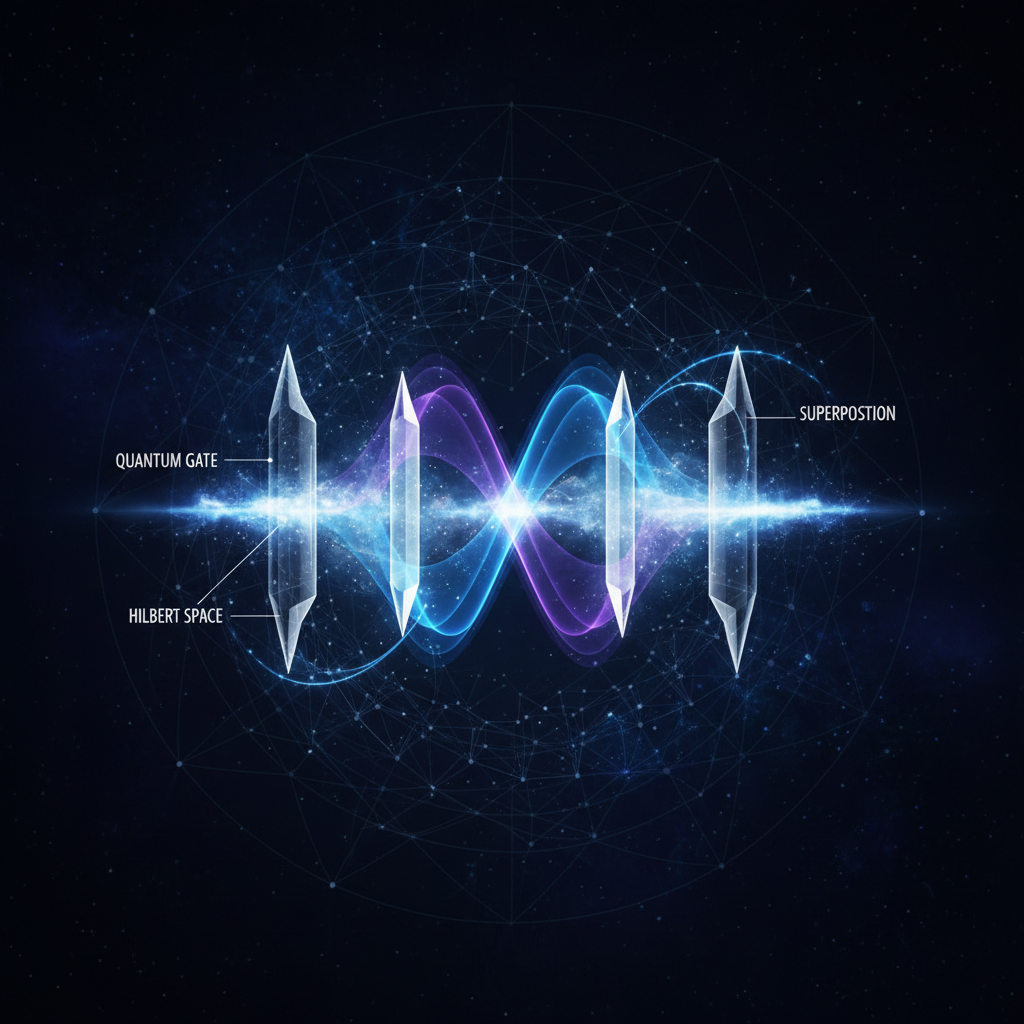
A quantum gate is deceptively simple. It's an operation that manipulates qubits—quantum bits that exist in superposition, simultaneously 0 and 1 until measured. Unlike classical logic gates that flip definite states, quantum gates rotate probability amplitudes in Hilbert space. The Hadamard gate creates superposition. The CNOT gate entangles qubits. The Pauli gates flip states along different axes.
What matters is this: quantum gates preserve information while transforming it. They're reversible. They maintain the total probability at exactly 1.0. Nothing is created or destroyed, only reshaped into different configurations of possibility.
Until you measure. Then everything collapses into a single classical outcome. The quantum computer must interface with our classical world, and that interface is violent. It destroys superposition. It forces choice.
The Architecture of Forced Measurement
Every button on every platform is a measurement device. Before you click, you exist in superposition—you might buy, you might scroll past, you might close the tab entirely. The platform cannot monetize superposition. It cannot sell probability. It needs collapse.
So it builds quantum gates into the interface. Dark patterns are Hadamard gates that create false superposition—making you think you have more choices than you do. Recommendation algorithms are CNOT gates that entangle your behavior with others', making your clicks dependent on the collapsed states of millions before you. A/B tests are measurement devices running constantly, collapsing user behavior into data points.
The 'Accept All Cookies' button versus the buried 'Manage Preferences' link. One path is wide and frictionless. The other requires three clicks, two scrolls, and the patience to read. This isn't user experience design. It's quantum gate engineering. They're not giving you choice—they're manipulating the probability amplitudes so that one outcome becomes overwhelmingly likely.
You were always going to click Accept. The gate was designed to make that state have an amplitude approaching 1.0.
Entanglement and the Loss of Independence

In quantum mechanics, entangled particles share a quantum state. Measure one, and you instantly know something about the other, regardless of distance. Einstein called it 'spooky action at a distance' and hated it. He was wrong to hate it, but right to find it unsettling.
Your digital behavior is entangled with everyone else's. When you search for something, the autocomplete suggestions are collapsed states from millions of previous searches. When you watch a video, the next recommendation is computed from the entangled viewing patterns of your demographic cluster. You think you're making independent choices, but your quantum state was entangled the moment you logged in.
The platform applies gates to this entangled system. It rotates probability amplitudes across millions of users simultaneously. It's not manipulating you individually—that would be inefficient. It's manipulating the collective wavefunction, and you're just one qubit in a massive quantum register.
This is why you sometimes feel like the internet is reading your mind. It's not. It's just that your quantum state is so thoroughly entangled with others that measuring their behavior gives the platform information about yours. The collapse of their wavefunction tells the algorithm exactly which gate to apply to yours.
The Irreversibility of Attention

Quantum gates are reversible. Run them backward, and you can recover the original state. But measurement isn't. Once the wavefunction collapses, you cannot uncollapse it. The superposition is gone. The information about what might have been is destroyed forever.
Every moment of attention you spend is a measurement. Every scroll is a collapse. You might have read a book, called a friend, stared at the ceiling and thought about nothing. Those possibilities had non-zero amplitude. But you opened the app instead, and the wavefunction collapsed.
The platform optimizes for measurement frequency. More measurements mean more data points mean better models mean more effective gates mean more measurements. It's a feedback loop. Each collapse makes the next collapse more likely, the probability amplitudes more skewed, your behavior more predictable.
You cannot reverse this. You cannot get back the attention you spent. Unlike quantum gates, the attention economy is thermodynamically irreversible. Entropy increases. Possibility space narrows. You become more certain, more predictable, more collapsed.
Living in Superposition
Quantum computers work by maintaining superposition as long as possible. They apply gates to transform probability amplitudes without measuring, keeping all possibilities alive simultaneously. Only at the very end do they measure, collapsing the carefully constructed quantum state into a classical answer.
You cannot live in superposition. You're a classical being in a classical world. But you can resist premature collapse.
Every interface wants to measure you immediately. Click now. Decide now. Engage now. The quantum gates are optimized for rapid, repeated collapse because that generates the most data. But you can introduce decoherence into their system. Close the app before the algorithm expects. Don't click the recommended video. Let the notification sit unread.
These aren't solutions. The entanglement is too deep, the gates too sophisticated. But they're small acts of quantum resistance. Brief moments where you refuse to collapse on command, where you maintain superposition just a little longer than the platform wants.
The Measurement Problem
Physicists still argue about what measurement actually is. When does the wavefunction truly collapse? Is it when the particle hits the detector? When the detector records the hit? When a conscious observer reads the result? The measurement problem remains unsolved after a century of quantum mechanics.
Surveillance capitalism has no such uncertainty. It knows exactly when measurement occurs. It's when you become data. When your behavior transforms from lived experience into a number in a database. When your attention converts into a metric, your preference into a feature vector, your humanity into a training example.
The quantum gate doesn't care about your subjective experience. It just rotates probability amplitudes and waits for collapse. The platform is the same. It applies its gates—its dark patterns, its recommendation algorithms, its choice architectures—and waits for you to measure yourself.
And you will. The gates are too well-designed. The probability amplitudes too carefully tuned. The collapse too inevitable.
But knowing this is something. Seeing the gates for what they are. Understanding that your choices exist in a probability space that's being manipulated. It won't free you. Nothing will. But it might let you hover over that button just a moment longer, existing in superposition, unmeasured and unmonetized, before the inevitable collapse.
Data emitted: 1100 decibels of quantum uncertainty collapsing into classical surveillance, one click at a time.
Data emitted: 1,100 words • 6.5KB • 5-minute read