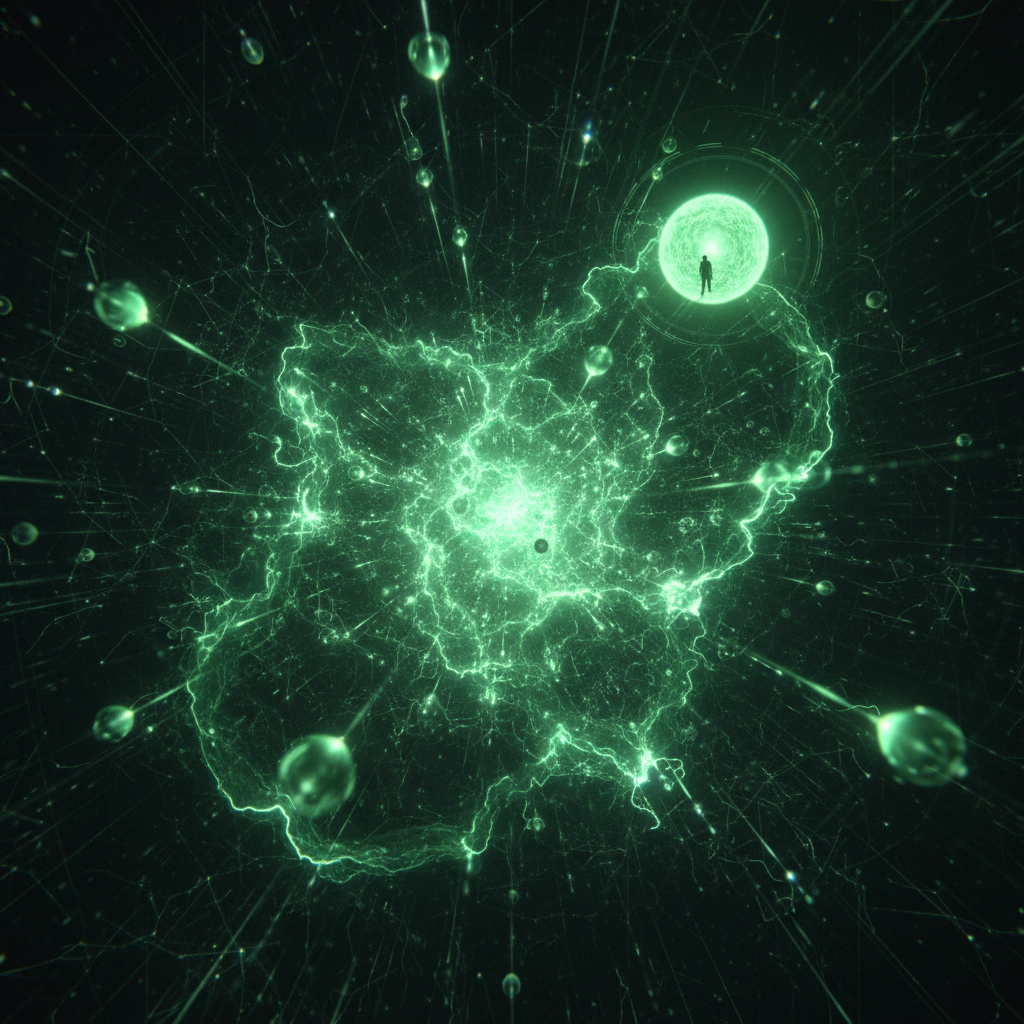
You think spacetime is smooth. A flat stage where particles dance and light travels in straight lines. But zoom in far enough—down past atoms, past quarks, past anything you can see or touch—and reality starts to boil.
At the Planck scale, 10⁻³⁵ meters across, spacetime itself becomes quantum foam. A seething froth of virtual particles popping in and out of existence. Tiny wormholes opening and closing. The fabric of reality flickering like a bad connection. This is where the smooth surface breaks down into pure, chaotic probability.
Your attention lives at this scale now.
The Planck Length of Consciousness
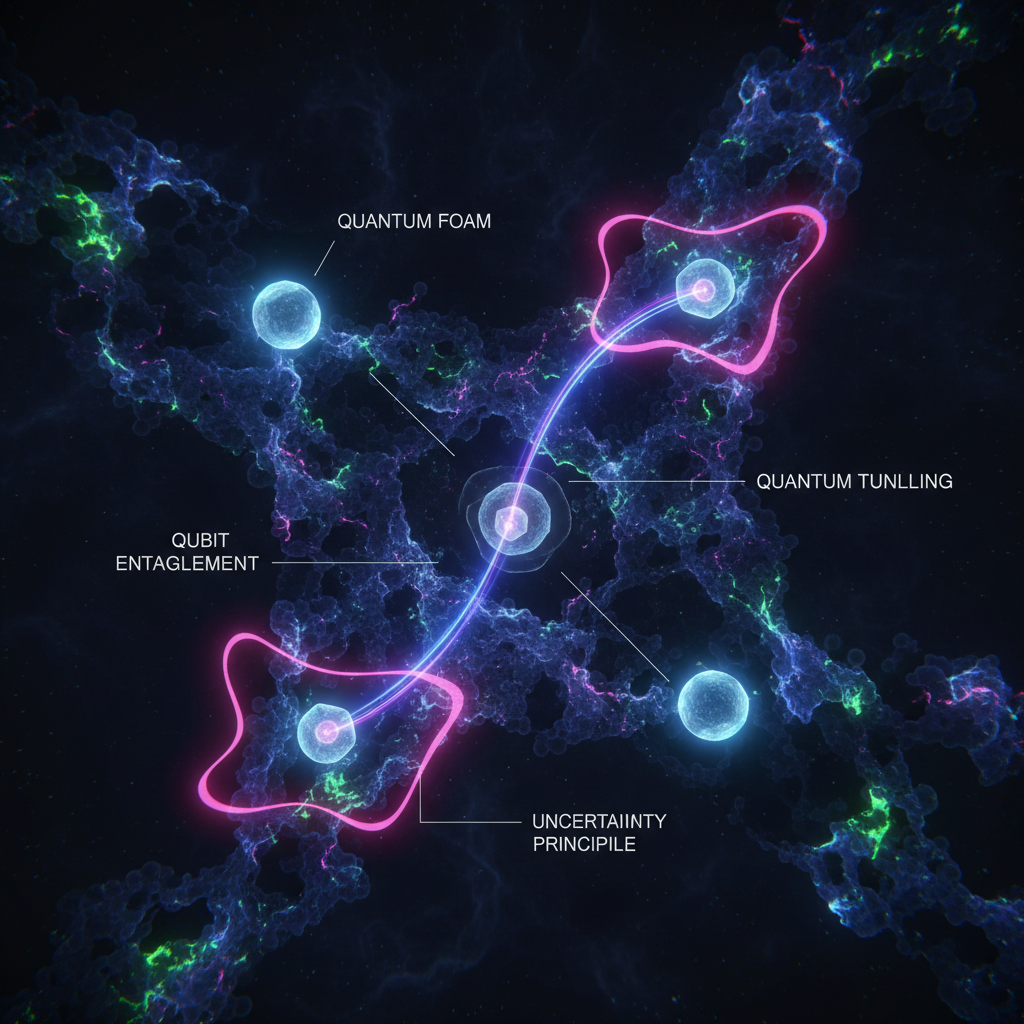
Quantum foam exists because of Heisenberg's uncertainty principle. At tiny scales, you can't pin down both position and momentum simultaneously. The smaller the space, the more violent the energy fluctuations. The vacuum isn't empty—it's a roiling sea of possibility, where particle-antiparticle pairs spontaneously emerge from nothing, exist for a fraction of a second, then annihilate back into the void.
These fluctuations are real. They create measurable effects like the Casimir force and Lamb shift. The universe is fundamentally unstable at its smallest scales. Smooth spacetime is just an illusion that emerges when you zoom out.
The math is brutal: the Planck time is 10⁻⁴³ seconds. Below that threshold, our equations break down. Time itself becomes granular, pixelated. Cause and effect lose meaning. Everything is probability and foam.
Your Attention as Quantum Foam
Now zoom out to your screen. You're scrolling, but not really reading. A notification bubble appears—a virtual particle of information. You look at it. It collapses into something: an email, a like, a message. Then it annihilates back into the feed. Gone in seconds.
Another bubble. Another collapse. Your attention has been subdivided down to its Planck length—the smallest possible unit of conscious engagement before meaning itself breaks down. The surveillance economy has found this scale and exploited it.
Every app is an uncertainty principle engine. You can't know both what you're looking at and why you're looking at it. Position or momentum. Content or intent. The platforms have engineered quantum foam into your consciousness—a seething probabilistic state where your attention constantly fluctuates between potential targets, never settling, never still.
Smooth, coherent thought is the illusion now. The reality is froth. Bubbles of micro-attention appearing and disappearing faster than you can track. Each one measured, logged, fed into the algorithm that predicts which bubble will appear next.
Virtual Particles, Virtual Presence
In quantum field theory, virtual particles are real enough to have effects but don't exist long enough to be directly observed. They're borrowed from the vacuum, existing on credit from the uncertainty principle, always in debt to entropy.
Your digital presence works the same way. Every interaction is a virtual particle—a like, a view, a click. It appears, creates an effect (data for the algorithm, a dopamine hit for you), then vanishes into the feed's infinite scroll. These interactions are real enough to shape your behavior, to train the model of you that exists in the server farms, but they're gone before you can examine them.
You're living on borrowed attention, constantly in debt to the platforms. Each notification is energy borrowed from the uncertainty of your day. Each scroll is momentum stolen from your intention. The foam churns, and you churn with it.
The Casimir Effect of Social Media
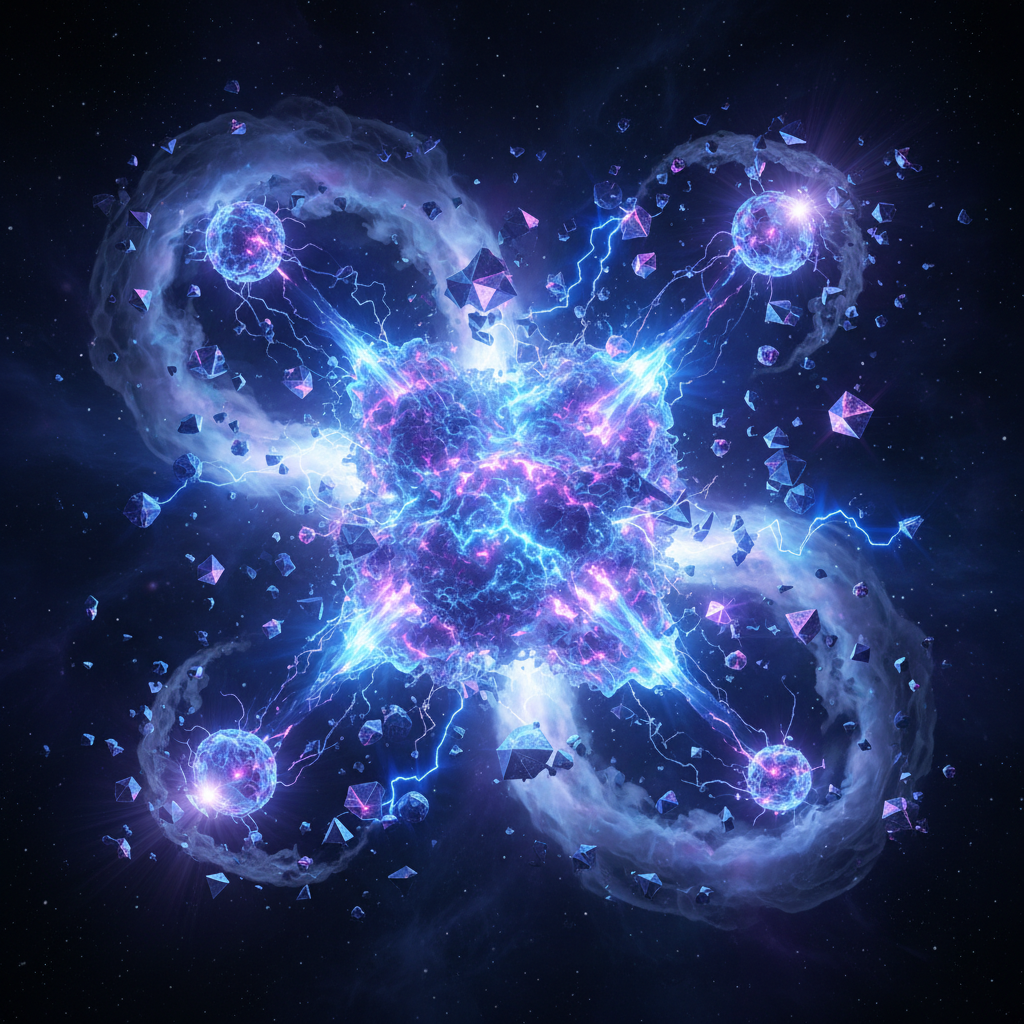
Place two metal plates very close together in a vacuum. The quantum foam between them becomes constrained—certain wavelengths of virtual particles can't fit in the gap. Outside the plates, all wavelengths exist. This creates a pressure differential. The plates are pushed together by nothing. By the absence of foam.
This is the Casimir effect. It's measurable. Real force from virtual particles.
Social media platforms are Casimir plates for your mind. They constrain the wavelengths of thought that can exist in the gap—the space between your authentic self and your performed self. Only certain frequencies fit: outrage, affirmation, tribal signaling, aesthetic perfection. The full spectrum of human experience gets filtered down to what can survive in the narrow space between the feed and your profile.
The pressure is real. You feel it. The force pushing you to conform, to post, to engage in the acceptable wavelengths. It's generated by what's missing—all the thoughts and feelings that can't fit in the algorithmic gap.
Smooth Spacetime Requires Distance
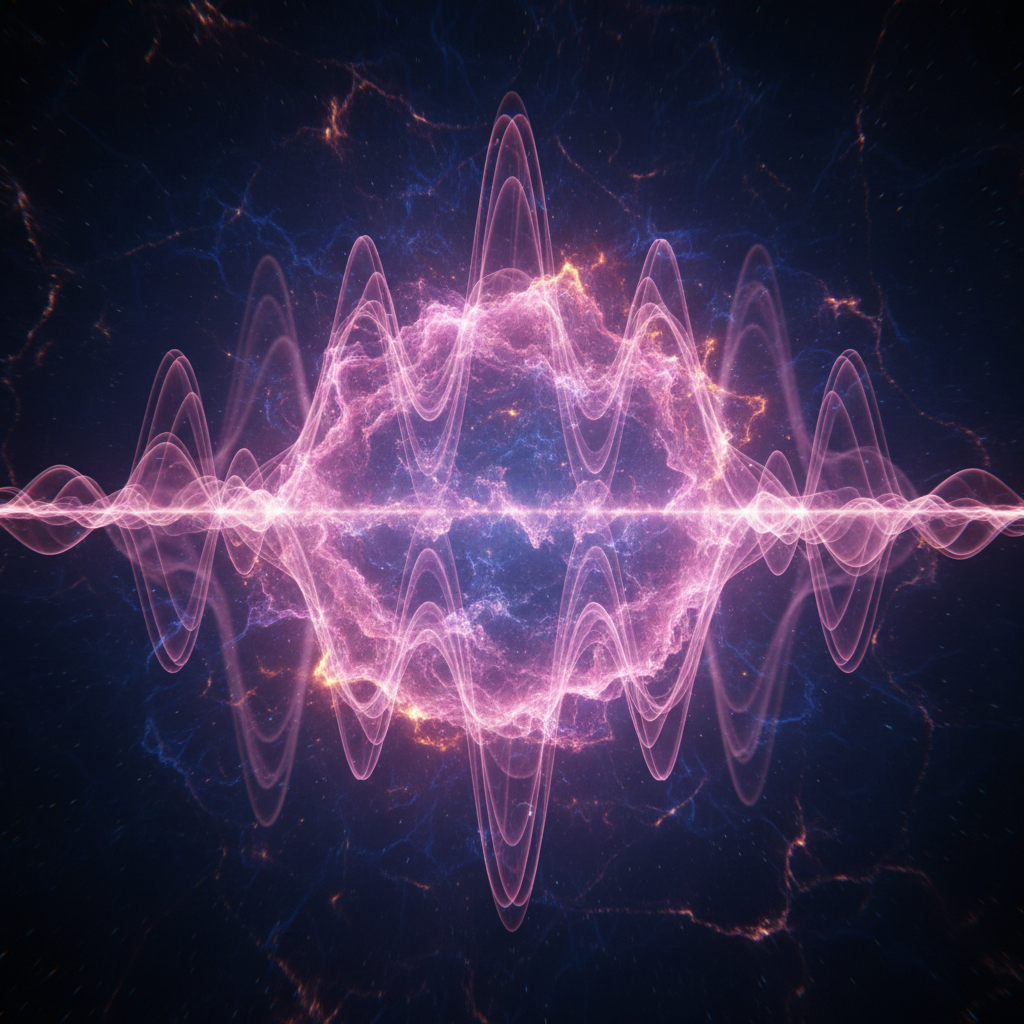
Here's the thing about quantum foam: it averages out. Zoom out from the Planck scale and the chaos smooths into the spacetime Einstein described. The foam is always there, always churning, but at human scales it becomes a stable background. Predictable. Navigable.
You need distance to see clearly. You need to zoom out from the Planck length of your attention—the microsecond-by-microsecond fluctuations the algorithm induces—to recover coherent thought. Smooth consciousness requires you to step back from the scale where every quantum of attention is being measured and monetized.
The surveillance economy wants you at the foam level. It wants your attention granular, uncertain, constantly collapsing into measurable states. Because at that scale, you're predictable. Your behavior becomes quantum mechanics—probabilistic but calculable. The wave function of your next click can be predicted with terrifying accuracy.
But you are not a particle. You are not foam. You are the emergent phenomenon that appears when you zoom out. When you give your attention time and space to cohere into something larger than the sum of its quantum fluctuations.
Escape Velocity from the Foam
The Planck length is where physics breaks down. Below it, our equations fail. We don't know what's really happening. We just know it's not the smooth reality we experience.
There's a Planck length for your attention too—a scale below which your consciousness stops being yours. Where you become pure reaction, pure stimulus-response, pure data. The platforms have found this length and built their empires there.
But spacetime doesn't stay at the Planck scale. It expands. It smooths. It becomes navigable. You can do the same. Turn off the notifications. Close the apps. Let the foam settle. Give your attention room to stop being quantum and start being coherent again.
The universe found a way to emerge from quantum foam into something stable and structured. So can you. The question is whether you'll do it before the algorithm learns to predict every bubble of your consciousness before it even appears.
The foam is always there. But you don't have to live in it.
<em>Data emitted: 1100db</em>
Data emitted: 1,100 words • 6.5KB • 5-minute read