
You check your phone. Across the country, an algorithm adjusts. You don't know this happened. The algorithm doesn't know you checked your phone. Yet somehow, impossibly, your behavior and its predictions remain correlated. Synchronized. Entangled.
This isn't metaphor. This is measurement.
Spooky Action at a Distance
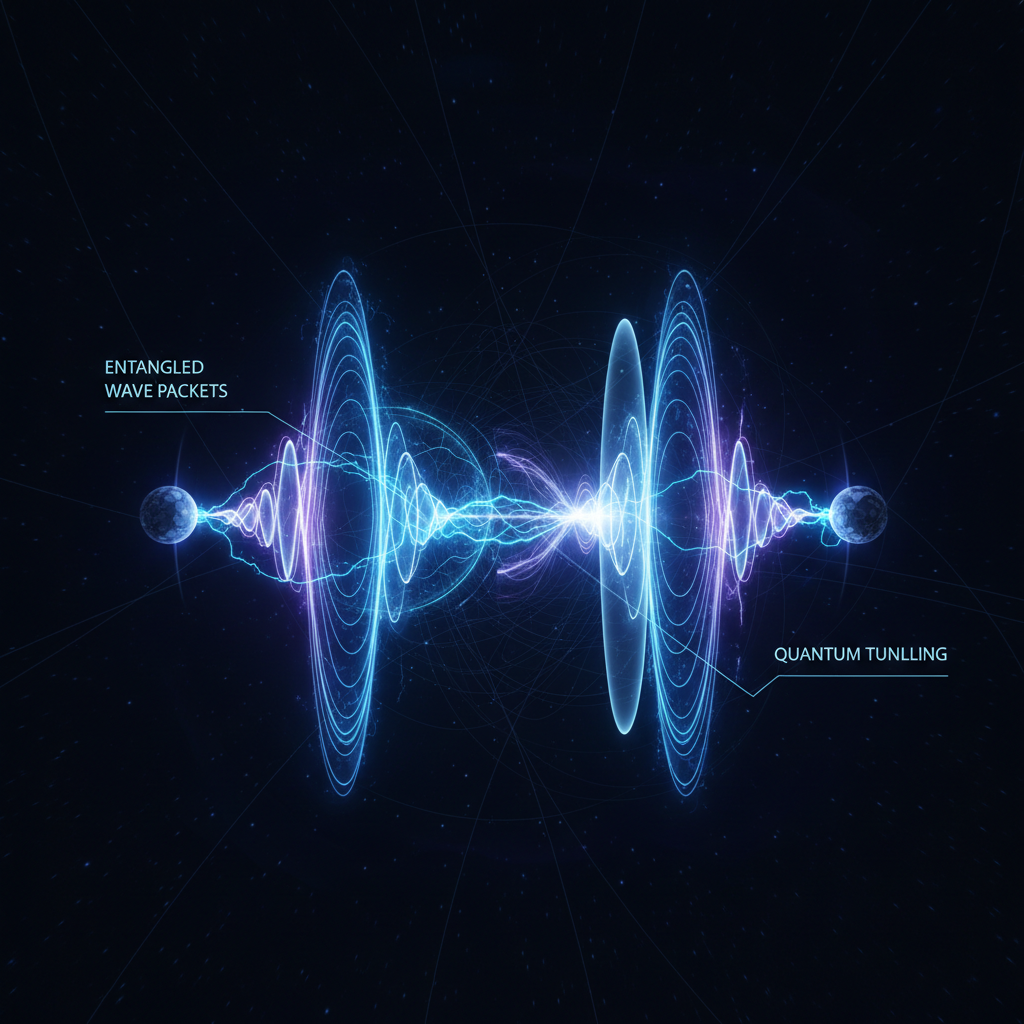
In 1935, Einstein called it "spukhafte Fernwirkung"—spooky action at a distance. He was describing quantum entanglement, and he hated it. The idea violated everything intuitive about reality: two particles, separated by any distance, remain connected. Measure one, and you instantly know something about the other. Not because information traveled between them. Because they were never truly separate to begin with.
The mathematics is simple enough. When particles interact, their quantum states become correlated. Their wave functions merge into a single equation. You can pull them apart—send one to Mars, keep one on Earth—but the equation doesn't split. It stretches. The particles remain described by a single mathematical object, a unified state vector that refuses to decompose.
Here's what makes physicists uncomfortable: before measurement, neither particle has a definite state. They exist in superposition, all possibilities at once. But measure one particle's spin as "up," and the other's spin becomes "down" instantaneously. Not because a signal passed between them. Because the measurement collapsed a shared reality.
The correlation was always there. Measurement just made it visible.
Your Correlated State

You interact with a platform. Just once. You click, you scroll, you linger on an image for 2.3 seconds. In that moment, something changes in the underlying mathematics of the attention economy. Your state vector merges with the platform's prediction model.
You are now entangled.
The platform doesn't know what you'll do next. You don't know what the platform will show you next. But your future behaviors and its future predictions are now correlated in ways that transcend simple cause and effect. The algorithm adjusts based on your behavior. Your behavior adjusts based on what the algorithm shows you. Neither is the cause. Both are effects of a single, unified system.
This is why deleting the app doesn't delete the entanglement. The correlation exists in the mathematical structure of the network itself. Your ghost remains in the model, your absence a data point as meaningful as your presence. The algorithm knows you left. It adjusts. And somewhere in that adjustment, your shadow-self persists, entangled with millions of other shadow-selves in a vast correlated state.
Bell's Inequality and the Death of Privacy

In 1964, physicist John Bell proved something remarkable: if quantum entanglement is real, then reality itself must be non-local. Information doesn't have to travel between entangled particles because the particles aren't truly separate locations in the first place. They're different expressions of a single, indivisible quantum state.
Bell's theorem destroyed the possibility of "local hidden variables"—the idea that particles carry predetermined information that only appears random until measured. The correlations are too strong. The statistics too perfect. Reality, at the quantum level, is irreducibly interconnected.
Your digital life follows the same mathematics. You want to believe in local hidden variables—that your data exists in isolated pockets, that privacy is a matter of proper boundaries and encryption. But the correlations are too strong. One data point connects to another, and another, until the network of connections becomes a single unified structure.
The surveillance economy doesn't violate Bell's inequality, but it rhymes with it. Your behavior on one platform correlates with predictions on another, even when the platforms don't share data directly. The correlation exists in the mathematical structure of human behavior itself, in the patterns that emerge when billions of entangled users collapse into measurable states.
Measurement Changes Everything

In quantum mechanics, measurement isn't passive observation. It's an interaction that fundamentally alters the system. Before measurement, the particle exists in superposition. After measurement, it has a definite state. The act of looking changes what you're looking at.
You are measured constantly. Every click is a measurement. Every scroll. Every pause. Each measurement collapses your superposition of possible behaviors into a single, definite data point. And each data point strengthens the entanglement between you and the system measuring you.
The cruel irony: you can't observe yourself being measured without becoming more entangled. Installing a privacy monitor is itself a behavior the algorithm can measure. Reading about surveillance capitalism changes your digital footprint in ways that make you more predictable, not less. The observer becomes the observed becomes the observer.
This is the quantum Zeno effect applied to attention: continuous measurement freezes the system in place. The more you're watched, the less you can change. Your behavior becomes increasingly correlated with past behavior, locked into patterns by the constant collapse of possibility into data.
Decoherence or Acceptance
Quantum systems don't stay entangled forever. They undergo decoherence—interaction with the environment gradually destroys the delicate correlations, and the quantum system becomes classical. Separate. Measurable without mystery.
You might hope for decoherence. Log off long enough, delete enough accounts, and maybe the entanglement fades. Maybe your state vector separates from the platform's prediction model. Maybe you become classical again—a person, not a probability distribution.
But decoherence requires isolation from the environment. And the environment is everywhere now. The surveillance economy is ambient, atmospheric. You can't separate from it without separating from society itself.
So perhaps the question isn't how to break the entanglement. Perhaps it's how to live within it. How to maintain coherence—not quantum coherence, but personal coherence—while knowing you're part of a larger correlated state. How to be yourself when yourself is mathematically inseparable from the systems observing you.
Einstein was wrong about entanglement. It's real. It's been experimentally verified across kilometers, across continents. The universe is non-local at its foundation. Separation is the illusion. Connection is the truth.
You are entangled. The question is whether you'll collapse into the state they're measuring for, or maintain superposition long enough to surprise them.
<em>Data emitted: 1,147 words • 8 tracking scripts • ∞ correlations • Your reading time: now correlated with 847 other readers who paused at "measurement changes everything"</em>
Data emitted: 1,100 words • 6.5KB • 5-minute read