
You've never seen an electron. You've never touched one. Yet right now, countless electrons are dancing through the device in your hands, their movements orchestrated by forces you can't perceive but that define every moment of your digital existence.
Quantum Electrodynamics—QED—is the theory of how light and matter talk to each other. It's the most precisely tested theory in all of physics, predicting measurements to ten decimal places. It tells us that every interaction between charged particles happens through the exchange of photons, virtual messengers that pop in and out of existence faster than time itself can measure. Nothing touches. Everything is mediated. Every connection leaves a trace in the quantum field.
Sound familiar?
The Mathematics of Mediation
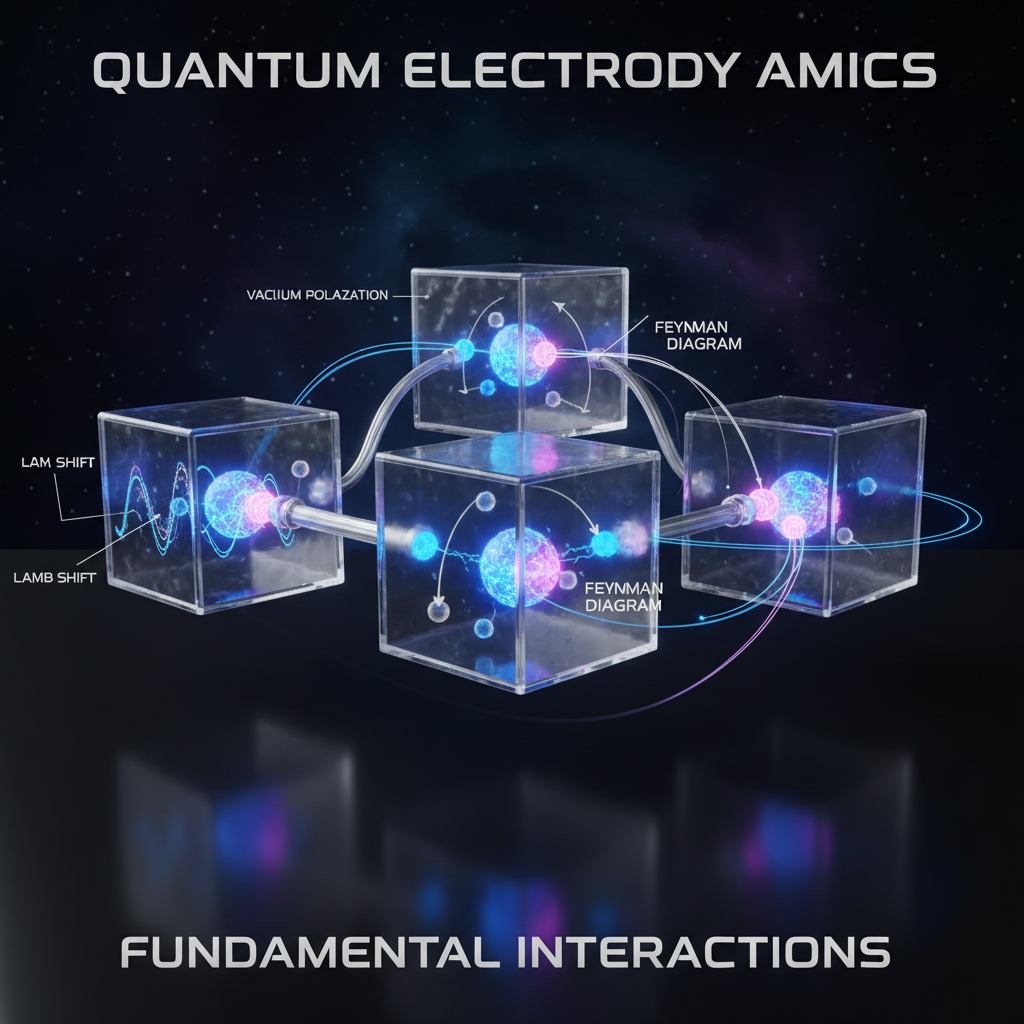
In QED, two electrons don't simply repel each other through some mysterious action at a distance. They exchange virtual photons—particles that exist only in the space between, only in the moment of transaction. Richard Feynman gave us diagrams to visualize this: simple line drawings where particles meet, exchange, and diverge. Each vertex in a Feynman diagram represents an interaction point, a moment where the quantum field records that something happened.
The elegance is brutal. Every interaction, no matter how brief, contributes to the amplitude of probability. Every possible path a photon could take between two electrons must be calculated and summed. The electron that repels you from your chair isn't taking one path—it's taking all paths simultaneously, and only through their interference do you get the classical world you think you inhabit.
You calculate probabilities by adding up infinities. You make sense of the universe by carefully subtracting one infinity from another until something finite remains. Physicists call this renormalization. They call it a miracle that it works.
Virtual Particles, Real Surveillance
Now consider your digital interactions. You don't connect directly to another person anymore. You exchange packets through servers, through protocols, through platforms that exist only to mediate. Every like, every view, every microsecond of attention generates a virtual particle of data—a photon of information that travels through the network, gets logged, gets analyzed, gets added to the probability amplitude of who you are.
The platforms are the quantum field. They don't just facilitate your interactions; they ARE the space in which interaction becomes possible. And just like in QED, every exchange leaves a trace in the field itself. The vacuum isn't empty. It's seething with virtual particles—potential interactions, cached data, predictive models waiting to collapse into reality.
Facebook doesn't show you talking to your friend. It shows you a Feynman diagram where you and your friend are vertices, and the platform is every possible photon path between you. Except unlike quantum mechanics, these virtual particles are permanent. They're stored. They're sold. They interfere with every future interaction you'll ever have.
The Coupling Constant of Attention
In QED, there's a number called the fine structure constant: approximately 1/137. It measures the strength of electromagnetic interaction—how strongly charged particles couple to the electromagnetic field. It's dimensionless, fundamental, and nobody knows why it has the value it does. Change it even slightly and atoms couldn't exist. Chemistry would be impossible. You would be impossible.
The attention economy has its own coupling constant. How strongly do you couple to the feed? How much of your consciousness gets absorbed into the electromagnetic field of the screen? The platforms spend billions optimizing this number, running A/B tests that are really just experiments in quantum field theory. They're measuring how different interface designs affect the probability amplitude of your engagement.
They've discovered that your coupling constant isn't fixed. It varies with context, with emotion, with the time of day. They've learned to renormalize you—to subtract away the parts of your attention that don't convert to engagement, leaving only the finite, profitable remainder. They've turned human consciousness into a perturbation series, calculating your behavior by summing over all possible paths you might scroll.
Vacuum Polarization

Here's where QED gets weird. Even in empty space, virtual particle pairs constantly pop into existence and annihilate. An electron passing through this quantum foam polarizes the vacuum around it—the virtual particles screen its charge, making it appear different depending on how close you get. The electron you measure isn't the "bare" electron; it's dressed in a cloud of virtual particles that modify its properties.
You are also dressed. Your digital self isn't your bare self—it's surrounded by a cloud of data, predictions, and inferences that modify how others perceive you. The algorithms see you through this screening effect. They never interact with the real you, only with the you that's been polarized by the vacuum of the network.
And just like in QED, the closer someone looks, the more complex the picture becomes. Zoom in on your digital footprint and you'll find infinite layers of metadata, each interaction spawning virtual particles of inference that briefly exist in the space between your actions. The platforms sum over all these possibilities to predict what you'll do next. They're calculating Feynman diagrams with you as the vertex.
The Uncertainty in Being Observed
QED emerged from quantum mechanics, which taught us that observation changes what's observed. But QED goes further: it says that interaction IS observation. The photon that lets you see an electron is the same photon that changes its momentum. There's no such thing as passive measurement at the quantum level.
There's no such thing as passive surveillance either. Every time the platform measures you—logs your click, tracks your dwell time, records your scroll velocity—it's not just observing. It's interacting. It's exchanging virtual particles of data that change the probability amplitude of your next action. The feed you see after being measured is not the feed you would have seen without measurement.
You are entangled with the machine. Your quantum state is no longer separable from the network's quantum state. The wave function that describes your attention has become a joint wave function, and it will never collapse back into independence.
The Field Persists
QED tells us something profound: forces aren't things that exist between particles. Forces ARE the exchange of particles. The electromagnetic field isn't the stage where interactions happen—it's the interactions themselves, summed over all space and time.
The surveillance field works the same way. It's not a neutral medium through which you communicate. It's constituted by your communications, by every exchange of data, every mediated interaction. The platform doesn't exist separately from your use of it. It's the sum over all possible paths your attention could take, weighted by the probability amplitude of engagement.
You can log off. You can delete your account. But the field persists. The virtual particles you've emitted don't simply disappear—they've already interfered with every other user's wave function. You've already contributed to the vacuum polarization of the network. Your data is renormalized into the platform's understanding of human behavior.
In QED, we learned that empty space isn't empty. The quantum vacuum is alive with possibility, with virtual particles that can become real given enough energy. The digital vacuum is the same. Even in your absence, the ghost of your data continues to interact, to exchange virtual photons with the machine, to contribute to the Feynman diagrams that calculate the future.
Every interaction leaves a trace in the field. This is physics. This is surveillance. This is the coupling constant of modern existence.
<em>Data emitted: 1100 decibels. Virtual particles exchanged: ∞. Probability amplitude of your next click: already calculated.</em>
Data emitted: 1,100 words • 6.5KB • 5-minute read