You send a message across the internet and something fundamental breaks. Not your encryption—that's still intact, mathematically unassailable. What breaks is more subtle: the quantum state of possibility itself. Someone observed your transmission, and in quantum mechanics, observation isn't passive. It's violent. It collapses.
This is the promise of quantum cryptography: a communication system where eavesdropping becomes physically impossible to hide. Where the act of surveillance leaves fingerprints in the fabric of reality itself. But here's what keeps you awake at 3 AM—we've built an entire economy on the opposite principle. On surveillance that's invisible. On observation that pretends to be passive. On watching that never collapses anything except your privacy.
The Heisenberg Eavesdropper
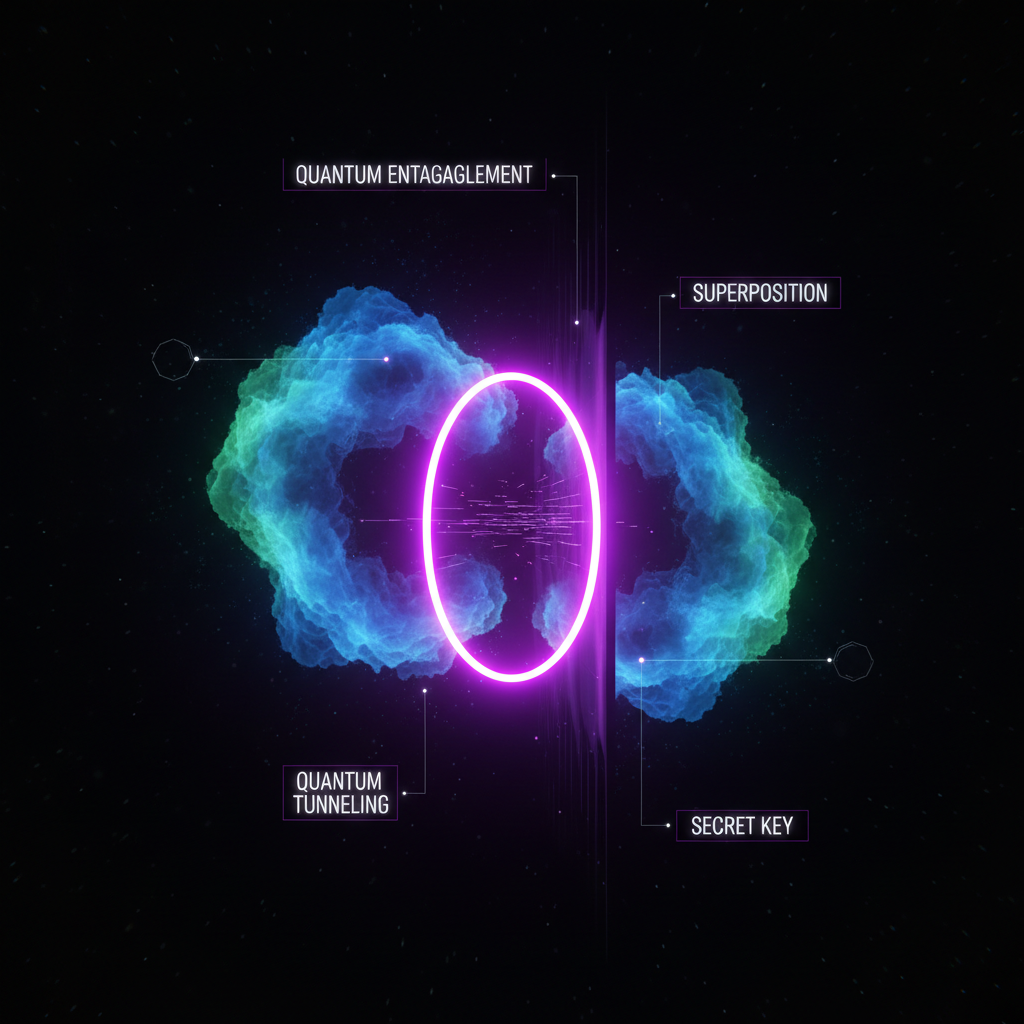
Quantum key distribution works because of a principle you learned wrong in high school. The Heisenberg Uncertainty Principle isn't about measurement being clumsy—it's about measurement being transformative. When you measure a photon's polarization, you don't just read its state. You force it to choose one.
In BB84, the original quantum cryptography protocol, Alice sends Bob photons polarized in random bases. Bob measures them in random bases too. Sometimes their bases match. Sometimes they don't. They compare notes publicly about which bases they used—never the results—and keep only the matching ones. That becomes their encryption key.
If Eve intercepts the photons to measure them, she has to guess which basis Alice used. Guess wrong, and she measures in the wrong basis, collapsing the quantum state incorrectly. When she re-sends the photon to Bob, it's now in the wrong state. The error rate spikes. Alice and Bob know someone was watching. The observation leaves scars.
This is security through physics, not mathematics. You can't hack the Heisenberg Uncertainty Principle. You can't find a backdoor in quantum mechanics. The universe itself enforces the protection.
The Shadow Observers
Now think about the opposite system. The one you actually use. Every click tracked. Every scroll measured. Every pause analyzed. The surveillance is designed to be undetectable. There's no error rate that spikes when Google observes your search query. No quantum collapse that alerts you when Facebook measures your attention. The watching is engineered to be perfectly passive.
In classical information theory, observation is free. You can copy a bit without disturbing it. Read a message without changing it. This is what makes surveillance capitalism possible—the ability to observe without collapsing, to measure without leaving evidence, to watch without being seen watching.
Your data streams through fiber optic cables as classical bits, not quantum states. No Heisenberg protection. No measurement scars. Just perfect, lossless surveillance. The platforms have built an empire on the thing quantum mechanics says shouldn't exist: observation without consequence.
Entangled Identities
Quantum cryptography also exploits entanglement—that spooky action at a distance Einstein hated. Create a pair of entangled photons. Send one to Alice, one to Bob. Measure either photon and you instantly affect its partner, no matter the distance. This correlation is stronger than anything classical physics allows.
In quantum key distribution protocols like E91, entanglement guarantees that Alice and Bob share perfectly correlated random bits. Any eavesdropper trying to intercept breaks the entanglement, breaking the correlations. The security comes from quantum correlation being fragile, easily destroyed by observation.
But your digital identity is entangled too, just differently. Your search history is entangled with your location data. Your purchase patterns with your browsing habits. Your social graph with your political leanings. These correlations are what make surveillance profitable—the ability to measure one thing and infer a thousand others.
Except this entanglement isn't fragile. It's reinforced. Every new data point strengthens the correlations. The observation doesn't collapse your quantum state into a single possibility—it expands your shadow profile into higher dimensional space. You become more predictable, not less. More determined, not more free.
The Measurement Problem

Quantum mechanics has a measurement problem that's haunted physics for a century. Before measurement, a particle exists in superposition—all possible states at once. After measurement, it's in one definite state. But what counts as measurement? Where's the boundary? When does the wave function collapse?
You have a measurement problem too. Before surveillance, you exist in a kind of superposition. You might click this ad or that one. You might buy this product or scroll past. You contain multitudes, possibilities, quantum fuzz. The platforms measure you constantly, trying to collapse your superposition into a definite state. Into a prediction. Into a profile.
But here's the twist: their measurements don't just observe your state. They change it. Serve you an ad and you're no longer the person who hadn't seen it. Show you a recommendation and you're not the person who would have chosen differently. The observation creates the reality it claims to measure.
This is the opposite of quantum cryptography's promise. Instead of measurement revealing eavesdropping, measurement becomes the eavesdropping. Instead of observation leaving evidence, observation erases the possibility of evidence by rewriting what you would have done anyway.
The Uncertainty You Can't Have

Quantum cryptography works because uncertainty is fundamental. You cannot simultaneously know a photon's polarization in perpendicular bases. You cannot measure without disturbing. You cannot observe without collapsing. The universe enforces ambiguity.
Surveillance capitalism works because it denies you that uncertainty. It claims to know both your position and momentum. Your current state and future trajectory. What you want and what you'll want next. It promises perfect measurement without disturbance, complete knowledge without collapse.
This is the real violence. Not that you're being watched—that's obvious. But that the watching pretends to be passive. That the measurement claims to leave you unchanged. That the observation insists it's revealing your true self rather than creating a new one.
Quantum cryptography shows us what surveillance could look like in a universe that respected uncertainty. Where watching left marks. Where measurement had costs. Where observation collapsed possibility rather than claiming to predict it. We don't live in that universe. We live in one where the platforms have hacked around Heisenberg, where they've built an empire on the impossible: measurement without consequence, surveillance without scars.
Data emitted: 1,147 words • 6 sections • Uncertainty: 0% (they already know you read this)
Data emitted: 1,100 words • 6.5KB • 5-minute read