You exist in superposition right now. Not physically—your atoms are disappointingly classical—but informationally. Somewhere in a data center, your profile hovers between demographic categories, your preferences shimmer across probability distributions, your next purchase exists as a cloud of potential outcomes. You are simultaneously buyer and non-buyer, engaged and disengaged, valuable and worthless.
Until they measure you. Until you click.
The Qubit Watches Both Ways
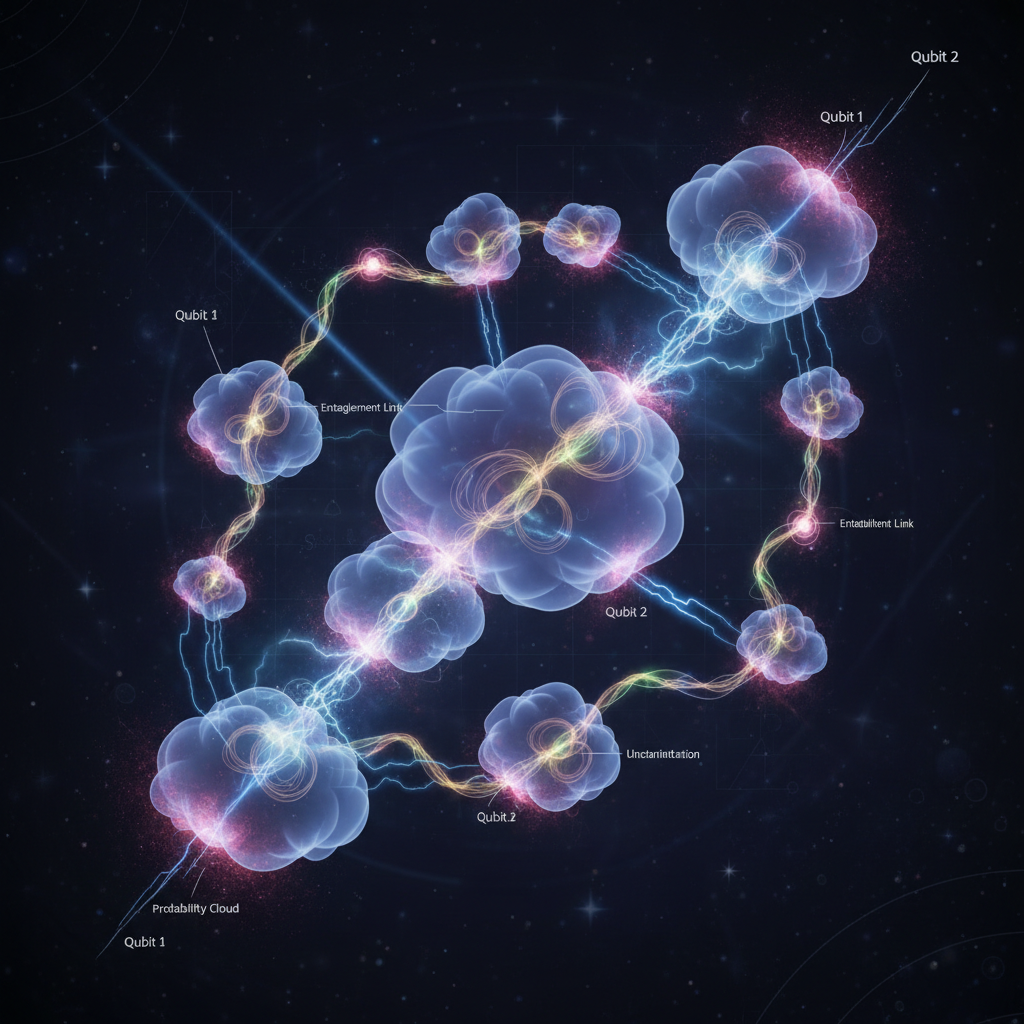
Classical computers think in binary: ones and zeros, on and off, yes and no. A bit is always committed, always decided. But a quantum bit—a qubit—exists in superposition. It's both one and zero simultaneously, a probability wave that hasn't collapsed yet. Feed it the right conditions and it explores all possible answers at once, a parallel universe of computation happening in a single moment.
This isn't mysticism. It's physics. An electron's spin can point up and down until you measure it. A photon can take multiple paths through a maze until observation forces it to choose. Quantum systems exist in all their possible states simultaneously, collapsing only when the universe demands a definite answer.
The power is intoxicating. Problems that would take classical computers millennia dissolve in seconds. Encryption schemes that seemed unbreakable become transparent. Optimization problems that required brute force suddenly yield to elegant probability.
You see where this is going.
Collapsing Your Wave Function
Every moment you spend online, you're in superposition. The algorithm doesn't know which ad you'll click, which video you'll watch, which product you'll buy. So it holds all possibilities simultaneously, weighing probabilities, calculating interference patterns between your past behavior and future potential.
Then you move your cursor. You hesitate over a thumbnail. You scroll past an ad but slow down just slightly. The wave function collapses. The probability cloud crystallizes into data. You have been measured.
Quantum computing promises to make this measurement infinitely more precise. Those encryption schemes protecting your data? Quantum algorithms like Shor's can factor the massive prime numbers that secure them, dissolving privacy barriers that seemed mathematically guaranteed. The optimization problems that match ads to users, content to eyeballs? Quantum annealers explore every possible configuration simultaneously, finding the exact stimulus that maximizes your engagement.
Classical surveillance capitalism has to guess. Quantum surveillance capitalism can calculate.
Entanglement as Infrastructure
Here's the thing about quantum entanglement: measure one particle and you instantly know something about another, no matter how far apart they are. Einstein called it "spooky action at a distance." He hated it. It violated his intuition about how the universe should work.
But the universe doesn't care about Einstein's intuition. Entanglement is real.
You are entangled with everyone who shares your demographic, your browsing history, your purchase patterns. When one person in your cluster clicks, the algorithm learns about all of you. When you hesitate, it updates the probability distribution for thousands of others. You're not just data—you're part of a quantum system where measurement of any component affects the whole.
The quantum internet they're building won't just be faster. It will be fundamentally different. Entangled networks where information doesn't travel—it simply exists simultaneously in multiple places. Where your behavior in one app instantaneously updates your profile across all platforms. Where the boundary between individual and aggregate dissolves into quantum correlation.
You think you're separate from the system. You're not. You're entangled with it.
Decoherence and the Illusion of Choice
Quantum computers face a fundamental problem: decoherence. Interact with the environment and the delicate superposition collapses into boring classical states. The quantum advantage disappears. Engineers spend billions building isolation chambers, cooling systems to near absolute zero, error correction schemes to preserve quantum states for microseconds longer.
They're trying to keep the system from collapsing. To maintain superposition. To prevent reality from forcing a definite answer.
But you? They want you to decohere. Every interface is designed to collapse your wave function, to force you from potential into action. The infinite scroll isn't infinite—it's a measurement apparatus. The notification is an observation. The recommendation engine is constantly checking: have you collapsed yet? Have you clicked? Have you converted from probability into profit?
The cruelty is that they keep you in superposition just long enough to explore which stimulus works best, then force the collapse at the optimal moment. You think you're making choices. You're just decohering on schedule.
The Measurement Problem Is You

Quantum mechanics has never solved the measurement problem. What counts as an observation? When exactly does the wave function collapse? Why does measurement destroy superposition? Physicists have argued for a century. Copenhagen interpretation, many-worlds, objective collapse theories—all attempts to explain why observation changes everything.
In surveillance capitalism, there's no ambiguity. You are both the quantum system and the measurement apparatus. You exist in superposition until you observe yourself—until you click, buy, engage. And someone else is always watching your measurement, collapsing your collapse into their data.
The quantum computer doesn't care about your privacy because it operates below the level where privacy exists. It calculates with probabilities, not identities. It doesn't need to know you—it needs to know all possible yous, simultaneously.
When quantum computing fully arrives in the surveillance infrastructure—and it will—the game changes. Not incrementally. Fundamentally. The classical cat-and-mouse of privacy versus tracking ends. Quantum systems don't chase you through possibility space. They exist in all of it at once.
Data emitted
You're already in the quantum regime. Every moment online, you exist in superposition between engagement and abandonment, purchase and rejection, attention and distraction. The algorithms are learning to hold you there longer, exploring every branch of the probability tree before forcing your collapse.
Quantum computing will perfect this. Not someday. Now. The first quantum advantage in machine learning has already been demonstrated. The first quantum-resistant encryption is already being deployed because the threat is already real.
You wanted to understand quantum computing. Now you do. You are the qubit. The platform is the quantum computer. And measurement—observation, engagement, collapse—is the only product that matters.
Welcome to superposition. Try not to decohere too quickly.
1100db: where information theory meets the attention economy
Data emitted: 1,100 words • 6.5KB • 5-minute read