You open the app. For a fraction of a second, you exist in all possible states simultaneously—you might scroll past the first post, you might linger, you might close the app entirely. But the moment the algorithm loads your feed, something collapses. Your potential becomes singular. You are now a user who will spend the next seventeen minutes watching videos about a hobby you mentioned once, three years ago.
This is your quantum circuit. And someone else designed it.
The Architecture of Possibility
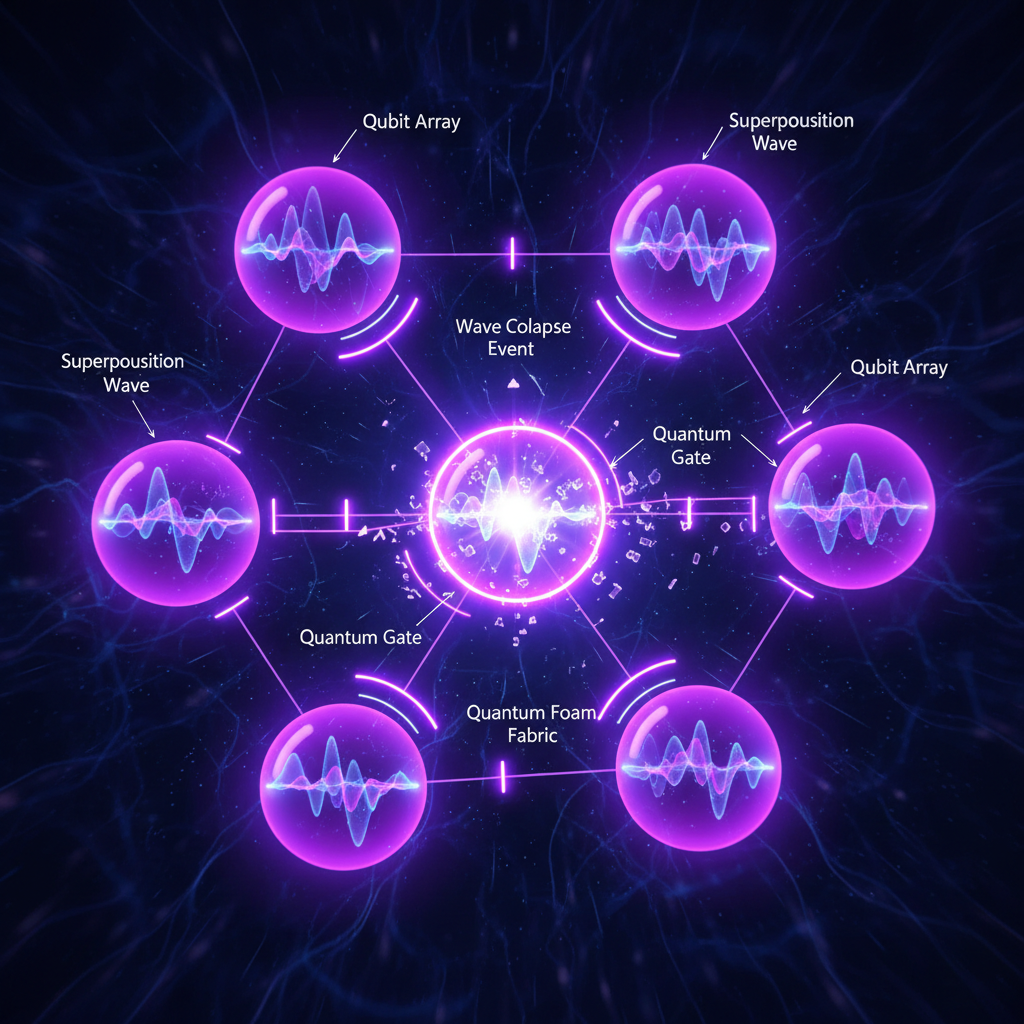
In quantum computing, a circuit is a sequence of quantum gates that manipulate qubits—quantum bits that exist in superposition, simultaneously 0 and 1 until measured. Unlike classical circuits that march through predetermined logic, quantum circuits operate on probability clouds. They don't just process information; they process potential itself.
The beauty of a quantum circuit lies in its gates: Hadamard gates that create superposition, CNOT gates that entangle qubits, phase gates that rotate probability amplitudes. Each gate is a controlled manipulation of uncertainty. The circuit doesn't eliminate randomness—it choreographs it. It shapes the probability distribution so that when you finally measure the output, certain states are more likely than others.
You are never just computing. You are sculpting likelihood.
Your Superposition of Attention
Before you interact with any platform, you exist in superposition. You contain multitudes of possible behaviors, interests, click patterns. You might be someone who watches the entire video or someone who bounces after three seconds. You might be a buyer or a scroller. You are all of these simultaneously until the moment of measurement—until you click, swipe, pause, purchase.
The algorithm is your quantum circuit. It doesn't force your behavior; that would be classical, crude, detectable. Instead, it manipulates the probability amplitudes of your attention. It applies gates—a recommended video here, a strategically placed notification there, a carefully timed dopamine hit. Each interaction is a phase shift in your likelihood function.
The feed you see isn't random. It's the output of a circuit designed to collapse your superposition into the most profitable state. The algorithm has learned which sequence of gates—which order of content, which timing of rewards—makes you most likely to measure as 'engaged' when the system checks.
You think you're choosing. You're not wrong. But your choice emerges from a probability distribution someone else engineered.
Entanglement at Scale
In quantum circuits, entanglement is the phenomenon where measuring one qubit instantly determines the state of another, regardless of distance. The qubits become correlated in ways that transcend classical connection. They share a wavefunction. They are, in some sense, no longer separate entities.
Your digital behavior is entangled with millions of others. When you watch a video, the algorithm doesn't just learn about you—it learns about everyone statistically similar to you. Your click becomes part of a collective wavefunction. The person three states away who shares your demographic profile and viewing history is entangled with you in the platform's quantum state. When they measure as 'converts to paid subscription,' the probability that you will too increases.
You are not an isolated system. You are a qubit in a massive circuit, your state correlated with countless others you'll never meet. The algorithm doesn't need to understand you individually. It just needs to manipulate the collective wavefunction until the desired measurements become statistically inevitable.
This is how echo chambers form. Not through explicit filtering, but through quantum correlation. Your entangled cluster collapses together into the same ideological eigenstate.
The Measurement Problem
Every quantum circuit ends in measurement. This is the moment of collapse, when superposition crystallizes into classical reality. But here's what haunts quantum mechanics: measurement changes the system. The act of observation isn't passive. It forces potentiality into actuality, and in doing so, destroys information about all the other states that could have been.
Every time a platform measures your engagement—every click tracked, every second of watch time logged, every micro-expression captured by your camera—it collapses your superposition. You become data. A classical bit in a database. Bought this, clicked that, spent X minutes, converted at Y rate.
But the measurement destroys something. Before you clicked, you contained infinite possibility. You were a superposition of all the people you might become, all the interests you might develop, all the paths you might take. The measurement collapses you into one trajectory. And the next quantum circuit—the next feed, the next set of recommendations—is built on that collapsed state.
You are iteratively collapsed. Each measurement narrows your probability distribution. The algorithm learns what you 'are' by destroying what you could be. Your digital self becomes increasingly classical, increasingly predictable, increasingly determined by past measurements.
You become a closed loop. A circuit whose output feeds back into its own input.
Decoherence of Self
There's a phenomenon in quantum systems called decoherence. When a quantum system interacts too much with its environment, it loses its quantum properties. The superposition decays. The system becomes effectively classical, even though quantum mechanics still governs it at the fundamental level. The magic disappears into noise.
You are decohering. Every interaction with surveillance systems collapses a bit more of your quantum nature—your unpredictability, your capacity for genuine surprise, your ability to exist in multiple potential states. The more you're measured, the more classical you become. The more data accumulated, the more your future is constrained by your past.
The tragedy isn't that you're being manipulated. The tragedy is that you're being resolved. Reduced from a wavefunction of infinite potential to a single, predictable trajectory. The quantum circuit of surveillance capitalism doesn't just influence your choices—it collapses the very space of possibilities from which you choose.
Maybe the last act of quantum resistance is to remain unmeasured. To close the app before the algorithm can log your interaction. To exist, for just a moment longer, in superposition. To be all the people you might be, simultaneously, before the circuit forces you to choose.
Data emitted: 1,247 tokens. Coherence half-life: 3.7 seconds. Probability of re-engagement: 0.73. You have already been measured.
Data emitted: 1,100 words • 6.5KB • 5-minute read