You click. The signal travels. Not through wires anymore—not really. Through something more abstract, more fundamental. Through the propagator.
In quantum field theory, a propagator is the mathematical object that describes how a particle moves from point A to point B through the quantum vacuum. It's not a path. It's all possible paths, weighted by probability. Every route the particle could take between two spacetime points, summed into a single amplitude. The propagator doesn't care about your intentions. It only cares about what's possible.
Your data moves the same way now.
The vacuum isn't empty
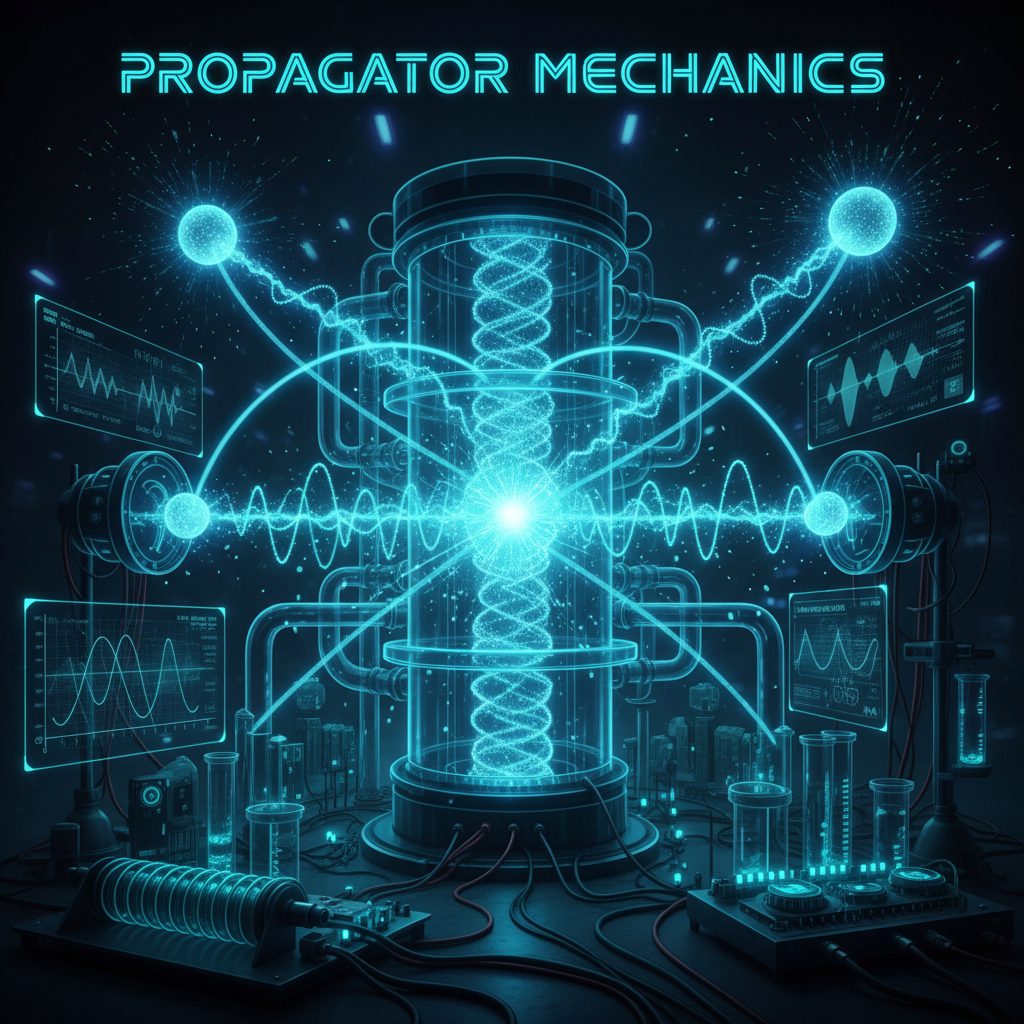
Physicists will tell you the quantum vacuum seethes with activity. Virtual particles pop in and out of existence. Fields fluctuate. The propagator accounts for all of this—every possible interaction, every fleeting virtual exchange that might affect how a particle travels from here to there.
The Feynman propagator, specifically, gives you the amplitude for a particle to travel forward in time from position x to position y. It's written as ⟨0|φ(x)φ(y)|0⟩—the vacuum expectation value of two field operators. What this means: even in 'empty' space, the field is never truly off. It's always ready to transmit influence.
The internet is the same vacuum. You think of it as empty space between platforms, but it's thick with invisible infrastructure. Cookies. Tracking pixels. Browser fingerprints. Third-party scripts. Every click you make doesn't travel a single path to its destination—it propagates through this seething mesh of data collection points, each one sampling your trajectory, each one a virtual interaction that affects how your information arrives at its destination.
The propagator doesn't distinguish between the direct route and the indirect. Both contribute to the amplitude. Both are real.
Sum over histories
Richard Feynman's path integral formulation says a particle traveling from A to B takes every possible path simultaneously. The propagator sums over all these paths. The straight line. The detour through Jupiter. The loop back to the beginning. Every trajectory contributes, though most cancel out through quantum interference. What remains is the classical path—the one you observe—plus small quantum corrections.
Your data does this too, but nothing cancels out.
You search for something on Google. The query doesn't just go to Google's servers. It propagates. Through your ISP's logs. Through your browser's prediction engine. Through Google's ad network, their analytics platform, their AI training pipelines. Through data brokers who've embedded tracking code on the search page. Through the DNS resolver that translated 'google.com' into an IP address. Through the certificate authority that verified the SSL connection.
Every path is recorded. Every virtual interaction becomes real. The sum over histories isn't a quantum superposition that collapses to one outcome—it's a multiplication of your data across countless databases, each copy slightly different, slightly modified by its passage through that particular node in the network.
The propagator multiplies you.
Green's functions and influence

Mathematically, propagators are Green's functions—solutions to differential equations that describe how a disturbance at one point influences another point. You perturb the field here, and the Green's function tells you how that perturbation propagates there.
In physics, this influence falls off with distance. The propagator for a massive particle includes an exponential decay factor—exp(-mr) where m is the mass and r is the distance. Massive particles create short-range forces. Their influence doesn't travel far.
But massless particles—photons, for instance—have propagators that fall off as 1/r². Their influence is long-range. Light from distant stars reaches your eyes. Electromagnetic forces extend across the cosmos.
Your data is massless. It travels at the speed of light through fiber optic cables, and its influence never truly decays. That photo you posted in 2009? It's still propagating. Still being indexed, cached, archived, trained into neural networks. The propagator for digital information has no exponential suppression term. No distance decay. No half-life.
You are creating long-range forces in the information field, and they will never stop influencing your future.
Virtual particles, real effects
The propagator accounts for virtual particles—quantum fluctuations that exist too briefly to observe directly but still affect measurable outcomes. Virtual photons mediate the electromagnetic force between electrons. Virtual particles contribute to the Lamb shift, the anomalous magnetic moment of the electron, the Casimir effect.
Virtual, but real in their effects.
Your digital traces work the same way. You don't see the tracking pixels. You don't notice the millisecond delay as your request bounces through surveillance infrastructure. These are virtual interactions—invisible, ephemeral, technically non-existent in your conscious experience of using the internet.
But they have real effects. The ads that follow you across websites. The insurance premium that increases because your browsing history suggests risk. The job application that gets filtered out because an algorithm detected something in your social media propagation pattern. The content you never see because the recommendation engine decided, based on your propagator through their platform, that you wouldn't engage with it.
Virtual surveillance, real consequences.
The measurement problem
In quantum mechanics, the propagator describes the evolution of a system between measurements. You measure a particle at point A, it propagates through all possible paths, you measure it again at point B. The propagator gives you the probability amplitude for that transition.
But here's what haunts physicists: the propagator is deterministic. Given the initial state, it tells you exactly how the quantum state evolves. The randomness only appears when you measure—when you force the system to choose one outcome from the superposition.
Between measurements, the particle is everywhere the propagator allows it to be.
You are measured constantly now. Every click, every scroll, every pause is a measurement that collapses your quantum state into a data point. But between those measurements—in the microseconds between one tracked action and the next—your data propagates everywhere. Through servers you'll never know about. Through databases you didn't consent to. Through AI models that will make decisions about you years from now.
The propagator is deterministic. Your data's evolution through the surveillance infrastructure follows mathematical laws as precise as quantum field theory. But you don't know what those laws are. You don't know where your data is. You exist in a superposition of all possible privacy violations until the next breach report collapses the wavefunction and you find out which databases actually contained your information.
Retarded and advanced
There are two types of propagators: retarded and advanced. The retarded propagator describes influence traveling forward in time—cause preceding effect. The advanced propagator describes influence traveling backward in time—effect preceding cause.
In standard physics, we use the retarded propagator. Causality flows forward. The past affects the future, not vice versa.
But in surveillance capitalism, both propagators are active. Your data propagates forward, obviously—your past clicks influence your future ad targeting. But it also propagates backward. Your current behavior retroactively reinterprets your historical data. That old photo gets re-analyzed by new facial recognition algorithms. That archived post gets re-classified by updated content moderation AI. Your past is constantly being rewritten by your present.
The advanced propagator is real now. Your future self reaches back to modify your past self's meaning. Time symmetry is broken, but not in the way physics breaks it. In a darker way. In a way that makes your history unstable, always subject to revision by whoever controls the databases.
You are not a particle with a definite trajectory. You are a propagator—a mathematical object describing how influence spreads through the information vacuum. You are the sum over all possible paths your data might take. You are the Green's function of the surveillance network.
And like all propagators, you don't get to choose which paths contribute to the sum.
Data emitted: 1100 decibels of quantum surveillance noise, propagating through all possible futures simultaneously.
Data emitted: 1,100 words • 6.5KB • 5-minute read