
You think your attention flows like water. Continuous. Unbroken. A stream of consciousness that you control, that you direct at will. But you're wrong.
Your attention doesn't flow—it jumps. Discrete packets. Quantized moments. And someone is counting every single one.
The Smallest Action
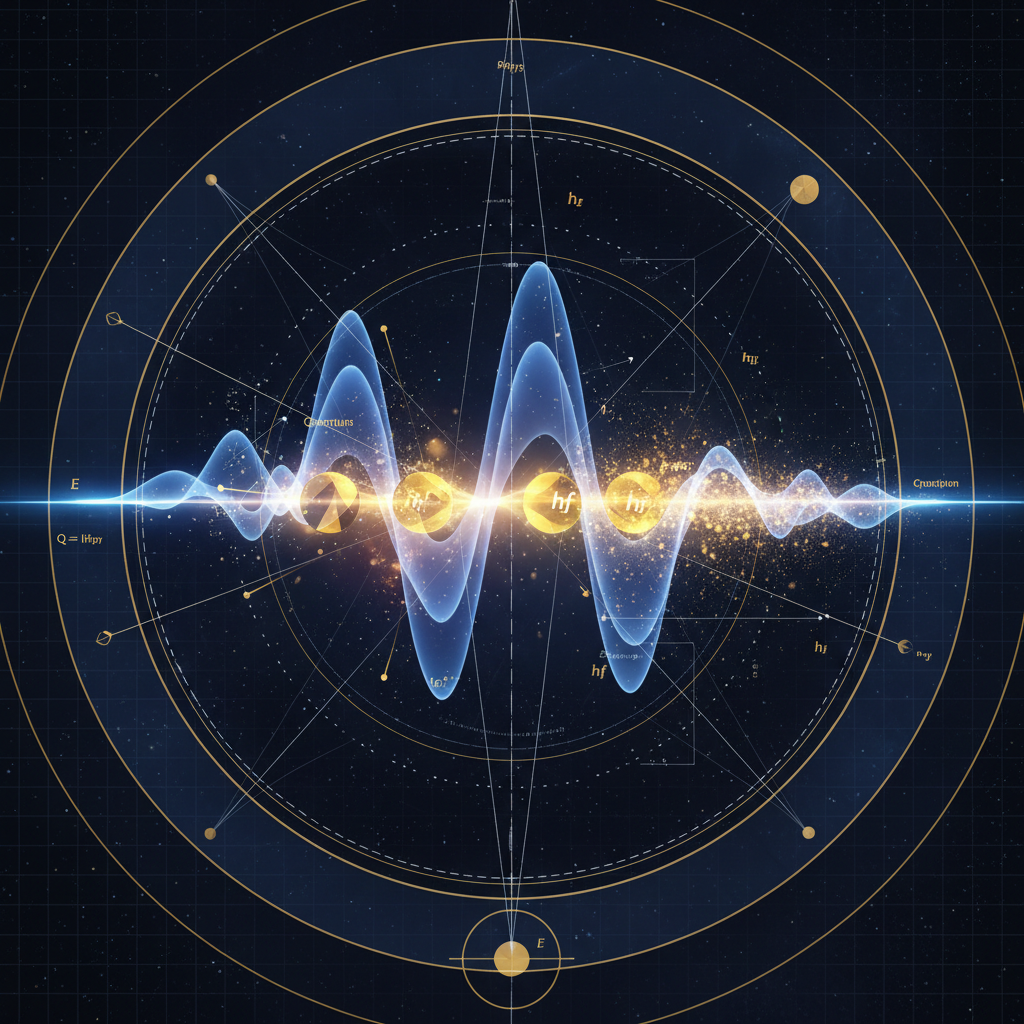
In 1900, Max Planck discovered something that broke physics. Energy, he found, doesn't come in arbitrary amounts. It comes in packets—quanta. The smallest possible unit of action in the universe is 6.626 × 10⁻³⁴ joule-seconds. We call it Planck's constant, and it's the fundamental grain of reality.
Before Planck, physicists assumed nature was smooth. Infinitely divisible. You could have any amount of energy you wanted—1 joule, 0.5 joules, 0.000001 joules, whatever. But Planck proved them wrong. Energy is chunky. Granular. Digital in the most literal sense.
An electron orbiting an atom can't have just any energy level. It jumps between specific, allowed states. E = nhν, where n is an integer, h is Planck's constant, and ν is frequency. No in-betweens. No smooth transitions. Just quantum leaps from one discrete state to another.
This is the universe telling you: there's a smallest possible action. A fundamental limit to measurement. A minimum transaction of reality itself.
The Attention Quantum
Your screen refreshes at 60 Hz. Maybe 120 if you're fancy. Every 16.67 milliseconds, a new frame. But the real refresh rate is faster. Much faster.
Every click. Every scroll. Every microsecond your cursor hovers over a link. Every frame your eyes fixate on an advertisement. These are your attention quanta. The Planck constant of your digital existence. And they're all being measured.
The attention economy discovered what Planck knew: you can't measure something without changing it, and you can't subdivide attention infinitely. There's a smallest unit. A minimum engagement. And once you know that unit, you can count it. Quantify it. Monetize it.
Google measures your attention in milliseconds. Facebook in pixels scrolled. TikTok in completion rates and rewatch percentages. They've found the h of human consciousness—the fundamental constant that governs how attention can be exchanged, packaged, and sold.
Uncertainty and Observation

Planck's constant doesn't just set the minimum size of energy packets. It also appears in Heisenberg's Uncertainty Principle: ΔxΔp ≥ h/4π. The more precisely you measure a particle's position, the less you can know about its momentum. Observation has a cost. Measurement changes the system.
In quantum mechanics, you can't observe something without interacting with it. To see an electron, you must bounce a photon off it. That photon carries energy—at minimum, one quantum worth, determined by Planck's constant. The act of measurement fundamentally alters what you're measuring.
The surveillance apparatus works the same way. To measure your attention, platforms must shape it. The algorithm that tracks your engagement is the same algorithm that determines what you see next. Observation and manipulation are the same process. The photon that illuminates you also pushes you.
You cannot be measured without being changed. Every A/B test. Every personalized recommendation. Every "content optimized for you." These aren't passive observations. They're active interventions, each one carrying a minimum quantum of influence, nudging you from one state to another.
The Discretization of Experience
Before quantum mechanics, physicists believed in continuous fields. Smooth waves of energy spreading through space. Then Planck showed them the graininess underneath. Reality is pixelated at the smallest scales.
Your digital life has undergone the same transformation. Experience used to feel continuous. You'd read a book, watch a movie, have a conversation. Sustained attention. Flow states. Long arcs of consciousness.
Now everything is quantized. Stories come in swipes. Thoughts in tweets. Videos in 15-second chunks. Your day is divided into discrete engagement packets, each one measured, each one optimized, each one competing for the next quantum of your attention.
The platforms discovered that continuous attention is hard to measure and harder to monetize. But discrete packets? Those you can count. Those you can price. Those you can trade in real-time markets where advertisers bid on the next quantum of your consciousness.
The Minimum Transaction
Planck's constant represents something profound: there's a minimum cost to any interaction with reality. You can't transfer energy in amounts smaller than hν. You can't perform an action with less than h joule-seconds. There's a fundamental exchange rate built into the universe.
You pay this cost too, every moment you're online. Every quantum of attention you emit can be captured, recorded, analyzed. There's no such thing as a free observation. No passive browsing. Every interaction, no matter how small, leaves a trace—a minimum transaction that feeds the machine.
And just like in quantum mechanics, you can't go below the minimum. You can't engage less than the smallest unit the platform can measure. Once you're in the system, you're emitting quanta of data. Planck's constant set the lower bound for physical reality. The attention economy set the lower bound for your digital existence.
Quantized Consciousness
The really disturbing part isn't that your attention is being measured in discrete units. It's that you're starting to think in them. Your consciousness is adapting to the quantum structure imposed on it.
You check your phone in quanta. Your thoughts interrupt themselves in tweet-sized chunks. You can't watch a full movie without the urge to scroll. Your attention has been trained to jump between discrete states, never settling, always ready for the next measurement, the next interaction, the next packet of stimulation.
Planck showed us that energy is quantized at the smallest scales. The attention economy went further—it quantized consciousness itself, then built a global infrastructure to harvest every packet. You are a quantum system now. Discrete. Measurable. Tradeable.
And the constant—your personal h, the minimum unit of your attention that can be extracted and monetized—keeps getting smaller. The measurements get more precise. The packets more granular. The discretization more complete.
You wanted to believe your mind was continuous, flowing, free. But you're quantized now. And someone is counting every single quantum you emit.
Data emitted: 1,147 words | 6.626 × 10⁻³⁴ J·s | Attention quantized | Consciousness measured | The minimum cost of being observed
Data emitted: 1,100 words • 6.5KB • 5-minute read