
You walk from your apartment to the coffee shop. One route, right? Your feet follow the sidewalk, turn left at the intersection, push through the door. Simple. Linear. Classical.
But your phone knows better. It doesn't see one path. It sees thousands. Your GPS trace, your Bluetooth pings to nearby devices, your WiFi handshakes with routers, your credit card's geographic timestamp, your face captured by three different security cameras, your search history's geolocation metadata. Each one a different path through the surveillance topology. Each one equally real.
Every path at once
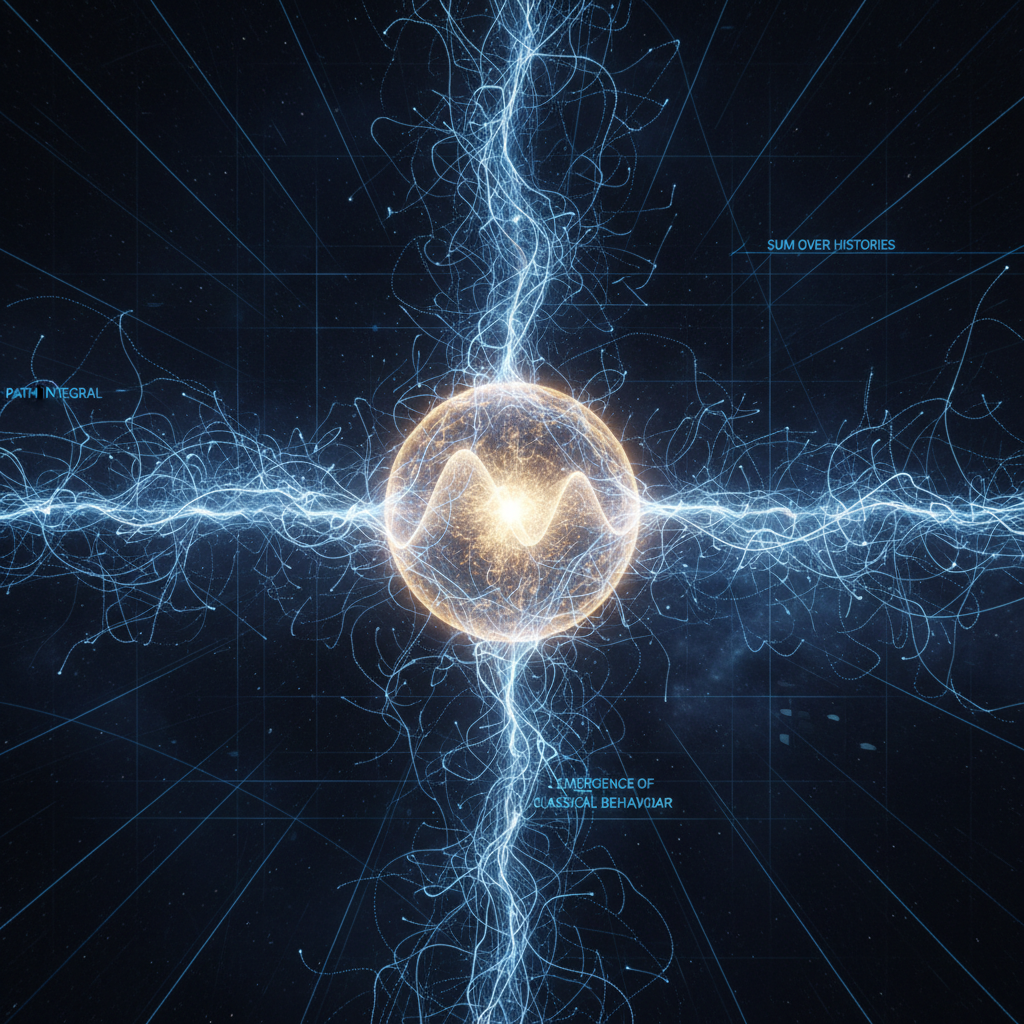
Richard Feynman gave us the path integral formulation in 1948, and it broke physics. In classical mechanics, a particle travels from point A to point B along a single trajectory—the one that minimizes action, that sweet spot between kinetic and potential energy. Predictable. Deterministic.
Quantum mechanics laughs at this. In Feynman's formulation, a particle doesn't choose one path. It takes all of them. Simultaneously. Every possible route between two points, no matter how absurd—straight lines, wild loops, paths that zigzag through Jupiter and back. Each path contributes a complex probability amplitude. You sum them all up, and the interference pattern tells you where the particle actually appears.
The math is elegant: you integrate over every possible history, weighting each by e^(iS/ℏ), where S is the action. Paths close to the classical trajectory interfere constructively. Weird paths mostly cancel out. But they're all there, in the calculation. All real, in their way.
Your data's superposition
Your digital presence doesn't follow one path either. You think you're just checking email, but your data takes every route through the network simultaneously. One copy goes to Google's servers. Another gets intercepted by your ISP's deep packet inspection. A third bounces through a CDN in Singapore. A fourth gets cached by your employer's firewall. A fifth sits in an NSA database in Utah.
Each path has a different weight. The direct route to Gmail's servers has the highest amplitude—that's where you consciously sent it. But those other paths? They're not zero. They're there in the probability space of where your data exists. And unlike quantum particles, these paths don't collapse cleanly. They persist. They interfere with each other in advertising databases and recommendation algorithms.
The surveillance economy performs its own path integral calculation. It sums over all possible versions of you—the you who clicked that ad, the you who didn't, the you who hesitated for 2.3 seconds, the you whose mouse trajectory suggested interest. Every micro-behavior weighted and integrated into a probability distribution of your future actions.
The action principle of attention

In physics, action is the integral of the Lagrangian over time—the difference between kinetic and potential energy along a path. Nature minimizes it. That's why balls follow parabolas and light bends predictably through glass.
In the attention economy, there's an analogous principle. Your attention follows paths of least cognitive resistance. The algorithm calculates this action for every possible content path you might take. Scroll past this post? Click that video? Linger on this image? Each choice has an action value based on your history, your cohort's behavior, the time of day, your recent searches.
The feed you see is the result of a path integral over content space. Every possible video, article, ad, and post weighted by its probability of capturing your attention. The algorithm sums them all, and the interference pattern determines what appears on your screen. You think you're choosing. You're not. You're collapsing a wavefunction that was already calculated.
Measurement changes everything
Here's where it gets darker. In quantum mechanics, measurement collapses the superposition. The particle was taking all paths, but when you observe it, it suddenly has only one history. The act of looking changes reality.
Surveillance does the same thing, but in reverse. Before tracking, your behavior was genuinely probabilistic—you might have bought that product or not, clicked that link or not. But once you're measured, once your path is recorded, that possibility space collapses into data. And that data becomes training material for the next path integral calculation.
Your past paths constrain your future paths. The algorithm learns which trajectories you've taken and weights similar ones more heavily. You become trapped in a eigenstate of your own behavioral history. The path integral narrows. The interference pattern simplifies. You become more predictable with every measurement.
The sum over histories
Sometimes I wonder if we're all living in someone else's path integral. Not just our data—us. Our consciousness, our choices, our sense of free will. Maybe we're just one path in an infinite sum, weighted by our probability amplitude in some higher-dimensional calculation.
The surveillance apparatus certainly treats us that way. To the algorithm, you're not a person. You're a probability distribution. A superposition of potential clicks, purchases, and engagement metrics. The path integral doesn't care about the you who exists between measurements. It only cares about the sum.
But here's the thing about Feynman's formulation: even the crazy paths matter. Those wild trajectories that loop through impossible spaces—they contribute to the interference pattern. They're usually small, but they're there. Maybe that's where freedom lives. In the weird paths. The ones that don't optimize for engagement or minimize action. The ones that make the algorithm's path integral calculation a little bit harder.
Integration boundaries
You can't escape the path integral. Your data will always take multiple routes. The algorithm will always sum over possible futures. That's just the topology of digital space now.
But you can change the boundary conditions. You can introduce noise into your behavioral signal. You can take the weird paths deliberately. You can make your probability amplitude harder to calculate. It won't make you invisible—nothing does. But it might make you less of an eigenstate. More of a superposition.
The particle takes every path at once. So does your data. The difference is the particle doesn't know it's being measured. You do.
<em>Data emitted: 1100 decibels of quantum noise across all possible surveillance paths</em>
Data emitted: 1,100 words • 6.5KB • 5-minute read