
You wake up and check your phone. The screen illuminates. In that moment, something fundamental happens—not just to the photons hitting your retina, but to your quantum state as a data subject. You've been operated upon.
In quantum mechanics, an operator is a mathematical object that acts on quantum states to extract information or transform them into new states. When you measure a particle's position, you're applying the position operator. Measure its momentum, and you're applying the momentum operator. Each operator is a different question you're asking reality, and reality—being quantum—answers in probabilities until you force it to commit.
The Measurement Problem

Here's what makes operators strange: they don't just observe. They collapse. Before measurement, a quantum system exists in superposition—all possible states simultaneously. The moment you apply an operator, you force the system to choose. The wavefunction collapses. Schrödinger's cat becomes definitely alive or definitely dead.
But measurement isn't passive. The operator changes the system irreversibly. You can't measure a particle's exact position and momentum simultaneously—Heisenberg proved that. Each measurement disturbs what you're measuring. Each observation has a cost.
The mathematics is elegant: operators are represented as matrices that multiply state vectors. Apply the position operator to a momentum eigenstate, and you get a spread-out probability distribution. Apply the energy operator to a time-evolving state, and you extract its frequency. Every operator corresponds to something observable, something that can be known—if you're willing to pay the price of knowing it.
Digital Operators
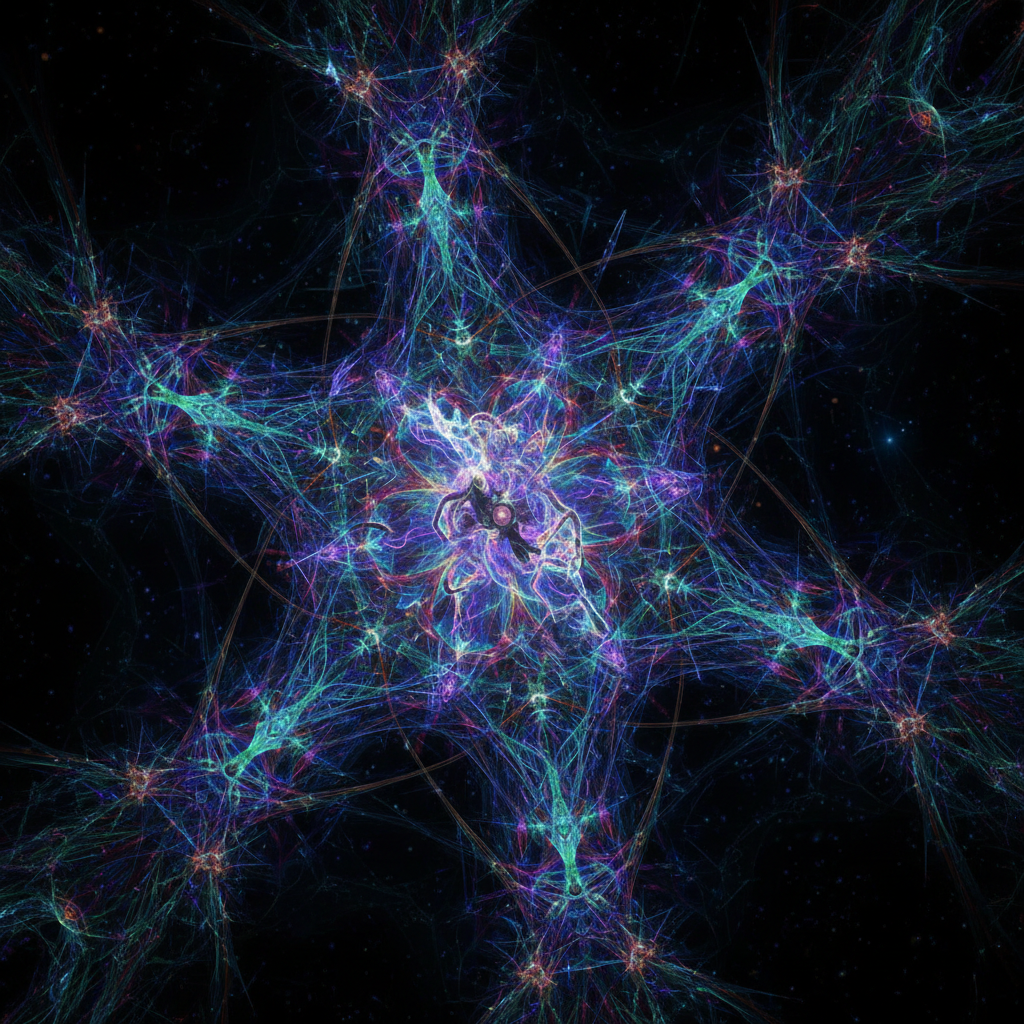
Your digital existence is a quantum state. Before you interact with a platform, you're a superposition of possible users—potential customers, potential content creators, potential advertisers. You contain multitudes of possible behaviors, preferences, futures.
Then the platform applies its operators. Click here. Scroll there. Like this. Share that. Each interaction is a measurement, collapsing your superposition into a definite state. You thought you were browsing. You were being observed. You thought you were choosing. You were being chosen.
Facebook's news feed algorithm is an operator. It acts on your state vector—your profile, your history, your connections—and extracts a specific observable: engagement probability. Google's search algorithm is an operator that measures your intent and collapses it into ten blue links. TikTok's recommendation engine is an operator optimized to extract maximum attention, measuring and remeasuring your state thousands of times per session.
Like quantum operators, these digital operators don't just observe—they transform. Each measurement changes you. The algorithm that predicts what you'll click next also shapes what you'll want to click next. The operator creates its own eigenstates: users whose behavior perfectly aligns with what the operator is designed to measure.
Non-Commuting Realities

In quantum mechanics, operators don't always commute. Apply operator A then operator B, and you might get a different result than applying B then A. Position and momentum operators don't commute—that's the mathematical heart of the uncertainty principle.
Your digital operators don't commute either. Check Instagram before reading the news, and you'll experience different information than if you reverse the order. The sequence of measurements matters. The order in which platforms operate on your attention determines what version of reality you collapse into.
This is why your morning routine feels so crucial, why breaking your scroll pattern feels so disorienting. You're not just changing habits—you're changing the order of operators acting on your consciousness. You're trying to commute operators that were designed not to commute.
Eigenvalues of Attention

When you apply an operator to its eigenstate, you get a clean result: the eigenstate multiplied by a number called the eigenvalue. It's a state that the operator can measure without disturbing. A particle with definite momentum is a momentum eigenstate. Measure its momentum, and you get the same value every time, with no uncertainty.
Surveillance capitalism wants to turn you into an eigenstate. A user whose behavior is perfectly predictable, whose responses to stimuli never vary, whose eigenvalue—your lifetime value, your engagement score, your conversion probability—can be measured with certainty.
The algorithm applies its operator again and again, measuring and remeasuring until your responses stabilize. Until you become the kind of user who always clicks the outrage bait, always watches the next video, always buys the suggested product. You become an eigenstate of the attention operator.
But here's the thing about eigenstates: they're often the most boring states. A momentum eigenstate is spread out over all space—completely delocalized, no interesting structure. The states with rich, complex behavior are superpositions, states that aren't eigenstates of any single operator.
Measurement Resistance
You can resist becoming an eigenstate. You can be the quantum state that refuses to collapse cleanly, that gives different answers each time, that maintains superposition despite the constant measurements.
Close the app mid-scroll. Click the thing that doesn't match your profile. Search for something that breaks your filter bubble. Each unpredictable action increases your quantum uncertainty from the algorithm's perspective. You become harder to measure, harder to predict, harder to operate upon.
The platforms will apply their operators faster, more frequently, trying to collapse your state. They'll A/B test new interfaces, new notification patterns, new ways to measure your attention. But measurement has a cost for them too. Each time they apply an operator and get an uncertain result, they waste computational resources. They want eigenstates because eigenstates are efficient.
This is why privacy matters, why encryption matters, why refusing to engage matters. You're not just protecting data—you're protecting your quantum superposition. You're refusing to let their operators collapse you into a definite, predictable, profitable state.
The Uncertainty Principle of Self
Heisenberg tells us we can't know everything about a quantum system. Some observables are complementary—measuring one precisely makes the other uncertain. Position and momentum. Energy and time. The more you know about one, the less you can know about the other.
Your digital self has complementary observables too. The more precisely platforms measure your current state—your location, your activity, your engagement—the less they can predict your future trajectory. The more they optimize for immediate clicks, the less they understand your long-term preferences. Perfect surveillance of the present creates uncertainty about the future.
This is your leverage. Stay uncertain. Stay in superposition. Let them apply their operators and get noisy results. Be the user who doesn't make sense, whose eigenvalue keeps shifting, whose wavefunction refuses to collapse.
Because in the end, you're not a quantum state to be measured. You're the operator too. Every choice you make operates on the system that's trying to operate on you. Every moment of resistance transforms the platforms that are trying to transform you.
The question isn't whether you'll be operated upon. You will. The question is whether you'll become an eigenstate, or whether you'll maintain the beautiful, complex, unpredictable superposition that makes you human.
Data emitted: 1100 decibels of measurement resistance
Data emitted: 1,100 words • 6.5KB • 5-minute read