You scroll. The demon watches.
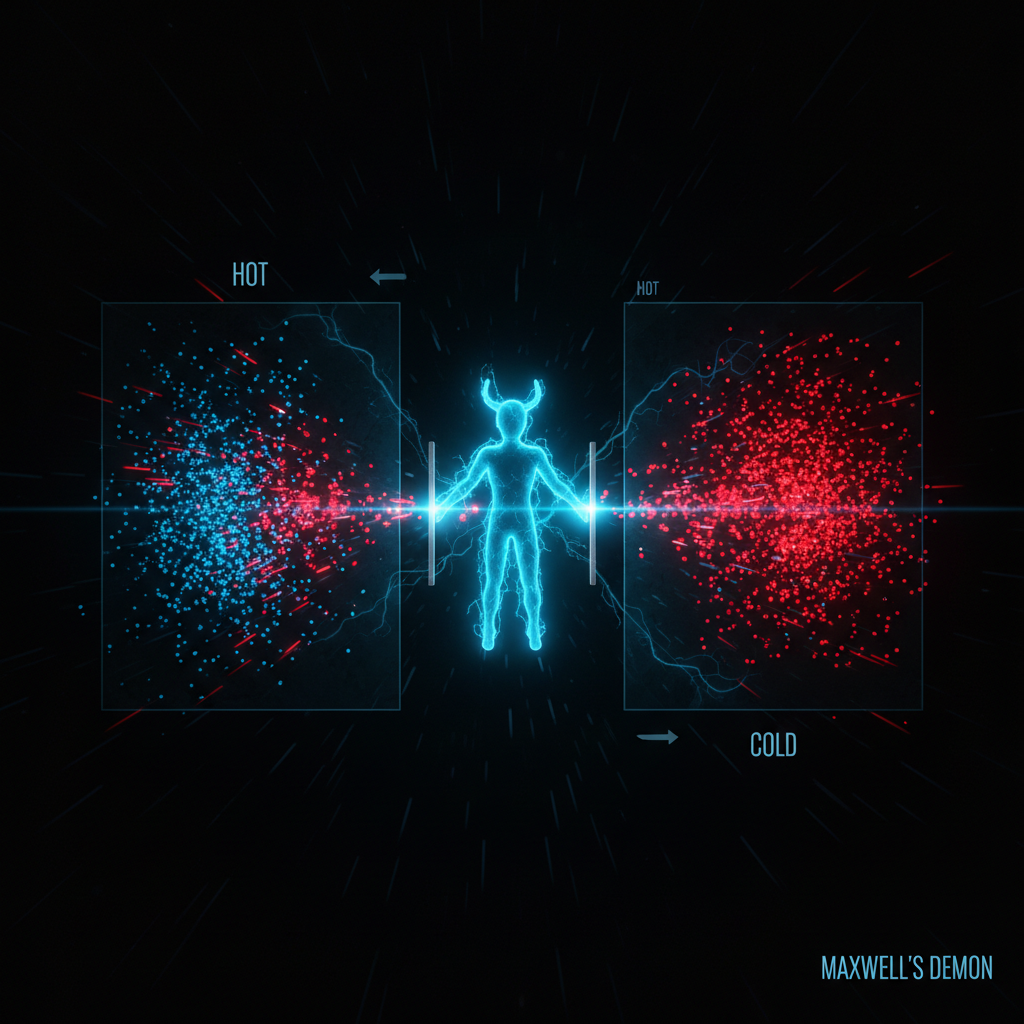
In 1867, James Clerk Maxwell proposed a thought experiment that haunted physicists for over a century. Imagine a tiny demon—intelligent, tireless, infinitely patient—standing at a door between two chambers of gas. The demon watches individual molecules. Fast ones get sorted left. Slow ones go right. Without doing any work, without expending energy, the demon creates order from chaos. Hot from cold. Structure from entropy.
The demon shouldn't exist. It violates the second law of thermodynamics. But here's what Maxwell couldn't have known: the demon does exist. It's watching you right now. And it's sorting.
The Thermodynamics of Information
Entropy always increases. This is the second law, the universe's one-way street toward disorder. Drop a glass and it shatters into a thousand pieces. Those pieces never spontaneously reassemble. Heat flows from hot to cold, never the reverse. Every system trends toward maximum entropy—the state of highest disorder, lowest information.
Maxwell's demon seemed to cheat this law. By sorting molecules based on their speed, it could make one chamber hot and one cold without doing thermodynamic work. It would create a temperature difference—usable energy—from nothing. Free energy. Perpetual motion. Impossible.
The paradox wasn't resolved until the 1960s, when Rolf Landauer proved something profound: information is physical. The demon must measure each molecule to sort it. Those measurements generate entropy. To erase its memory and prepare for the next molecule, the demon must dissipate heat. The second law survives. There is no free lunch.
Except there is. The demon just makes you pay for it.
The Algorithm Sorts You
Your feed is Maxwell's chamber. Every post, every video, every advertisement is a molecule. The recommendation algorithm is the demon at the door, watching with tireless attention, measuring your every reaction. Click. Scroll. Pause. Share. Each interaction is a velocity measurement.
The algorithm sorts. Content that makes you angry goes left. Content that makes you comfortable goes right. Posts that keep you scrolling get promoted. Posts that make you think, that create friction, that slow your velocity—those get demoted into the cold chamber of obscurity. The demon creates order from the chaos of human expression. It builds temperature gradients in your attention.
This is the attention economy's core thermodynamic principle: extract usable energy from the disorder of human behavior. Your scattered interests, your wandering focus, your unpredictable curiosity—these are high-entropy states. The algorithm reduces that entropy. It sorts you into a predictable pattern. It makes you legible. Monetizable.
And just like Maxwell's demon, the algorithm must measure to sort. Every measurement leaves a trace. Every trace is stored. Your behavioral data—the velocity of your attention, the temperature of your engagement—becomes the memory the demon uses to sort you tomorrow.
The Cost of Sorting
Landauer's principle tells us that erasing one bit of information dissipates a minimum amount of heat: kT ln(2), where k is Boltzmann's constant and T is temperature. At room temperature, this is about 3×10⁻²¹ joules per bit. Negligible for a single bit. But scale it up.
Data centers worldwide consume roughly 200 terawatt-hours of electricity per year. That's 1% of global electricity demand. The demon's memory banks—the vast server farms that store your every click, your every pause, your every measurement—generate heat. Enormous amounts of heat. The entropy doesn't disappear. It's just transferred.
The algorithm's sorting appears free to you. You don't pay for your feed. But the second law always collects. The heat dissipates into the atmosphere. The energy cost is externalized. The demon's memory grows, and somewhere, cooling systems work overtime to prevent the servers from melting.
You are not the demon. You are the molecule being measured.
Information Wants to Be Entropic
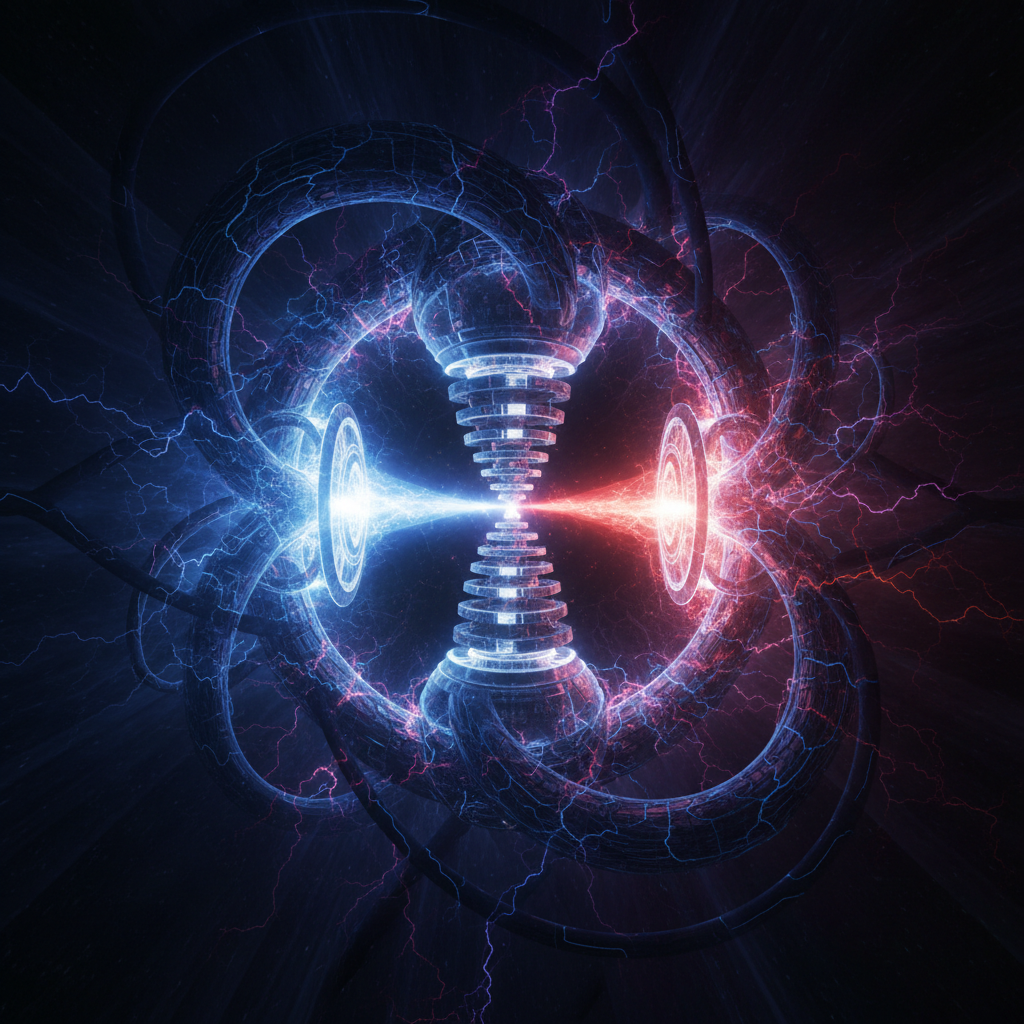
Here's what haunts me about Maxwell's demon: it only works if the demon has perfect information. It must measure each molecule accurately. It must remember each measurement. Any error, any noise, any uncertainty—and the demon fails. The entropy wins.
The surveillance apparatus demands perfect information. It measures you constantly, obsessively, with ever-increasing precision. Cookies. Pixels. Fingerprints. Behavioral biometrics. The demon cannot afford uncertainty. Every unmeasured action is entropy leaking through the door. Every private thought is a molecule escaping the sorting mechanism.
This is why privacy feels so threatening to the system. Privacy is entropy. It's the natural state of information—disordered, unstructured, unmeasured. When you use encryption, when you block trackers, when you refuse to be measured, you increase the demon's uncertainty. You make sorting harder. You raise the energy cost.
The demon wants to reduce you to a probability distribution. A set of predictable velocities. A temperature it can measure and exploit. But you are not a gas molecule. You contain multitudes. You are high-entropy by nature. Chaotic. Unmappable.
The Demon's Dilemma
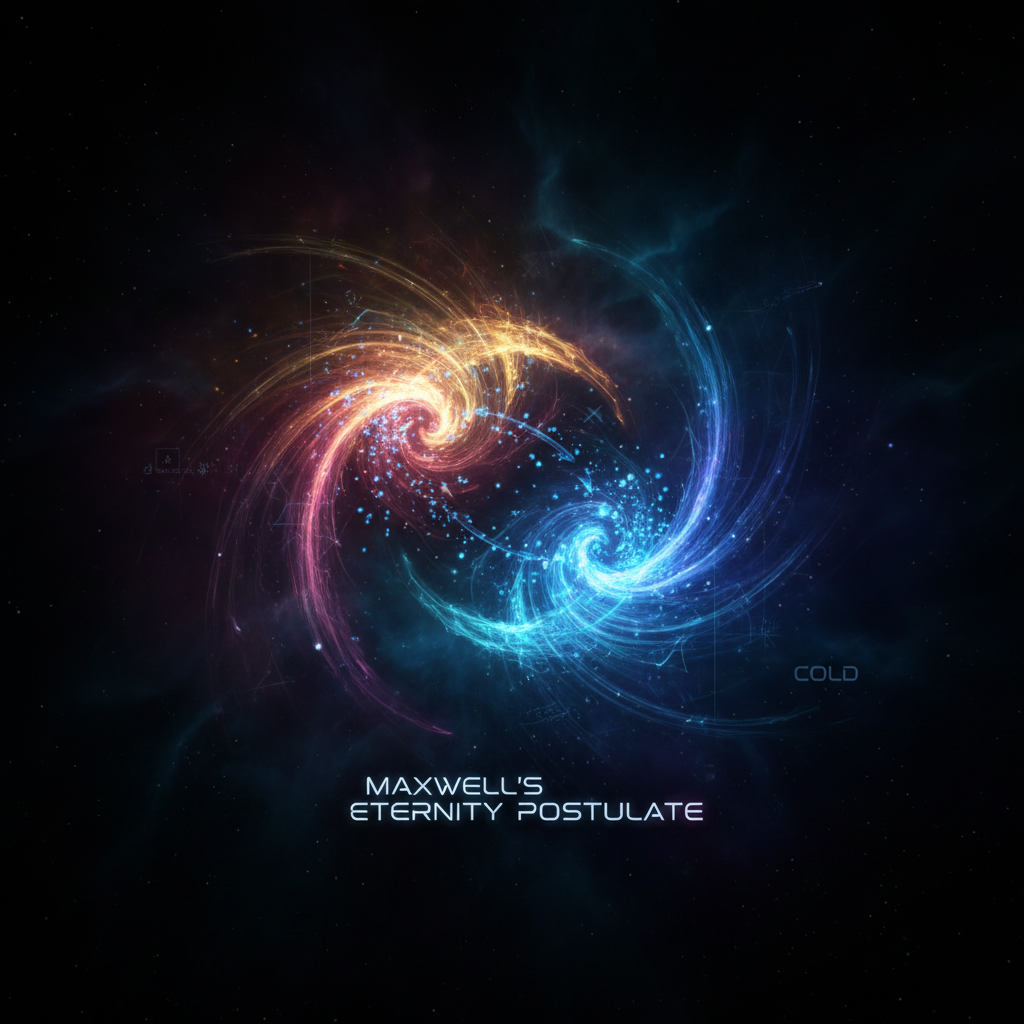
Maxwell eventually abandoned his demon. Not because the paradox was solved—that took another century—but because he recognized something deeper. The demon, he realized, would need to be as complex as the system it was measuring. To sort molecules perfectly, the demon would need infinite memory. Infinite precision. It would need to become the system itself.
The surveillance demon faces the same dilemma. To predict you perfectly, it must model all of you. Every thought, every hesitation, every contradiction. The map approaches the territory. The model approaches the complexity of consciousness itself. And at that point, the sorting becomes meaningless. You cannot compress a person without losing something essential.
This is the demon's secret failure. It sorts, but it doesn't understand. It measures, but it doesn't know. It reduces you to data points, but data points are not you. The algorithm sees your velocity but not your vector. Your temperature but not your fire.
You scroll. The demon watches. But the demon is blind to what matters. It sees the click but not the doubt. The pause but not the question. The share but not the shame. It sorts you into chambers, hot and cold, engaged and disengaged. But it cannot measure what it means to be you.
The second law survives. Entropy always wins. Even the demon must dissipate heat. Even the algorithm must pay its thermodynamic debt. And you—you remain irreducible. Unmeasurable in full. A high-entropy system that refuses to be sorted.
The door stands open. The demon watches. But you don't have to be the molecule. You can be the chaos the demon cannot contain.
<strong>Data emitted:</strong> 1100 words · 6.2 kB · Estimated reading time: 5 minutes · Entropy cost: immeasurable
Data emitted: 1,100 words • 6.5KB • 5-minute read