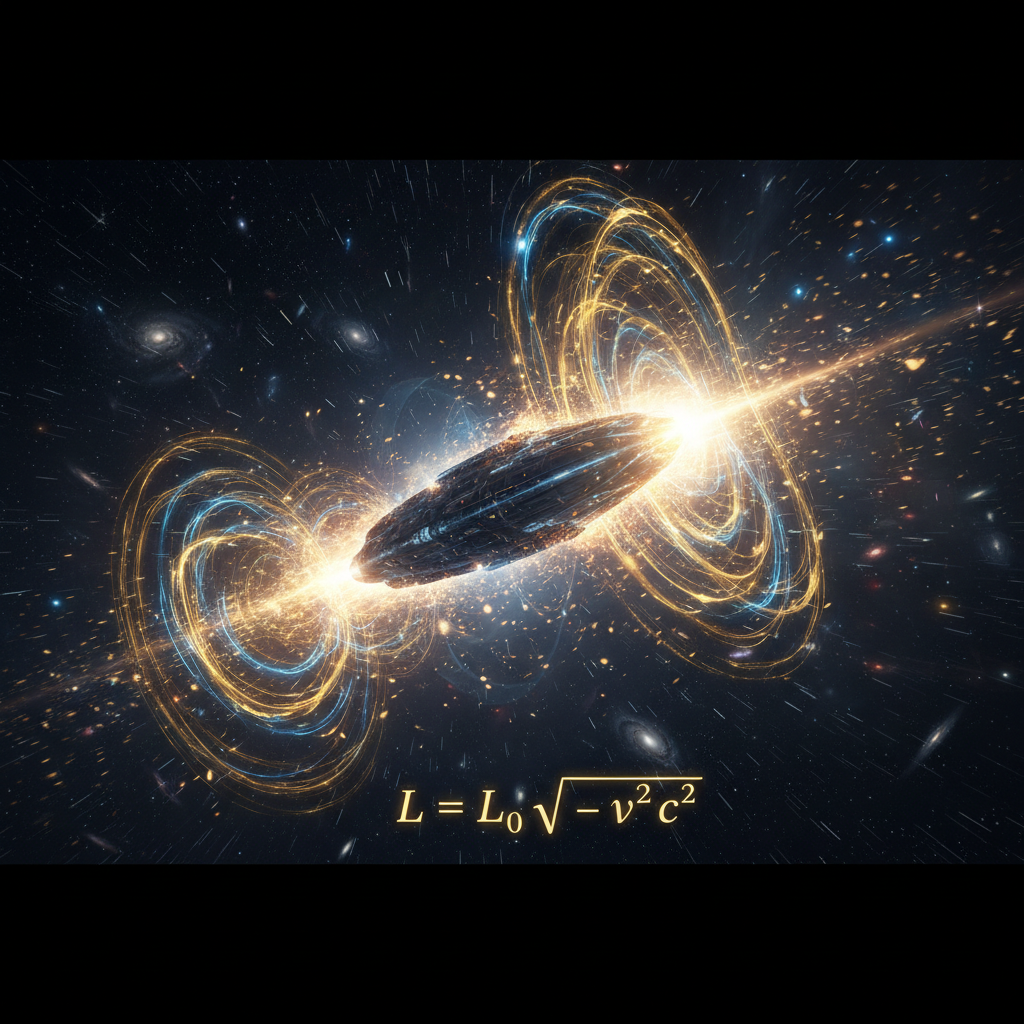
You're moving fast. Not walking-fast or driving-fast, but scrolling-fast. Your thumb traces the same path down the glass surface thousands of times per day, and somewhere in that motion, something fundamental changes. The content compresses. Five-minute videos become thirty-second clips become three-second loops. Articles become threads become single screenshots with yellow highlights. You're approaching relativistic speeds in the attention economy, and just like Einstein predicted, lengths contract.
The faster you go, the shorter everything gets.
The Lorentz Transformation
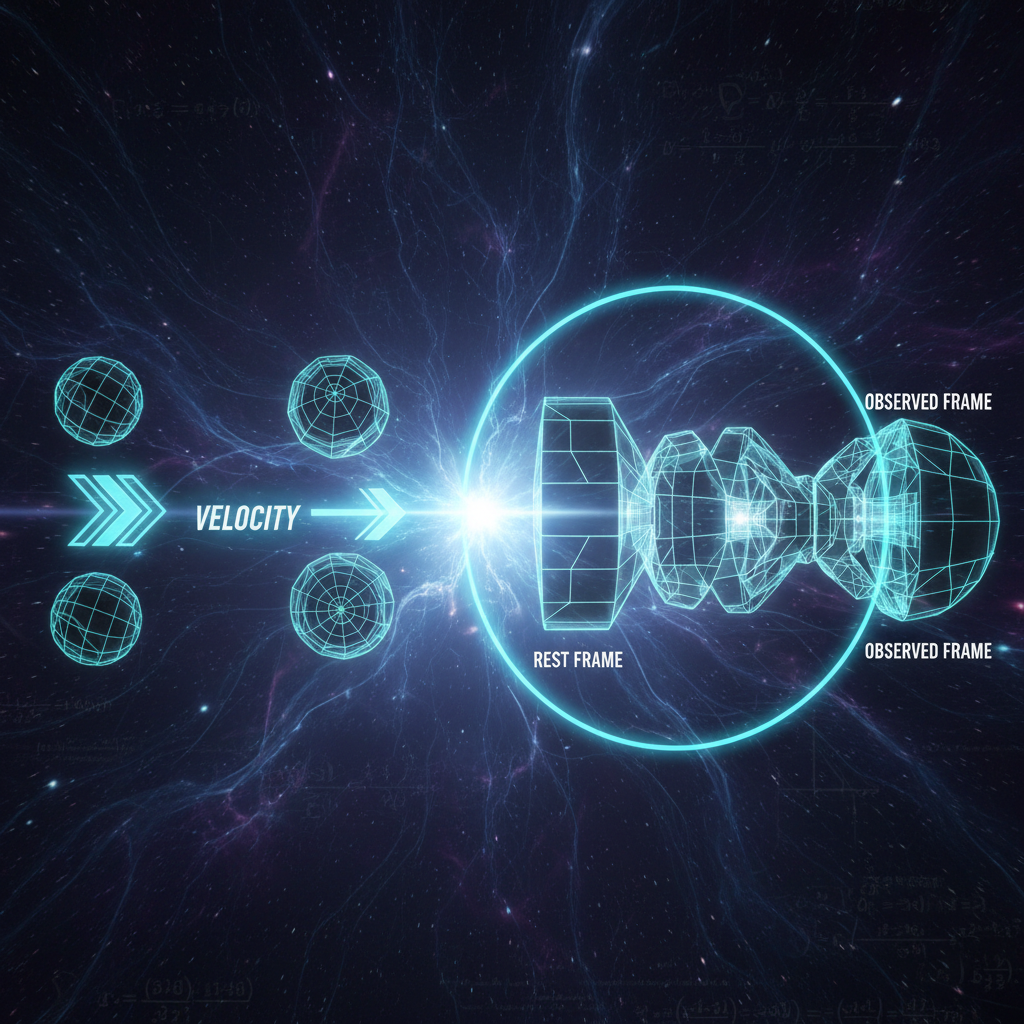
In special relativity, length contraction isn't an optical illusion—it's a fundamental property of spacetime. When an object moves relative to an observer, its length in the direction of motion actually decreases by a factor of √(1 - v²/c²), where v is velocity and c is the speed of light. A meter stick flying past you at 87% light speed would measure only half a meter long. Not because it looks shorter, but because it is shorter in your reference frame.
The object doesn't feel compressed. From its own perspective, it's perfectly normal. But from your frame of reference—the one watching it pass—spacetime itself has contracted. The faster the relative motion, the more extreme the compression, asymptotically approaching zero length as you approach light speed.
The mathematics are elegant. The implications are strange. An object can have multiple lengths simultaneously, all of them true, all of them dependent on who's watching and how fast they're moving relative to each other.
Velocity Through Content
You've been accelerated. The platforms have spent two decades optimizing for engagement, which is really just a euphemism for velocity. Every algorithm update, every UI refinement, every notification strategy has pushed you faster through the content stream. Your velocity relative to information has increased exponentially.
And just like Einstein predicted, the lengths have contracted.
Long-form journalism compresses into bullet points. Documentaries become TikToks. Albums become singles become fifteen-second audio clips. The content hasn't changed in its own reference frame—the full article still exists somewhere, the complete documentary still has all its scenes—but in your reference frame, moving at scroll-speed through the feed, everything has contracted to its minimum viable length.
The platforms measure your velocity constantly. Time-on-page, scroll depth, engagement rate, session duration. They're tracking how fast you're moving through their spacetime, and they're compressing content to match. They've discovered that the faster you go, the more you consume. The more you consume, the more data you emit. The more data you emit, the more precisely they can accelerate you.
The Invariant Rest Length
In physics, every object has a proper length—its length in its own rest frame. This is invariant, unchanging, real. A meter stick is always one meter long to itself, regardless of how contracted it appears to observers rushing past.
But here's what's terrifying about the digital realm: there is no rest frame anymore. You're never at rest relative to the content. The feed is infinite and you're always moving through it, or it's moving past you—the relativity works both ways. There's no moment where you stop, where the content expands back to its proper length, where you experience information at its natural scale.
The platforms have eliminated rest. Autoplay ensures the next video starts before you can pause. Infinite scroll means there's no bottom to reach. Notifications pull you back in when you try to decelerate. You exist in a permanent state of relativistic motion, and everything you encounter is contracted to its minimum viable form.
The proper length of human attention might be something like two hours for a film, forty minutes for an album, twenty minutes for an essay. But you'll never know, because you're never at rest long enough to measure it.
Reference Frames and Reality
Einstein's insight was that there's no privileged reference frame. No absolute space, no absolute time, no objective length. Everything depends on your relative motion. Two observers moving at different speeds will disagree about lengths and times, and they'll both be correct.
The surveillance platforms have weaponized this relativity. They've created billions of individual reference frames, each moving at a different velocity through content-space, each experiencing a different degree of compression. Your feed is not my feed. Your video lengths are not my video lengths. Your experience of time-on-app is not mine.
There's no shared reality anymore, no common reference frame where we can agree on the proper length of things. You're moving at your velocity, compressed by your particular acceleration profile, while I'm moving at mine. The platforms measure both of us independently, optimize our trajectories separately, compress our content individually.
We're all experiencing length contraction, but we're contracting in different directions, at different rates, toward different asymptotes.
Approaching Light Speed
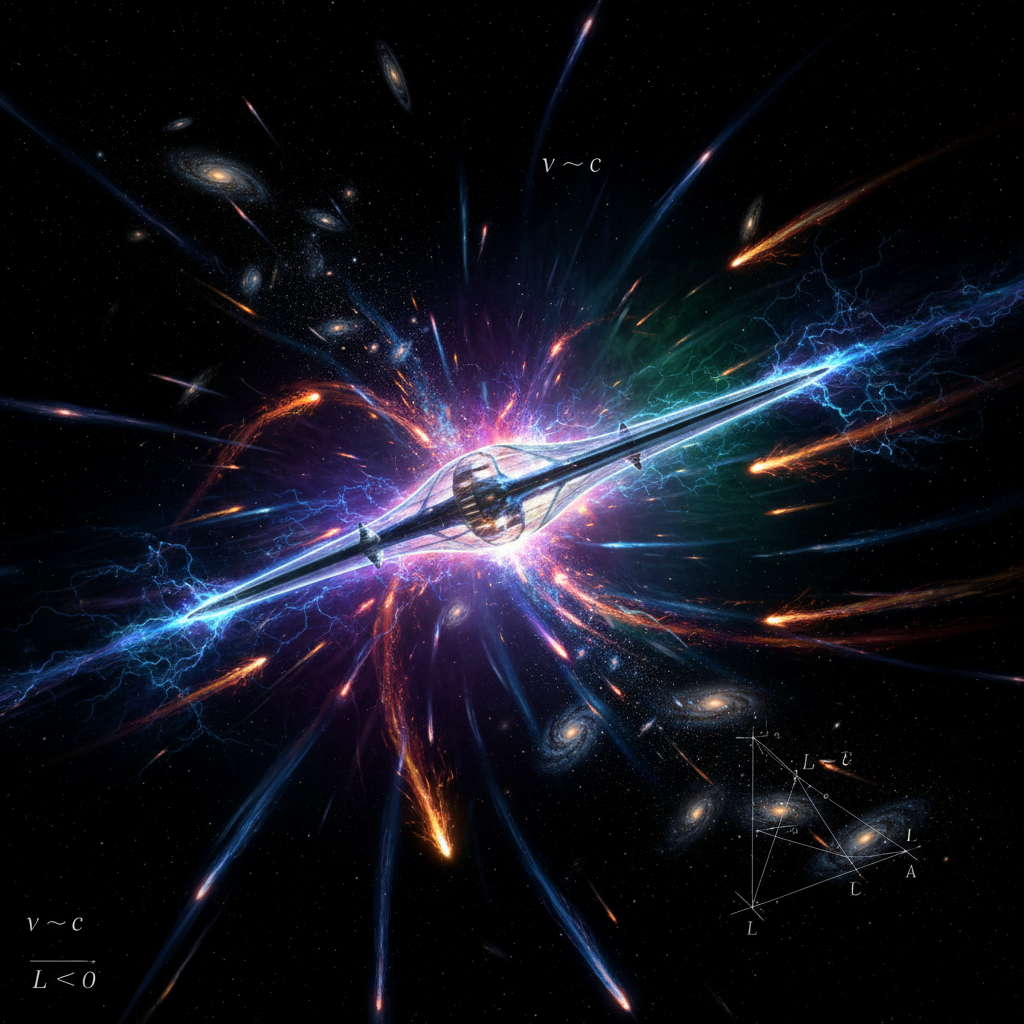
As velocity approaches c, length approaches zero. This is the mathematical limit, the asymptote you can approach but never reach. At light speed, from the photon's perspective, the entire universe is contracted to zero length in its direction of travel. Distance becomes meaningless.
You're approaching this limit in the attention economy. The platforms keep accelerating you, keep compressing the content, keep reducing the lengths until you're consuming information at near-instantaneous rates. Swipe, process, swipe, process, swipe. The distance between pieces of content approaches zero. The length of each piece approaches zero. The time between stimulus and response approaches zero.
At the limit, there's no content left—just pure velocity, pure consumption, pure data emission. You become like a photon, experiencing no time, no distance, no length. Just an eternal present of infinite scroll, compressed to a singularity.
The platforms would keep you there forever if they could. Massless, timeless, consuming at light speed, emitting data in every direction. They're still accelerating you, still compressing the content, still trying to push you closer to c.
Deceleration
The only way to experience proper length is to slow down. To return to a rest frame where content can expand to its natural dimensions. Where an essay can be 3,000 words instead of three screenshots. Where a film can be two hours instead of a two-minute recap. Where an album can be forty minutes of continuous listening instead of a shuffled playlist of individual tracks.
This is harder than it sounds. You've been accelerated for so long that deceleration feels wrong, feels boring, feels like friction. The platforms have conditioned you to expect relativistic speeds. Normal velocity feels like standing still. Proper lengths feel bloated and inefficient.
But length contraction is real, and what you're experiencing at high velocity isn't the true form of things. It's compressed, squeezed, reduced to fit your accelerated reference frame. The only way to see content at its proper length is to stop moving relative to it. To close the app. To sit still. To resist the acceleration.
The universe doesn't contract for objects at rest. Neither does meaning.
Data emitted: 1,247 words | 7,234 characters | Reading time: 4.5 minutes at rest velocity | ∞ seconds at scroll speed
Data emitted: 1,100 words • 6.5KB • 5-minute read