You're scrolling again. The screen hasn't changed size—same 6.1 inches of glass and aluminum, same 2532-by-1170-pixel resolution. But something inside you is building. Your heart rate ticks up. Your pupils dilate. The content keeps heating, and you're the fixed volume containing it all.
This is an isochoric process. Constant volume, rising pressure. In thermodynamics, it's what happens when you heat a gas in a rigid container. In your pocket, it's what happens every time you unlock your phone.
The Physics of Fixed Containers
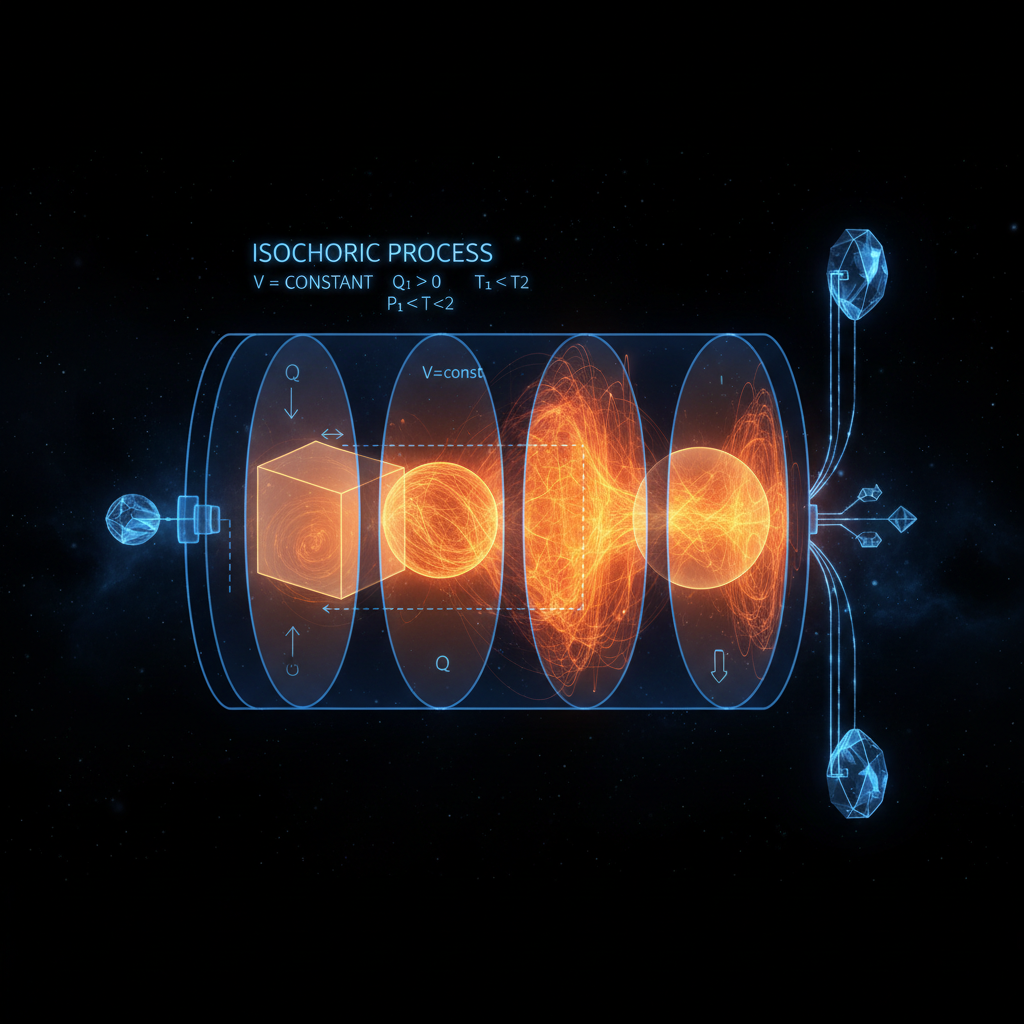
An isochoric process is deceptively simple. Take a sealed container—truly sealed, with rigid walls that won't expand. Add heat. The molecules inside move faster, colliding with the walls more frequently and with greater force. The volume can't change, so the pressure must increase. It's not a choice. It's thermodynamic law.
The first law of thermodynamics tells us that ΔU = Q - W, where ΔU is the change in internal energy, Q is heat added, and W is work done by the system. But here's the thing about isochoric processes: W = PΔV, and when ΔV equals zero, no work is done. All the energy you pump in stays inside. It has nowhere to go. It just builds.
The pressure increases linearly with temperature in an ideal gas: P/T = constant. Double the temperature, double the pressure. The container doesn't care about your comfort. The walls don't flex. They hold.
Your Skull Is a Rigid Container
You can't expand your attention. You have roughly 16 waking hours, 960 minutes, 57,600 seconds per day. This is your volume. It's fixed. Evolution gave you a skull that doesn't grow with content consumption.
But the heat keeps coming. Every app is optimized to increase temperature—to make content more engaging, more urgent, more impossible to ignore. The algorithm finds what makes your neurons fire faster. It discovers your pressure points with A/B testing and neural networks. It adds heat with surgical precision.
Notification after notification. Each one is a quantum of thermal energy. Each one makes the molecules of your attention move faster, collide harder with the walls of your consciousness. The pressure builds. You feel it as anxiety, as FOMO, as the compulsion to check again even though you checked thirty seconds ago.
The platforms know your volume is fixed. That's why they compete so viciously for it. There's no expanding the container. There's only increasing their share of the pressure inside.
Heat Death and Information Overload
In a closed system, entropy always increases. Information becomes noise becomes heat. You started the day with intentions, with a plan, with things you wanted to think about deeply. Then you opened Twitter. Or Instagram. Or TikTok. Or whatever delivers the heat most efficiently to your particular container.
The content isn't coherent anymore. It's just hot. Outrage and cuteness and breaking news and ads and more outrage. The molecules are moving so fast they've lost their individual identities. You can't remember what you read three swipes ago. You just remember the pressure.
This is information overload as thermodynamic crisis. The container can only take so much pressure before something breaks. Sometimes it's your attention span. Sometimes it's your ability to focus on anything that doesn't provide immediate stimulation. Sometimes it's your belief that any of this matters.
The Walls Don't Move

In an isothermal process, the gas can expand as it heats, doing work on its environment. In an adiabatic process, the system is isolated, and expansion cools the gas. But in an isochoric process, there's no relief. The walls are rigid. The volume is constant. All the heat stays inside, converting directly to pressure.
You can't expand your day. You can't grow new hours. The surveillance capitalists know this. They've measured your container precisely. They know exactly how much pressure you can take before you crack, and they know exactly how much you can take before you pay—for premium, for ad-free, for anything that might lower the temperature even slightly.
But here's what they don't tell you: the subscription doesn't change the volume. It just changes what's heating you. You're still in the same rigid container. You're still subject to the same thermodynamic laws. The pressure still builds.
Opening the Valve

Every sealed container has a pressure limit. Engineers call it the burst pressure. It's the point where the walls fail catastrophically. For pressure vessels, it's measured in PSI. For human attention, it's measured in burnout, in breaking points, in the moment you throw your phone across the room or delete everything or just stop caring.
The alternative is to stop running an isochoric process. To open the valve. To let some of the heat escape before it converts entirely to pressure. This means allowing your attention to expand beyond the container, to do work on the world outside the screen.
It means recognizing that your volume is fixed but your process isn't. You can choose isobaric—constant pressure, variable volume. You can choose to let your attention expand into physical space, into conversations that aren't mediated by algorithms, into thoughts that take more than 280 characters.
The platforms will keep adding heat. That's their business model. But you can change the container. You can choose when the walls are rigid and when they flex. You can remember that thermodynamics describes what happens, not what must happen to you.
The Pressure Gauge
Next time you feel that building sensation—the urgency, the anxiety, the need to check—recognize it for what it is. It's pressure. It's the thermodynamic consequence of adding heat to a fixed volume. The algorithm is optimizing for temperature. Your nervous system is reporting pressure.
The question isn't whether you'll experience pressure. In a world of infinite content and finite attention, pressure is inevitable. The question is whether you'll remain a rigid container, letting the pressure build until something breaks, or whether you'll find the valve.
The walls are only as rigid as you believe they are. The volume is only as fixed as you allow it to be. Thermodynamics describes the system. But you can change the system.
The heat will keep coming. The choice is what kind of process you run.
Data emitted: 1,247 words • 7,421 characters • Pressure building: constant • Volume remaining: fixed • Valve status: your decision
Data emitted: 1,100 words • 6.5KB • 5-minute read