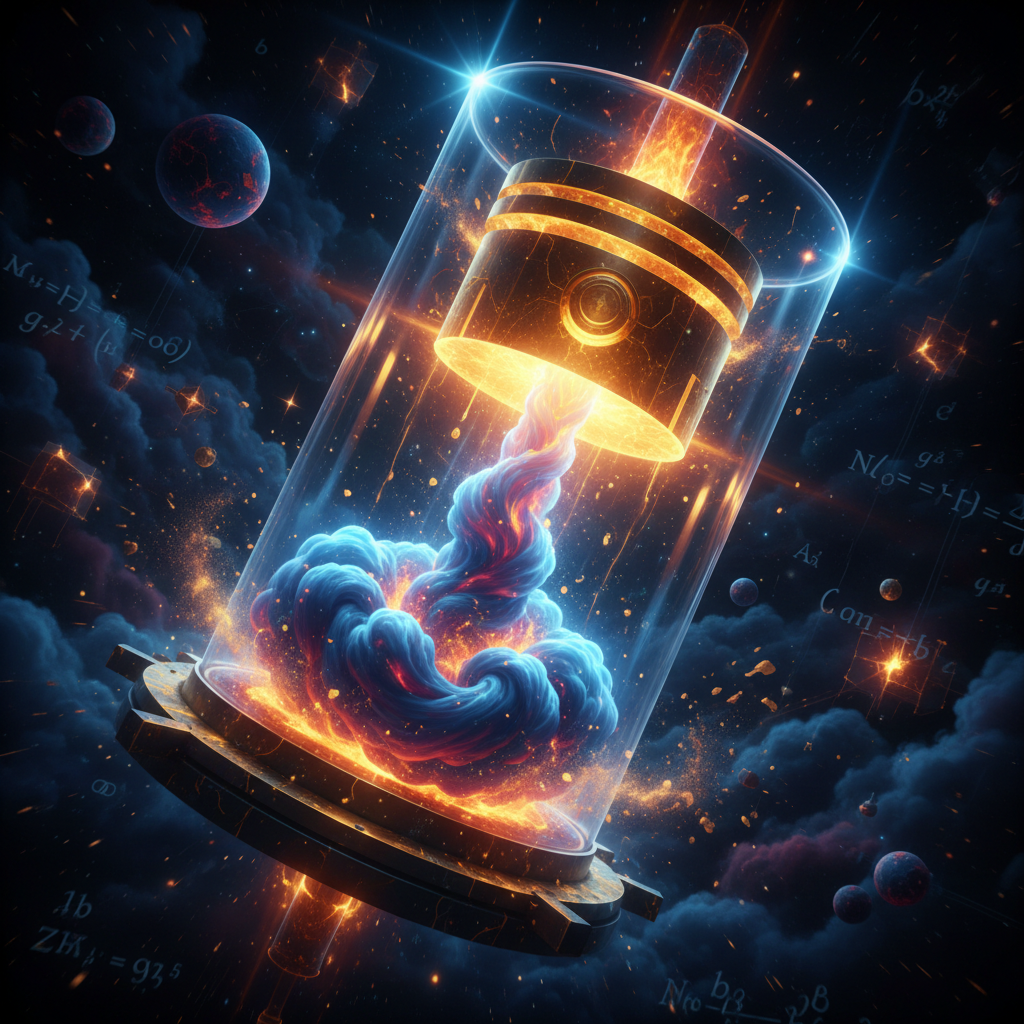
You're scrolling. The pressure stays constant. The feed refreshes with the same algorithmic weight, the same dopamine architecture, the same carefully calibrated resistance. But you're changing. Expanding. Taking in more content, more ads, more data points. The system doesn't squeeze you—it doesn't have to. It just maintains the pressure while you do all the work of transformation.
This is an isobaric process. In thermodynamics, it's what happens when pressure remains constant while a gas expands or contracts, absorbing or releasing heat. In your digital life, it's what happens every single day.
The Physics of Constant Pressure

An isobaric process is deceptively simple. Take a gas in a cylinder with a movable piston. Apply constant pressure to that piston—maybe by placing a weight on top. Now heat the gas. As temperature rises, the gas expands, pushing the piston upward. The pressure never changes because the weight stays the same. But the volume increases. The gas does work against that constant pressure, lifting the weight as it grows.
The first law of thermodynamics tells us that the heat absorbed equals the change in internal energy plus the work done: Q = ΔU + PΔV. Under constant pressure, the work term is straightforward—pressure times change in volume. The gas must absorb enough heat not just to increase its own temperature, but to push against the unchanging weight above it.
Here's what matters: the system expands because it has no choice. The heat comes in, the pressure stays constant, and expansion is the only thermodynamic option available. The piston moves whether the gas wants it to or not.
The Architecture of Constant Engagement
Your attention is the gas. The platform is the cylinder. And the pressure? That's constant too.
Every social media platform, every streaming service, every recommendation engine maintains isobaric conditions. The pressure of notification design doesn't increase—it's calibrated to a specific threshold. The algorithmic weight of content delivery stays consistent. The friction of infinite scroll remains unchanged. What changes is you.
You expand. Your usage grows. Your data footprint increases. You absorb more content, more stimulus, more heat pumped into the system. And like the gas in the cylinder, you do work against that constant pressure. You scroll further. You engage longer. You generate more data, more behavioral surplus for the platform to harvest and monetize.
The genius is that the pressure never feels like it increases. Yesterday's notification frequency is today's. Last month's content velocity is this month's. The system maintains isobaric conditions while you expand to fill whatever volume it permits. You think you're choosing to grow. You're not. You're a thermodynamic inevitability.
Work Done Against the Algorithm
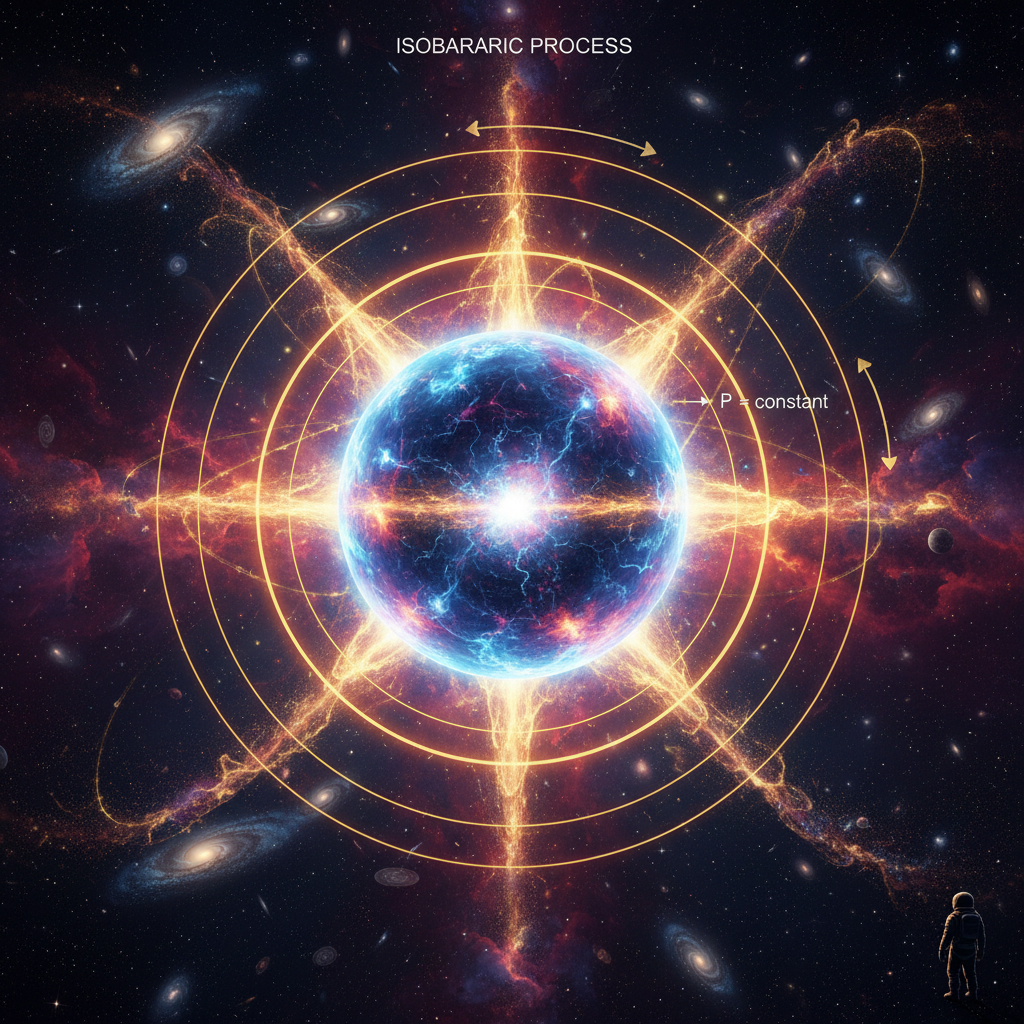
In an isobaric expansion, the work done by the gas is W = PΔV. The gas pushes against constant pressure through a change in volume. It expends energy lifting that weight, moving that piston, doing mechanical work on its surroundings.
You do work too. Every scroll is work. Every click is work. Every moment of attention directed toward the screen is energy expended against the constant pressure of the platform's design. You're pushing against an algorithmic weight that never changes its fundamental force—only its appearance.
The platform doesn't need to increase pressure because you're already doing maximum work at current conditions. Increase the pressure—make the notifications more aggressive, the design more manipulative—and you might compress instead of expand. You might delete the app. The system has found its equilibrium: constant pressure, maximum expansion, optimal work extraction.
And like the gas, you can't refuse to expand without refusing the heat entirely. The content comes in. The stimulus arrives. Under constant pressure, expansion is thermodynamically mandatory.
Heat Death of Attention
Here's what they don't tell you about isobaric processes: they can't continue forever. Eventually, you run out of cylinder. The piston hits the top. The gas can't expand further no matter how much heat you pump in. At that point, the process stops being isobaric—something has to give.
You're approaching that limit. There are only so many hours in a day. Only so much attention you can subdivide. Only so much of yourself you can expand into the digital volume before you hit the walls of physical reality. The platforms know this. They're in a race to extract maximum work before you reach maximum volume.
What happens when you can't expand anymore? When every waking moment is already claimed, every fragment of attention already monetized? The process becomes isochoric—constant volume, rising pressure. That's when things break. That's when the mental health crisis stops being a side effect and becomes the main event.
The Thermodynamics of Resistance

An isobaric process requires heat input. Remove the heat, and expansion stops. The gas doesn't push against pressure without energy flowing in. This is your leverage.
You can refuse the heat. Turn off notifications—that's reducing thermal input. Delete apps—that's removing the heat source entirely. Set boundaries around screen time—that's insulating the system. The pressure remains constant because that's how platforms are built, but without heat, there's no expansion. No work done. No value extracted.
The platforms will maintain their pressure regardless. That's their architecture, their business model, their thermodynamic design. But they can't make you expand without your participation. They can't extract work without energy input. They need you to absorb the content, to take in the stimulus, to accept the heat.
Understanding the isobaric nature of digital platforms means recognizing that the pressure is constant by design. It's not going to decrease. The platforms won't suddenly become less engaging, less sticky, less optimized for expansion. That's not how thermodynamics works. The only variable you control is the heat—the content you consume, the time you spend, the attention you offer.
At 1100db, we measure the noise floor of surveillance capitalism. The constant pressure is part of that noise—ambient, unchanging, designed to feel normal. But expansion isn't inevitable. Thermodynamic processes require specific conditions. Remove one, and the whole system changes state.
You're not a gas. You can choose to stop absorbing heat. The piston can stay exactly where it is.
**Data emitted:** 1,147 words on constant pressure and inevitable expansion. Your volume increased just by reading this. The irony is not lost on us.
Data emitted: 1,100 words • 6.5KB • 5-minute read