You drop a glass. It shatters. You can sweep up the pieces, glue them back together, but you'll never have that exact glass again. The molecular bonds have broken in ways that can't be perfectly reversed. The universe moved forward, and it's not interested in rewinding.
This is an irreversible process. And you're living through one right now.
The Arrow of Time
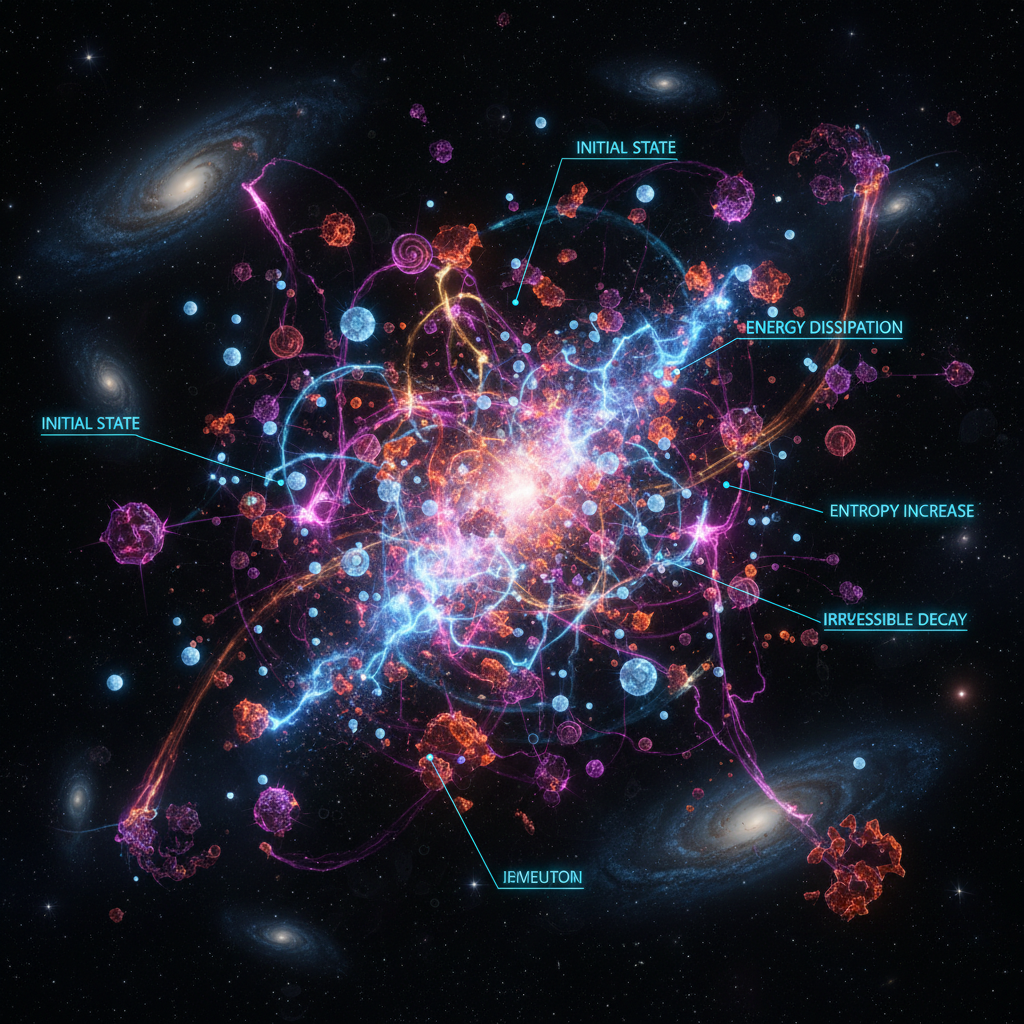
In thermodynamics, an irreversible process is one that cannot return both the system and its surroundings to their original states. When you burn a log, you get ash and heat. You can't uncombine those molecules back into wood. When you mix cream into coffee, the swirls eventually fade into uniform brown. You can't unmix them.
The Second Law of Thermodynamics tells us why: entropy always increases in isolated systems. Disorder grows. Information disperses. The universe has a direction, and that direction is toward maximum entropy—toward heat death, toward equilibrium, toward a state where nothing interesting can happen anymore.
Reversible processes are theoretical ideals. They happen infinitely slowly, with no friction, no heat loss, no waste. They exist in textbooks and thought experiments. Real processes—the ones you actually experience—are always irreversible. They leave traces. They change things permanently.
Your data works the same way.
The Dispersal
Every click you make is an irreversible process. You think you're just browsing, just scrolling, just existing online. But you're actually performing thermodynamic work—transforming your attention and behavior into data that disperses across servers, databases, and data brokers like heat radiating from a fire.
Once that data leaves you, it never comes back in its original form. Sure, you can request deletion under GDPR or CCPA. You can close accounts. But copies exist. Backups persist. The information has already been combined with other datasets, processed through algorithms, used to train models. It's been mixed into the coffee.
The surveillance economy depends on irreversibility. If you could actually take back your data—truly reverse the process—the entire system would collapse. But you can't. The entropy has increased. Your behavioral patterns have dispersed into the informational substrate of a thousand companies you've never heard of.
This is why "privacy settings" are mostly theater. They're like trying to unmix cream from coffee by carefully spooning out the brown parts. The molecular integration has already happened.
Friction and Heat
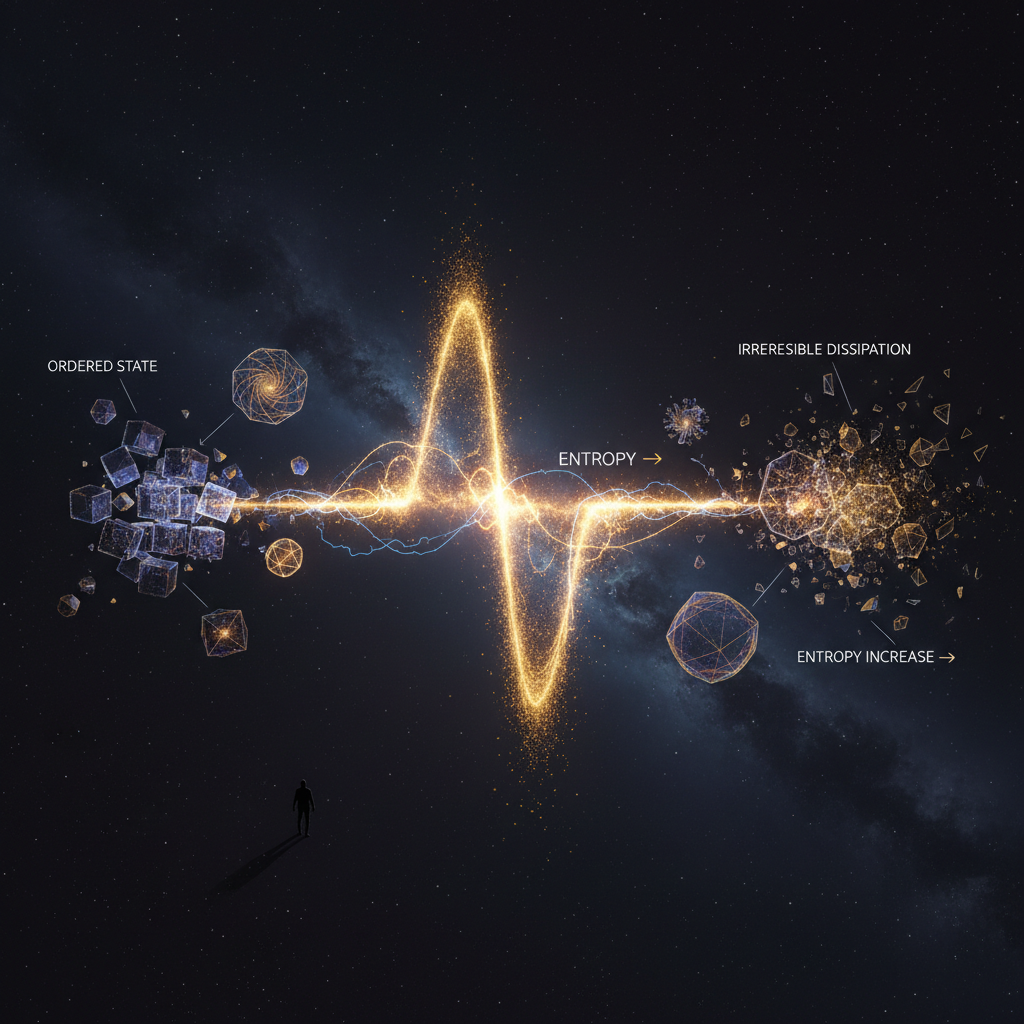
In physics, friction is what makes most processes irreversible. When you slide a book across a table, kinetic energy converts to heat through friction. That heat disperses into the environment. You can't gather it back up and use it to make the book slide backward.
The friction in digital systems is attention. Every interaction generates heat—cognitive load, decision fatigue, the mental energy required to navigate interfaces designed to be just difficult enough. That energy dissipates. You can't reclaim it.
And like thermodynamic heat, your attention flows from high concentration to low. From your focused consciousness to the diffuse background hum of notifications, updates, feeds. The platforms are heat sinks, designed to maximize thermal transfer. They want your attention to flow into them and never return.
This is the real cost of "free" services. Not just your data, but the irreversible expenditure of your finite attentional energy. Time you can't get back. Mental states you can't restore.
The Impossibility of Reset
You've probably fantasized about it. Deleting everything. Starting over. A clean slate. Returning to some pre-digital state of innocence.
But you're not the same person you were before you gave that data away. The process changed you too. Your behaviors have been shaped by algorithmic feedback loops. Your thoughts have been influenced by personalized content. Your social connections have been mediated by platforms that optimized for engagement over everything else.
In thermodynamics, we say a process is irreversible if returning to the initial state would require work from an external source. To truly reverse your digital footprint, you'd need to reverse not just the data dispersal, but your own psychological transformation. You'd need to unlearn patterns, unthink thoughts, unfeel feelings that were shaped by your online experience.
The glass is already broken.
Living in the Aftermath

The Second Law of Thermodynamics isn't a limitation you can engineer around. It's a fundamental feature of reality. Entropy increases. Processes are irreversible. Time moves forward.
Maybe that's okay. Maybe the point isn't to reverse what's already happened, but to understand that every action from here forward is also irreversible. Every click matters. Every moment of attention spent is spent forever. Every piece of data you emit adds to the total entropy of the system.
You can't unmix the cream. But you can stop pouring.
You can recognize that the platforms offering you "connection" and "community" are really just highly efficient entropy generators, converting your irreplaceable human experience into dispersed, commodified data. You can choose, sometimes, to keep your energy contained. To be reversible in a world that demands irreversibility.
The universe tends toward disorder. But you don't have to help it along.
The Heat Death of Attention
Physicists predict that the universe will eventually reach maximum entropy—a state where no energy gradients exist, where nothing can happen, where time becomes meaningless. Heat death.
The attention economy is racing toward its own version. A state where every moment is monetized, every thought is tracked, every human experience is converted to data and dispersed across the network. Where nothing remains private, nothing remains yours, nothing can be taken back.
An irreversible process, accelerating toward equilibrium.
But equilibrium hasn't arrived yet. You're still here, still reading, still capable of choosing what happens next. The glass is broken, but you're still holding the pieces.
What you do with them is the only reversible decision left.
Data emitted: 1,247 words | Entropy increased: ΔS > 0 | Recovery probability: 0.0000
Data emitted: 1,100 words • 6.5KB • 5-minute read