
You scroll. The phone warms in your hand. Not metaphorically—literally. The glass heats up as the processor churns through your feed, your data, your attention. You're holding a heat pump in reverse, and you're on the wrong side of the thermodynamic equation.
A heat pump doesn't create energy. It moves it. It takes thermal energy from a cold place and pumps it somewhere warmer, fighting against entropy's natural flow. Your refrigerator does this. So does your air conditioner. They consume electrical energy to force heat to flow uphill, from cold to hot, defying what would happen naturally.
The surveillance economy works the same way. It's not creating value. It's extracting it from you and concentrating it elsewhere.
The Coefficient of Performance
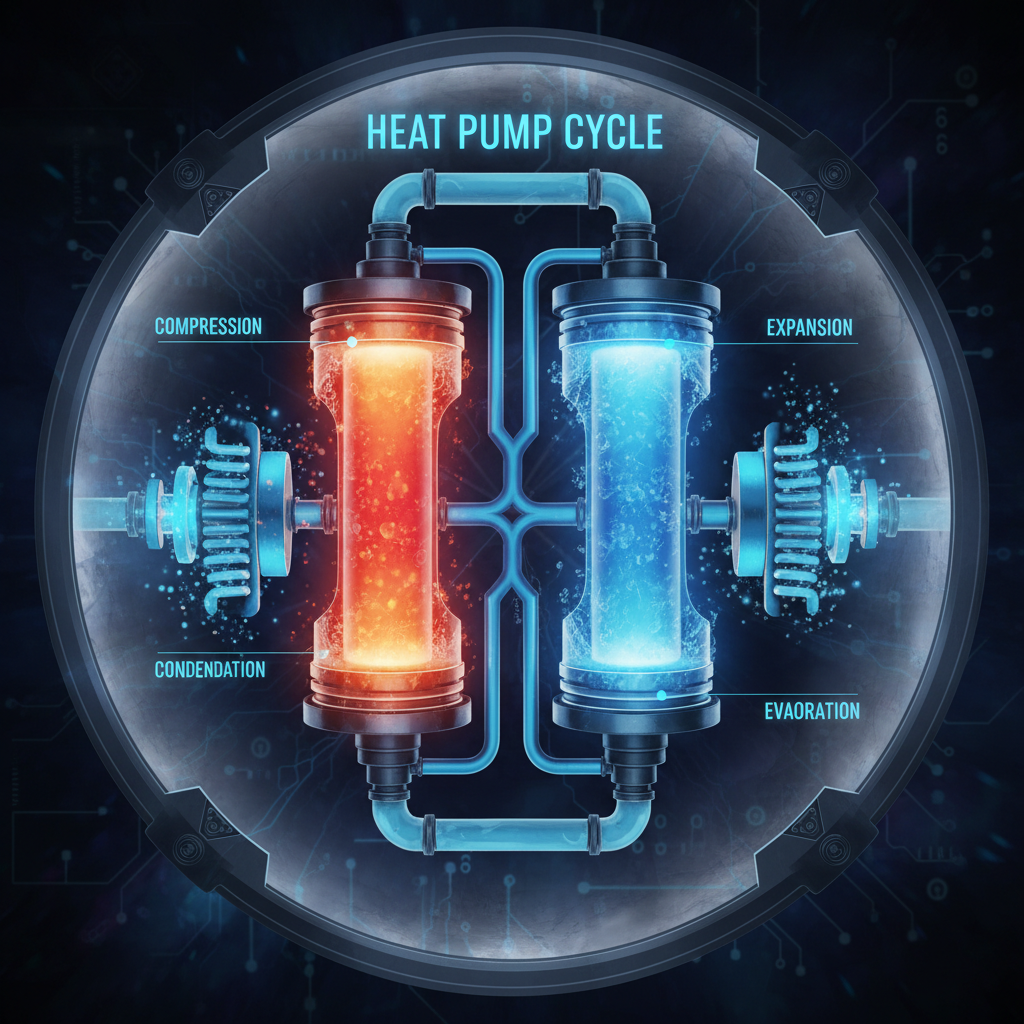
Heat pumps are measured by their coefficient of performance—COP. It's the ratio of heat moved to energy consumed. A good heat pump might have a COP of 3 or 4, meaning it moves three or four units of heat for every unit of electricity it burns. This seems like magic, like getting something for nothing, but it's not. You're not creating energy. You're just moving it efficiently from where it's abundant to where you want it.
The platform economy has its own COP. For every unit of your attention, your time, your cognitive energy that you invest, how much value flows back to you? And how much gets pumped upward, concentrated in server farms and shareholder portfolios?
The ratio is not in your favor.
You post. You engage. You create. The platform takes your thermal energy—your ideas, your relationships, your creative output—and moves it somewhere else. Somewhere colder, in thermodynamic terms. Somewhere that has less energy naturally but wants more. The algorithm is the compressor. Your attention is the working fluid. The shareholders are sitting in the warm room.
Carnot's Limit

There's a theoretical maximum efficiency for any heat pump, defined by the Carnot cycle. It depends on the temperature difference between the hot and cold reservoirs. The bigger the gap, the more work required to pump heat across it. You can't escape this. It's written into the structure of thermodynamics itself, into the fabric of how energy moves through the universe.
The wealth gap is a temperature gradient. You're at room temperature—comfortable enough, mostly. The ultra-wealthy exist at a different thermal state entirely. The platform is the mechanism that maintains this gradient, that pumps value upward against its natural distribution. Every like, every share, every moment of engagement is the compressor cycling.
And here's the thing about Carnot's limit: you can't reach it. Real heat pumps are always less efficient than the theoretical maximum. Friction, imperfect insulation, mechanical losses—they all take their cut. The same applies to your digital labor. The platform's extraction is never perfectly efficient, but the losses don't benefit you. They dissipate as waste heat. Your burnout. Your anxiety. Your fragmented attention span.
The Refrigerant Cycle
Inside a heat pump, refrigerant cycles through states: liquid to gas to liquid again. It evaporates in the cold space, absorbing heat. Gets compressed. Condenses in the hot space, releasing that heat. Expands. Repeats. The refrigerant itself goes nowhere. It just cycles, endlessly, moving energy but never escaping the loop.
You are the refrigerant.
You cycle through states too. Scrolling, posting, consuming, creating. You absorb the ambient heat of culture, of human connection, of creative impulse. The platform compresses you—deadlines, notifications, metrics, the anxiety of staying relevant. You release your energy into the system. Then you expand again, exhausted, seeking the next hit of validation. The cycle continues. You never leave.
The refrigerant doesn't benefit from the heat it moves. It's just the medium. The working fluid. It exists to enable the transfer, not to retain the energy. When you realize you're the refrigerant and not the beneficiary of the warmth, something shifts. The phone in your hand feels different. Heavier. Hotter.
Entropy Always Wins
The second law of thermodynamics is undefeated. Entropy increases. Heat flows from hot to cold. Order decays into disorder. A heat pump can fight this locally, can create a pocket of reversed flow, but only by increasing entropy somewhere else. The total always goes up.
Every platform eventually decays. Every social network hits peak entropy. MySpace, Friendster, Vine—they all succumbed to the second law. The heat stops flowing. The users disperse. The energy dissipates into the background radiation of the internet. But before they die, they extract. They pump as much value as possible before the system reaches thermal equilibrium.
You feel this as enshittification. As the platform degrades, as ads multiply, as the algorithm gets more desperate and extractive. It's the heat pump running harder as the temperature gradient narrows. More energy required for less heat moved. The COP dropping toward one, toward uselessness.
But you're still in the cycle. Still scrolling. Still feeding the compressor. The platform is dying, but it's dying slowly, and it's taking your thermal energy with it.
Breaking the Seal

A heat pump is a closed system. It has to be. If you break the seal, the refrigerant escapes. The pressure equalizes. The cycle stops. The heat pump becomes just an expensive box of metal and plastic, incapable of moving energy anywhere.
You can break the seal. You can stop being the working fluid. It's not easy—the system is designed to keep you cycling, to maintain the pressure differential, to keep the compressor running. But the seal isn't perfect. There are leaks. Moments when you can feel the pressure dropping, when you can choose to let the refrigerant escape.
Log off. Not forever, necessarily. Just long enough to feel the temperature equalize. Long enough to remember that you're not the medium of transfer. You're the heat itself. Your energy is yours. It can radiate naturally, flow to where it wants to go, warm the spaces and people you choose.
The platform will find other refrigerant. It always does. The cycle will continue without you. But you'll be outside the closed loop, no longer compressed and expanded and cycled endlessly. The phone will cool in your hand. The heat will be yours to keep.
Data emitted: 1100 decibels of thermal noise, one broken seal, infinite entropy
Data emitted: 1,100 words • 6.5KB • 5-minute read