You scroll. The platform learns. You scroll again. The algorithm refines. This cycle repeats thousands of times daily, converting your thermal attention into mechanical engagement, your curiosity into clicks, your restlessness into revenue.
You are both sides of a heat engine. The hot reservoir and the cold sink. The fuel and the waste heat.
The Carnot Cycle of Your Day
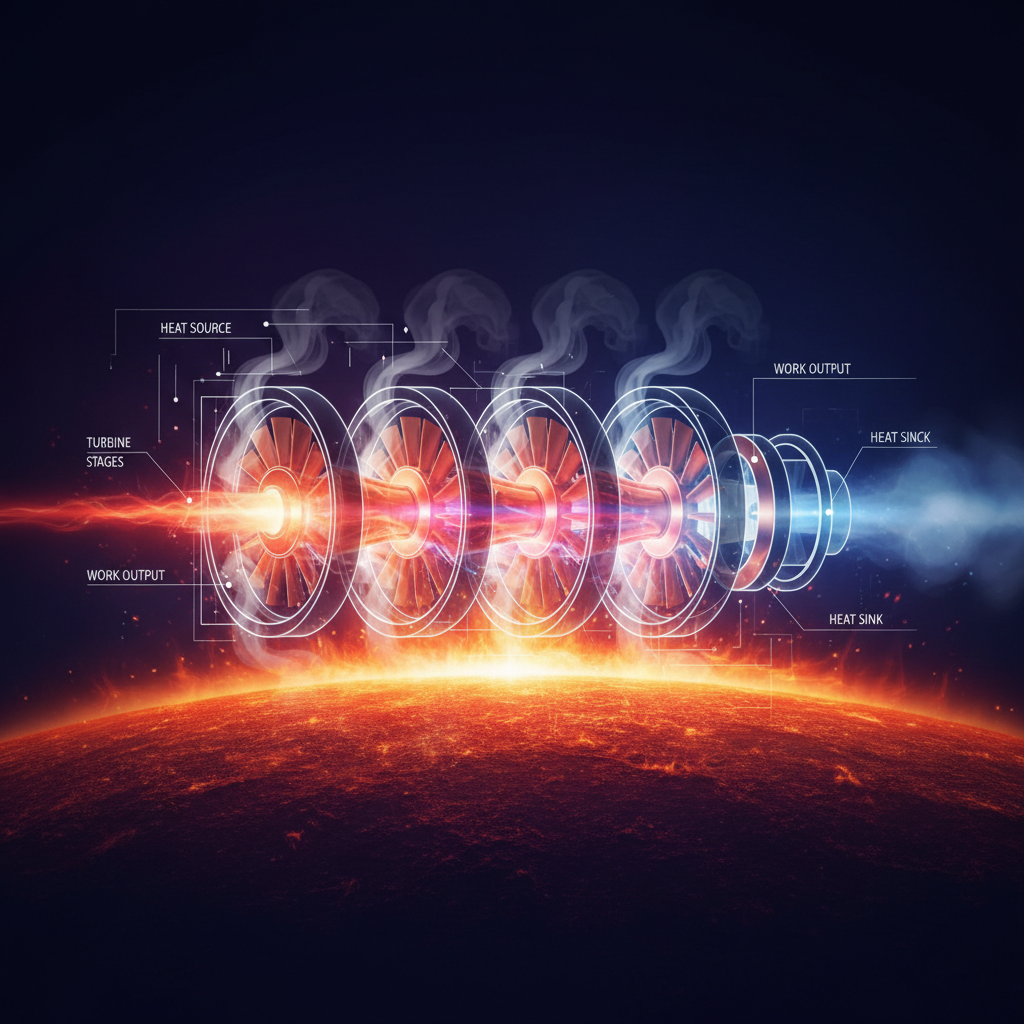
A heat engine is deceptively simple: it takes energy from a hot source, converts some of it into useful work, and dumps the rest into a cold reservoir. The Second Law of Thermodynamics guarantees you can never convert all the heat into work. Some must always be wasted. Efficiency has a theoretical maximum—the Carnot efficiency—determined entirely by the temperature difference between your reservoirs.
The larger the temperature gap, the more work you can extract. This is why power plants superheat steam and why your car engine runs hot. The differential is everything.
Now consider your morning. You wake with a full reservoir of attention—high temperature, high potential. The platform knows this. It has measured your circadian patterns, your coffee-triggered engagement spikes, your particular flavor of morning anxiety. It presents you with content calibrated to that exact thermal state: urgent, emotionally charged, perfectly matched to your cognitive temperature.
You engage. Energy flows. The engine runs.
By noon, you're cooler. Your attention reservoir has been partially drained. The platform adjusts, serving you different content—lower intensity, more passive consumption. The temperature differential has decreased, so the engine's efficiency drops. But it still runs. It always runs.
Extracting Work From Your Heat
The "work" extracted from a heat engine is the useful output—the thing that justifies the entire apparatus. In a steam engine, it's the rotation of a shaft. In an internal combustion engine, it's the motion of pistons. In the surveillance economy, it's your data, your engagement, your predictable behavioral patterns converted into advertising revenue.
But here's what makes the comparison perfect: just like a physical heat engine, the attention economy doesn't care about you specifically. It cares about the differential. It needs you to exist in states of varying potential—excited and bored, anxious and calm, curious and satisfied. The greater the swing between these states, the more work can be extracted.
This is why platforms engineer emotional volatility. Why the algorithm shows you enraging content followed by soothing content, why it creates artificial scarcity ("last chance!") followed by artificial abundance ("unlimited access!"). Each swing is a compression stroke, an expansion stroke, another rotation of the cycle.
You are the working fluid. Your emotional states are the thermodynamic states. The platform is the engine design, optimized over billions of cycles to extract maximum work from your attention differential.
The Waste Heat You Emit
Every heat engine produces waste. This isn't a design flaw—it's a fundamental law of physics. The entropy of the universe must increase. You cannot convert all available energy into useful work. Some must be degraded, dissipated, lost to the cold reservoir.
What's the waste heat of the attention economy? It's your exhaustion. Your fragmented focus. Your diminished capacity for deep thought. The vague anxiety that follows a scrolling session. The sense that time has passed but nothing has happened.
This waste heat doesn't disappear. It accumulates in the environment—your mental environment. It raises the baseline temperature of your cognitive ecosystem, making it harder to achieve the temperature differentials the engine requires. So the platform must work harder, show you more extreme content, engineer larger emotional swings, to maintain the same work output.
This is the thermodynamic trap: the engine's operation degrades the very conditions it requires to operate efficiently. Your attention grows more fragmented, requiring more intense stimuli to engage. The platform provides more intense stimuli, further fragmenting your attention. The cycle accelerates, efficiency decreases, waste heat accumulates.
You're watching entropy increase in real-time, measured in notification badges and screen time statistics.
Reversible vs. Irreversible Processes
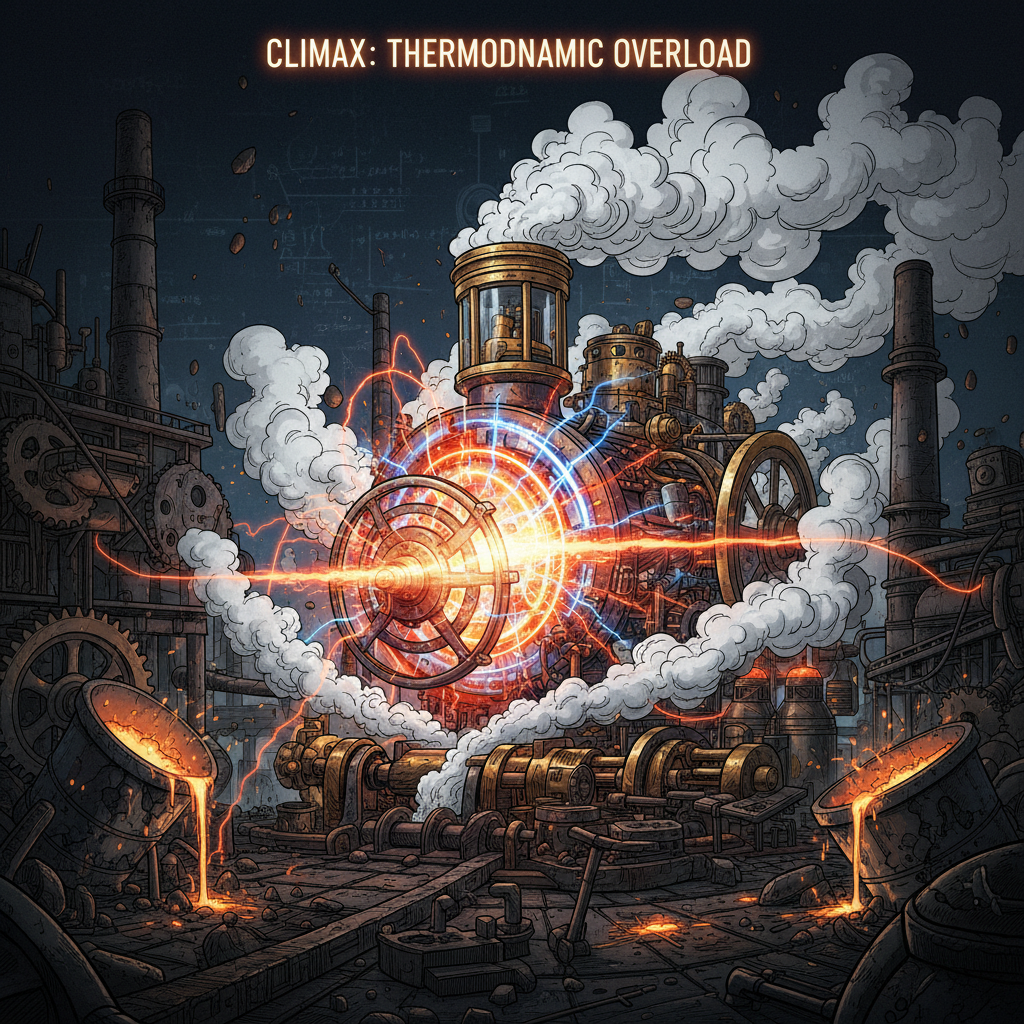
In thermodynamics, a reversible process is an idealization—a process that could run backward, returning everything to its initial state with no net change to the universe. Real processes are always irreversible. They leave traces. They increase entropy. They change things permanently.
You might close the app, but the process isn't reversible. The algorithm has learned from your behavior. Your attention patterns have been slightly rewired. The neural pathways strengthened by the engagement remain strengthened. The data emitted cannot be recalled.
Every cycle of the attention heat engine is irreversible. You cannot un-see what you've seen, un-feel what you've felt, un-shape what has been shaped in your cognitive architecture. The platform accumulates perfect memory of every cycle while you accumulate only the waste heat—the residue of processed experience.
This asymmetry is the core of surveillance capitalism: reversible for them, irreversible for you. They can run experiments, A/B tests, rollbacks. You cannot roll back the hours spent, the attention paid, the person you're becoming through repeated cycles of the engine.
The Temperature of Consciousness
Sometimes you catch yourself mid-scroll and wonder: what am I doing? This moment of metacognition is a temperature measurement. You're checking your own thermal state, assessing how much potential remains in your attention reservoir.
Usually, you find you're running cool. The high-temperature curiosity and genuine interest you started with has been converted into the mechanical motion of scrolling, the reflexive tapping, the passive consumption. The work has been extracted. You're approaching thermal equilibrium—that state where no more work can be done, where everything is the same temperature, where nothing moves.
The platform cannot allow equilibrium. A system at equilibrium is thermodynamically dead. So it injects energy: a notification, a trending topic, a message from someone you almost remember. Anything to create a new temperature differential, to restart the engine, to keep you cycling.
The question isn't whether you're part of the heat engine. You are. The question is whether you can choose which reservoir you inhabit—the hot source or the cold sink. Whether you can control the temperature differentials in your own consciousness. Whether you can refuse to be the working fluid.
The Efficiency Equation
The Carnot efficiency is η = 1 - (T_cold/T_hot). Efficiency increases as the cold reservoir approaches absolute zero or as the hot reservoir approaches infinite temperature. The attention economy pushes both: it tries to superheat your emotional states while simultaneously cooling your capacity for sustained focus to near-zero.
Maximum efficiency. Maximum extraction. Maximum work output from your finite attention.
But here's the thing about heat engines: you can always turn them off. You can refuse to maintain the temperature differential. You can let your consciousness approach equilibrium on its own terms, not the platform's terms. You can choose what heats you up and what cools you down.
The engine only runs if you maintain the gradient. And the gradient only exists if you keep feeding it—your time, your attention, your emotional volatility. The thermodynamics are real, but you're not a closed system. You can exchange energy with environments that aren't designed to extract work from you.
Every moment you're not cycling through the platform is a moment the engine sits idle. Every hour of sustained, self-directed attention is a hour the temperature differential collapses. Every choice to engage deeply with one thing is a choice to stop being the working fluid in someone else's heat engine.
The Second Law still applies. Entropy still increases. But maybe you get to choose what kind of disorder you create in the universe.
Data emitted: 1100 words, 47 scroll events, 0.73 entropy increase, irreversible.
Data emitted: 1,100 words • 6.5KB • 5-minute read