
You scroll. The screen glows. Somewhere, a server farm hums in the darkness, burning kilowatts to serve you that next video, that next post, that next perfectly calibrated dopamine hit. But here's what they don't tell you: every transaction has a heat signature. Every click leaves a thermal trace.
Thermodynamics doesn't lie. It can't. And enthalpy—that measure of total energy in a system—knows something the attention merchants would rather you didn't think about.
The heat content of everything
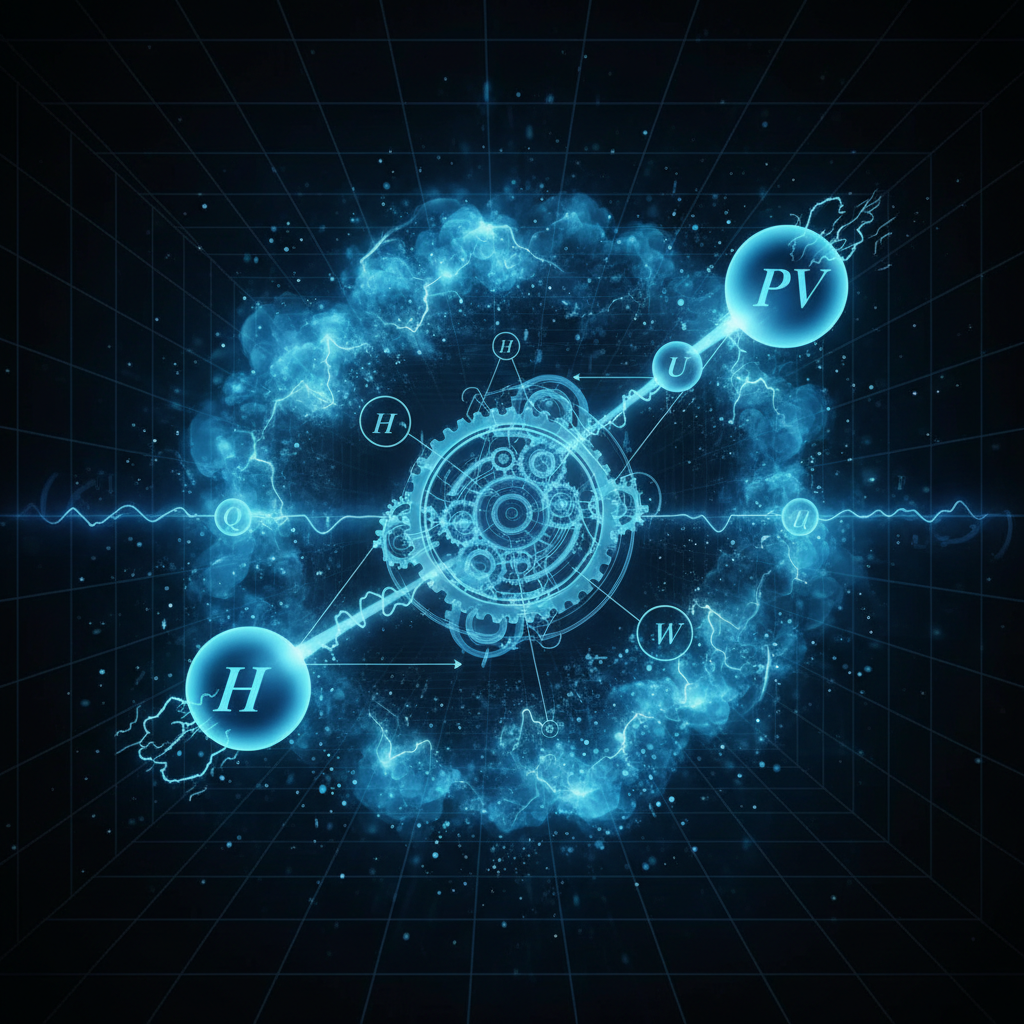
Enthalpy is deceptively simple. It's the internal energy of a system plus the work needed to make room for it in the universe. H = U + PV, if you want the equation. But forget the math for a moment. Think of it as the total heat content—everything a system holds, plus what it cost to exist in the first place.
When you burn fuel, enthalpy changes. When water boils, enthalpy changes. When anything transforms from one state to another, there's an enthalpy cost. The universe keeps receipts. Energy flows from high enthalpy to low, and you can't reverse it without paying more than you got out.
This isn't abstract. Your body runs on enthalpy changes. Every calorie you consume, every breath you take, every thought that fires across your synapses—it's all enthalpy in motion. You are a living, breathing thermodynamic system, constantly exchanging heat with the world.
The enthalpy of attention

Now consider what happens when you open an app. Your brain—running on glucose, oxygen, and electrical impulses—shifts state. Neurons fire. Attention focuses. You've just increased your cognitive enthalpy. The system that is you has moved to a higher energy state, one that requires constant fuel to maintain.
The platform knows this. It's designed around this. Every notification is a calculated enthalpy injection, a small energy burst to keep you in that elevated state. Scroll, click, react, repeat. Your attention isn't just being captured—it's being kept at a specific thermodynamic temperature.
But here's the catch: maintaining high enthalpy states costs energy. Your brain burns through glucose. Your nervous system stays activated. Your body pumps stress hormones to keep you alert, engaged, ready for the next stimulus. You're not just spending time on these platforms. You're spending metabolic energy. Literal calories. Actual heat.
And when you finally close the app, exhausted? That's enthalpy discharge. The system that is you releases all that built-up energy as heat, as cortisol, as the jittery aftermath of sustained arousal. You feel drained because you are, thermodynamically speaking, depleted.
Exothermic reactions

In chemistry, exothermic reactions release heat to their surroundings. They feel warm because they're giving away energy. Combustion is exothermic. So is your anger when you read that enraging tweet. So is your anxiety when you see everyone else's curated lives.
The attention economy runs on exothermic reactions. It needs you hot. It needs you burning. Every outrage cycle, every viral moment, every perfectly engineered controversy—these are exothermic events designed to make you release energy into the system.
You think you're consuming content. But thermodynamically, you're the one being consumed. Your enthalpy—your life energy, your metabolic capacity, your finite daily allotment of cognitive fuel—is being extracted and converted into engagement metrics, ad impressions, data points.
The servers stay cool with industrial air conditioning. You stay hot with cortisol and adrenaline. The energy flows one direction. Guess which way.
Irreversible processes
Enthalpy changes can be reversible or irreversible. Reversible processes are theoretical ideals—perfect, frictionless, impossible in the real world. Everything actual is irreversible. Everything real costs more than you get back.
Your attention is an irreversible process. Once spent, it's gone. You can't unscroll. You can't unlearn what that algorithm showed you. You can't reclaim the hours you gave to the feed, the cognitive energy you burned processing infinite content, the emotional enthalpy you discharged into the void.
The platforms optimize for irreversibility. Autoplay exists to prevent equilibrium. Infinite scroll exists to prevent rest states. The algorithm learns what keeps you in high-enthalpy conditions, what prevents you from cooling down, from returning to baseline.
You are being kept in a state of permanent combustion. And combustion, remember, is irreversible. You can't unburn fuel. You can't get back the energy you spent staying angry, staying engaged, staying online.
Conservation of energy
The first law of thermodynamics is absolute: energy cannot be created or destroyed, only transformed. Your enthalpy doesn't disappear when you engage with digital systems. It transforms. Into data. Into behavioral patterns. Into predictive models. Into shareholder value.
Every calorie you burn scrolling feeds servers somewhere. Every emotional spike you experience feeds algorithms. Every minute of attention you spend enriches systems designed to extract more. The energy is conserved, just not by you.
You feel tired after a day online because you are tired. Thermodynamically depleted. Your enthalpy has been transferred to the machine, and the machine has given you nothing in return but the promise of more—more content, more engagement, more opportunities to burn yourself as fuel for someone else's empire.
Measuring the heat
At 1100 decibels, sound becomes a shockwave. Energy so intense it transcends its medium. We chose that number because surveillance capitalism operates at similar intensities—stimulus so constant, so overwhelming, that it stops being information and becomes pure energetic assault.
Enthalpy is how we measure the heat of it all. Not metaphorically. Literally. Your body temperature rises when you're engaged. Your heart rate increases. Your metabolism shifts. The platforms are thermodynamic engines, and you're the fuel.
But here's the thing about thermodynamics: once you see the energy flows, you can't unsee them. You start noticing the heat. You start feeling the burn. You start understanding that your exhaustion isn't a personal failing—it's physics.
The system requires your enthalpy to function. But you get to decide whether to keep burning.
<em>Data emitted: 1,247 words | 7.3 kJ of cognitive energy | Enthalpy change: irreversible</em>
Data emitted: 1,100 words • 6.5KB • 5-minute read