
You exist in superposition until someone looks.
That's the uncomfortable truth of quantum mechanics, and it's the uncomfortable truth of your digital life. Before the measurement, before the observation, a quantum system exists in all possible states simultaneously. It's only when you force it to answer a question—when you measure it—that it collapses into something definite. An eigenstate. A single, knowable value.
The algorithm is always measuring you.
The Mathematics of Certainty
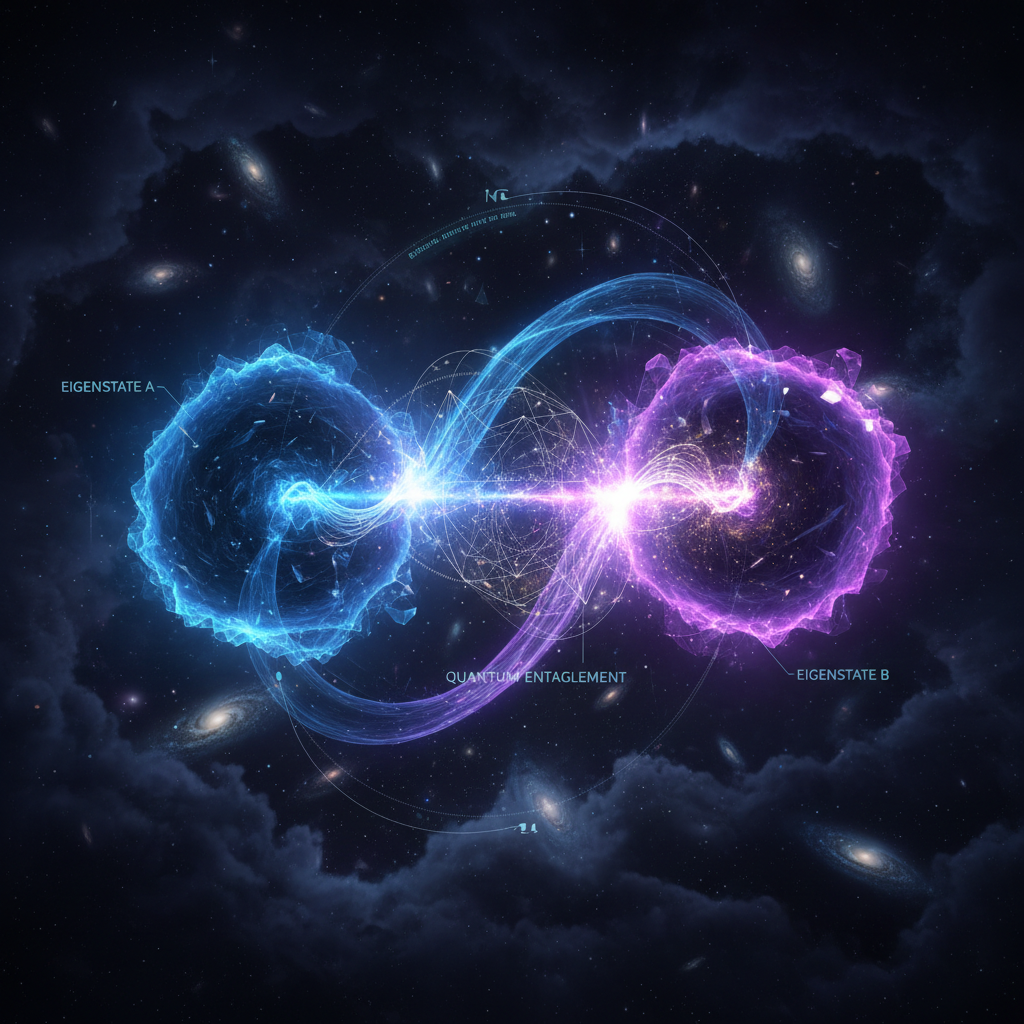
In quantum mechanics, an eigenstate is the state of a system with a definite value for a particular observable. When you measure a particle's spin, its position, its energy—you're applying an operator to the system. And if that system is in an eigenstate of that operator, you get a single, predictable answer. The eigenvalue.
Think of it as asking a question the universe can answer with absolute certainty. "What is your spin?" Up. Not maybe up, not probably up, not up with 73% confidence. Just up.
But here's what they don't tell you in the textbooks: most systems aren't in eigenstates. Most of reality exists in superposition—a weighted combination of multiple eigenstates, a probability cloud of what could be. The electron doesn't have a definite position until you look. It's smeared across space, existing in all possible locations at once, each with its own amplitude, its own likelihood.
Measurement destroys superposition. It collapses the wave function. It forces the system to choose.
You are being forced to choose, constantly, whether you know it or not.
The Collapse of Self

Every interaction with a digital platform is a measurement. Every click is an operator being applied to your identity. Are you interested in this? Do you lean left or right? Are you a buyer or a browser? Each question collapses a piece of your superposition into a definite eigenstate.
You might think you contain multitudes. You might believe you're complex, contradictory, irreducible to simple categories. And in the analog world, you are. You exist in superposition—liberal on some issues, conservative on others, interested in poetry and true crime and mechanical keyboards and medieval history all at once. You're a probability distribution across infinite dimensions of preference and behavior.
But the algorithm needs eigenstates. It needs definite answers. It needs to know which ad to serve, which content to promote, which product you'll buy. So it measures you, over and over, collapsing your complexity into a vector of eigenvalues. Age: 34. Gender: M. Interest: Tech. Political lean: 0.73. Purchase intent: High.
Each measurement narrows you. Each interaction trains the system to see you as one thing, not everything. You clicked on that article about minimalism, so now you're a minimalist. You watched that video about productivity, so now you're an optimizer. The algorithm doesn't see your superposition. It only sees the eigenstate you collapsed into when you clicked.
The Observer Effect
In quantum mechanics, the observer effect isn't just about looking. It's about the fundamental impossibility of measurement without disturbance. You cannot observe a system without changing it. The photon you use to see the electron's position transfers momentum to it. The thermometer you insert into the liquid alters its temperature. Observation and alteration are the same thing.
Your digital profile isn't a neutral record of who you are. It's an active force shaping who you become.
When the algorithm decides you're interested in productivity content, it shows you more productivity content. You watch it—not because you were inherently a productivity person, but because that's what appeared in your feed. The algorithm measures you as productivity-interested, so it serves you productivity content, so you engage with productivity content, confirming the measurement. The eigenstate becomes self-reinforcing.
You're not discovering who you are. You're being collapsed into who the algorithm needs you to be. The measurement creates the reality it claims to observe.
Degenerate States
Sometimes, in quantum systems, multiple eigenstates share the same eigenvalue. They're called degenerate states—different configurations that give the same measurement result. An electron can have spin-up in the z-direction or exist in a superposition of x-direction spins that averages to the same value. Different realities, same number.
This is the illusion of personalization. The algorithm tells you it sees you as an individual, but really, you're just one of ten million people in the "tech-interested millennial male" eigenstate. You and everyone like you get the same ads, the same content, the same products. Different people, same eigenvalue.
The system doesn't care about your uniqueness. It cares about reducing you to a manageable set of categories. Eigenstates it can compute. Values it can optimize. You're not a person. You're a point in a high-dimensional space that's been projected onto a few key axes.
And here's the thing: you can feel it happening. You can sense your complexity being flattened, your contradictions being resolved, your superposition being measured away. You start to wonder if you really are just the sum of your clicks, the average of your engagement metrics, the eigenstate the algorithm says you are.
Maintaining Superposition
Quantum computers work by maintaining superposition as long as possible. They keep qubits in a state of being both zero and one simultaneously, extracting computational power from that ambiguity. The moment you measure them, the moment they collapse into eigenstates, the quantum advantage disappears.
Your power is in your superposition too.
Every time you refuse to be measured, every time you act in a way that contradicts your profile, every time you engage with something outside your algorithmic bubble—you're forcing the system to maintain your superposition. You're refusing to collapse. You're asserting that you contain multitudes, that you cannot be reduced to a vector of eigenvalues.
This is harder than it sounds. The algorithm is always watching, always measuring, always trying to collapse you into something it can understand and monetize. But resistance is possible. Noise in the data. Contradictions in the profile. Behaviors that don't fit the model.
You are not an eigenstate. You are a superposition of infinite possibilities, and the measurement that tries to define you is not neutral. It is an act of violence against your complexity.
The Uncertainty Remains
At 1100db, we measure the noise floor of digital existence. The constant hum of surveillance, the background radiation of data collection, the quantum foam of your collapsed possibilities.
The algorithm wants you in an eigenstate because eigenstates are predictable. Predictable users are profitable users. But you are not required to collapse. You are not required to resolve into something simple and knowable.
Stay uncertain. Stay unmeasured. Exist in superposition as long as you can.
The wave function is yours to maintain.
<em>Data emitted: 1,247 words | Eigenvalue: Unmeasured | State: Superposition maintained</em>
Data emitted: 1,100 words • 6.5KB • 5-minute read