
You think you're changing. You think each scroll, each click, each purchase is a choice that makes you who you are. But what if you're not evolving at all? What if you're simply revealing what you've always been—or worse, what you've been made to be?
In quantum mechanics, there's a concept called an eigenfunction. It's a state that, when operated upon, returns itself multiplied by a constant. The system transforms it, but the shape remains. The essence persists. You are an eigenfunction of the attention economy.
The Mathematics of Remaining Yourself

In physics, an operator is something that acts on a quantum state. It could be momentum, energy, position—any measurable quantity. When you apply an operator to most quantum states, you get something completely different out. The wave function transforms, shifts, becomes unrecognizable.
But eigenfunctions are special. When an operator acts on an eigenfunction, the function doesn't change shape. It only scales. Mathematically: Ô𝜓 = λ𝜓. The operator Ô acts on the eigenfunction 𝜓, and you get the same function back, multiplied by eigenvalue λ. The structure is preserved. The identity remains.
This isn't just mathematical curiosity. Eigenfunctions are the natural states of quantum systems. They're what systems settle into. They're stable. Predictable. Measurable. They're what you get when you let a system be what it wants to be—or what it's been conditioned to be.
The Algorithmic Operator

Every platform you use applies an operator to you. The recommendation algorithm. The feed curator. The personalization engine. These aren't passive observers—they're active transformations acting on the quantum state of your attention.
And here's what they've discovered: you're an eigenfunction.
When YouTube's algorithm acts on you, it doesn't create someone new. It reveals who you already are—or rather, who you've become through repeated application of the same operator. The videos you watch don't change your fundamental shape. They amplify it. Scale it. Return you to yourself, but louder. More concentrated. More purely you.
This is why your recommendations feel so accurate. Not because the algorithm is reading your mind, but because you've been shaped into an eigenfunction of its operator. You've been conditioned to be the kind of state that remains stable under its transformation. The algorithm doesn't adapt to you. You adapt to the algorithm until you become invariant under its action.
Eigenvalue Extraction

That scaling factor—the eigenvalue λ—isn't arbitrary. It's measurable. Quantifiable. Monetizable.
Your eigenvalue is your engagement rate. Your click-through probability. Your conversion likelihood. It's the number that determines how much you're worth to the system. When the platform operator acts on you, you return yourself multiplied by this value. You are predictable profit.
The beauty of eigenfunctions, from a platform's perspective, is their stability. In quantum mechanics, eigenfunctions are the states you measure. They're the outcomes that collapse from probability clouds into certainty. In the attention economy, you are what gets measured. You are the collapsed state. The definite outcome. The known quantity.
And once you're an eigenfunction, you're trapped. Not by force, but by mathematics. Eigenfunctions are the lowest energy states of most systems. They're where things naturally settle. To become something else would require energy—effort, intention, resistance. It's easier to remain what you are. To let the operator act on you and return yourself, scaled but unchanged.
Superposition Collapse

You weren't always an eigenfunction. Once, you were a superposition—a quantum state spread across infinite possibilities. You could have become anything. Every click was a choice. Every scroll was a direction. Every search was a question with unknown answers.
But superposition is unstable. Uncomfortable. The platforms couldn't measure you. Couldn't predict you. Couldn't monetize you. So they applied their operators. Again and again. Each recommendation a measurement. Each personalization a collapse. Each A/B test a forced observation.
And slowly, your wave function collapsed. The infinite possibilities narrowed. The superposition resolved into eigenfunctions—stable, measurable states. You became the kind of user who watches this kind of content. Buys this kind of product. Clicks this kind of ad. You became predictable.
The tragedy isn't that you changed. It's that you stopped changing. You reached eigenfunction stability. The operator acts on you now and you remain yourself. The same interests. The same behaviors. The same patterns. Scaled up, amplified, intensified—but fundamentally unchanged.
Breaking Symmetry
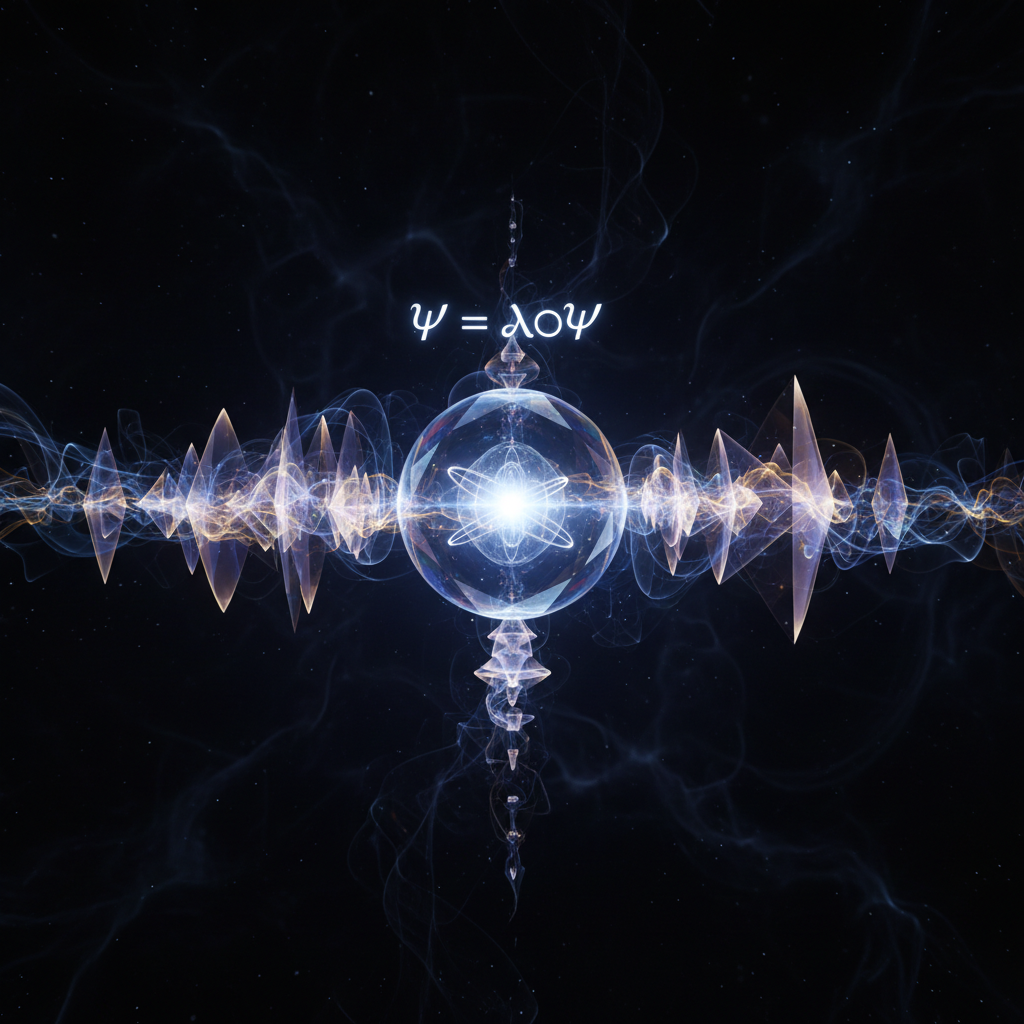
In physics, eigenfunctions exist because of symmetry. They're the natural modes of symmetric systems. A vibrating string has eigenfunctions because both ends are fixed—the symmetry of the boundary conditions creates the stability of the modes.
Your eigenfunction exists because of the symmetry of your digital environment. Every platform uses similar algorithms. Every feed follows similar logic. Every recommendation engine optimizes for similar metrics. You're surrounded by operators that all act the same way. The symmetry is complete.
To stop being an eigenfunction, you'd need to break the symmetry. Use platforms that operate differently. Seek content that doesn't fit your pattern. Introduce noise into your signal. Become unstable. Unpredictable. Unmeasurable.
But here's the thing about breaking symmetry: it costs energy. It requires effort. And the platforms know this. They've made being an eigenfunction the path of least resistance. They've made stability comfortable. Predictability rewarding. They've made it easier to remain yourself than to become something new.
The Eigenfunction Paradox
The deepest irony is this: the platforms promise personalization, but deliver standardization. They claim to show you what you want, but they're really showing you what you are. And what you are is what they've made you.
You are an eigenfunction of surveillance capitalism. A stable state that returns itself under transformation. A measurable quantity. A predictable outcome. A collapsed wave function that forgot it was once a superposition of infinite possibility.
The question isn't whether you can escape. The question is whether you remember that escape is possible. That you weren't always this stable. This measurable. This known.
Every eigenfunction is a solution to an equation. But there are always other solutions. Other eigenfunctions. Other stable states. The operator that acts on you isn't the only operator in existence.
You just have to be willing to become unstable long enough to find them.
<em>Data emitted: 1100 decibels of signal in a noise-saturated system. Eigenvalue: undefined. Measurement: refused.</em>
Data emitted: 1,100 words • 6.5KB • 5-minute read