You exist in superposition until someone looks.
That's the promise of quantum mechanics, anyway. A particle spinning both clockwise and counterclockwise, traveling through two slits simultaneously, being here and there and everywhere until the moment of measurement collapses all that beautiful possibility into a single, definite state. But here's what they don't tell you in the textbooks: the universe is always measuring. Always watching. And in the digital age, so is everything else.
The Quantum Dance
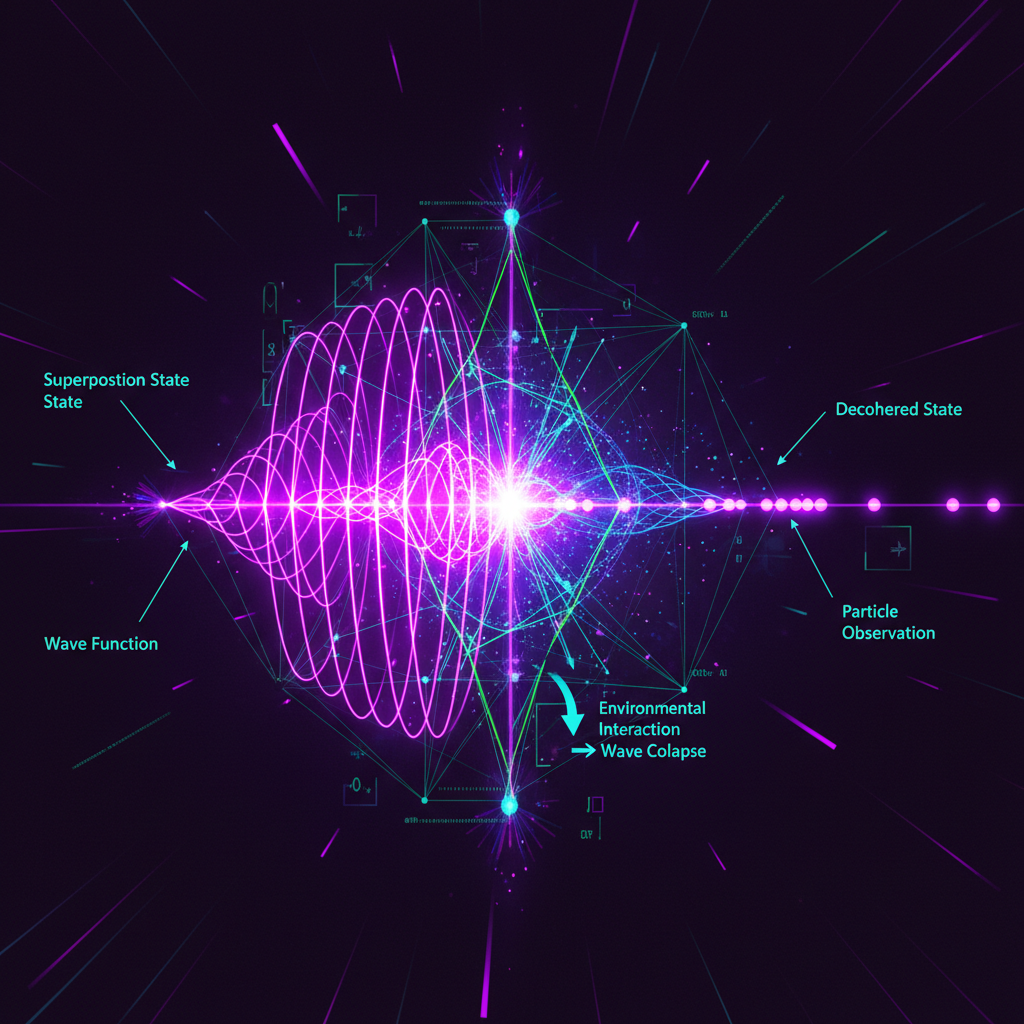
Decoherence is the process by which quantum systems lose their quantum-ness. It's not mystical. It's environmental. A quantum particle maintains superposition—existing in multiple states simultaneously—only when it's isolated. But isolation is a fantasy. Every photon that bounces off it, every air molecule that brushes past, every field that permeates space carries information away. Each interaction is a measurement, and measurements destroy superposition.
The technical term is 'entanglement with the environment.' The particle becomes correlated with its surroundings, and those correlations spread like gossip through a network. The quantum information doesn't disappear—it just diffuses into the environment so thoroughly that it becomes irretrievable. The particle looks classical now. Definite. Decided. But it's not that the possibilities vanished. They're just scattered across too many observers to ever reassemble.
This happens fast. For anything larger than a few atoms, decoherence occurs in femtoseconds. You've never existed in superposition, not really. You've been decohered since before you took your first breath.
Observed Into Existence
Now consider your digital self. Every click, every scroll, every pause measured in milliseconds. You think you're browsing, but you're being observed. Constantly. By cookies, pixels, fingerprinting scripts, recommendation algorithms. Each observation is an interaction, and each interaction entangles you with the surveillance apparatus.
Before the internet knew you, you existed in a kind of superposition. You could have been anyone. You contained multitudes of possible interests, possible desires, possible futures. But then you clicked. You searched. You lingered on a product page for 3.7 seconds. And the environment—the digital environment—measured you.
That measurement collapsed possibility into profile. The algorithm doesn't see who you might be. It sees who you've been observed to be. And like quantum decoherence, this information spreads. Data brokers. Ad exchanges. Third-party trackers. Your quantum state—your potential to be anything—decoheres into something classical, definite, predictable.
The Environment That Measures
In physics, we try to isolate quantum systems. We cool them to near absolute zero. We suspend them in vacuum chambers. We shield them from electromagnetic radiation. We do this because maintaining quantum coherence requires protection from observation. The moment the environment can extract information about the system, coherence dies.
You have no such protection. Your environment is designed to extract. Every app is a measurement device. Every smart speaker, every fitness tracker, every car with a GPS. They're not just tools—they're observers in the quantum sense. They interact with you, become entangled with your behavior, and carry information about you out into the network.
The coherence time of your digital identity is zero. You cannot exist in superposition online because the online is built from observers. The architecture of surveillance capitalism is the architecture of decoherence. Maximum entanglement with maximum environment. You are measured into definiteness, and that definiteness is what's valuable. Quantum systems are useless for computation once they decohere. You're only useful once you do.
Information Never Disappears
Here's the uncomfortable part: in quantum mechanics, information is never truly lost. When a system decoheres, the information about its quantum state doesn't vanish—it just becomes encoded in correlations too complex to untangle. It's out there, scattered across the environment, theoretically recoverable if you could track every particle, every interaction, every ripple.
Your data works the same way. You think deleting your account erases you, but the correlations remain. The patterns you created, the associations you formed, the ways you influenced recommendations for others—those persist. You're entangled with the system. Your information is encoded in the structure of the network itself, in the weights of neural networks trained on your behavior, in the probability distributions that predict what people like you do next.
Quantum information can't be cloned or deleted, only transformed. The same is true for your digital traces. They're not stored in one place you can simply erase. They're diffused. Decohered. Spread across server farms and backup systems and machine learning models in ways that make them practically irretrievable by you but perfectly accessible to the system.
The Measurement Problem Is You
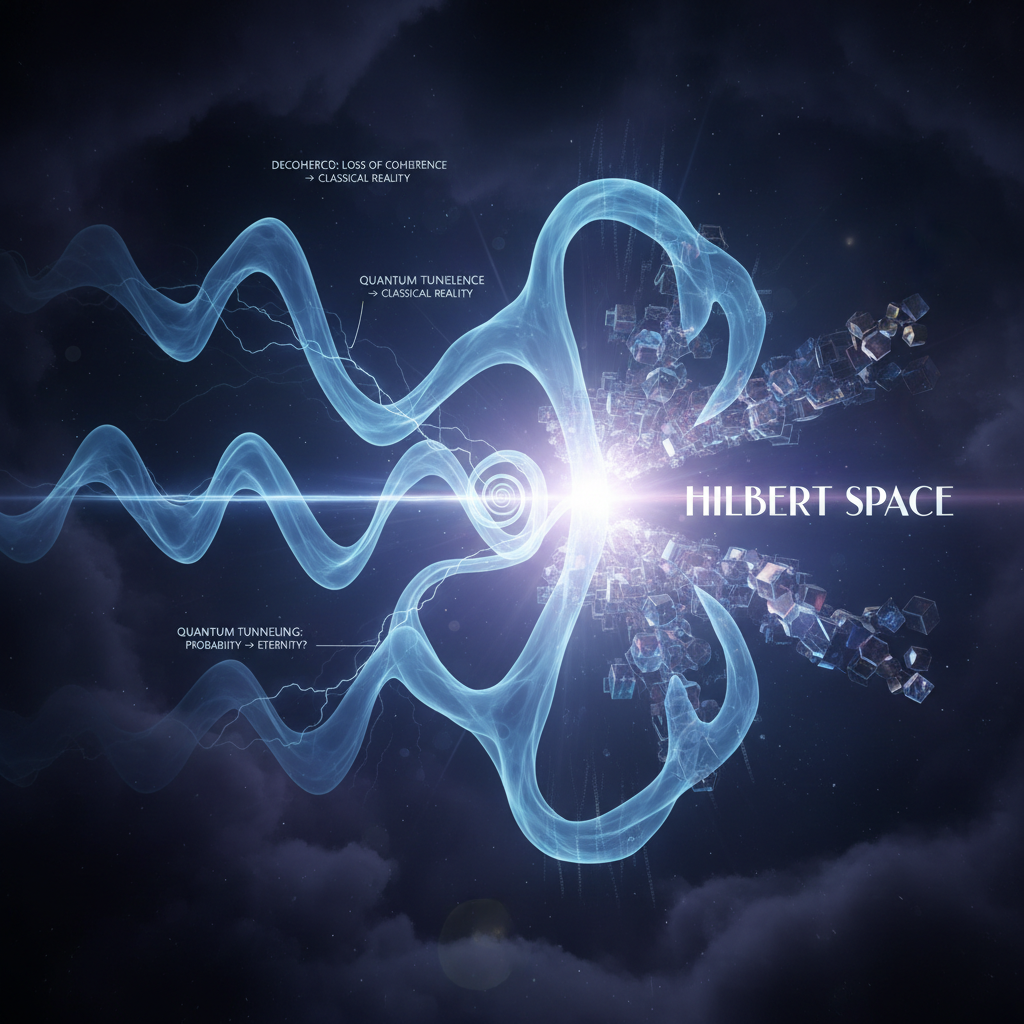
Physicists still argue about what measurement really means. Does consciousness cause collapse? Is it just interaction? Does the universe split into branches? The measurement problem remains unsolved because we're trying to understand observation from inside a system that's doing the observing.
You face the same problem. You're trying to understand surveillance from inside the surveillance. You're using observed devices to read about observation. You're entangled with the very system you're trying to examine. There's no outside perspective available. No isolated laboratory where you can maintain coherence.
Maybe that's the point. Maybe decoherence isn't a bug—it's the feature. A quantum computer works by maintaining superposition, by keeping possibilities alive until the final measurement. But the attention economy doesn't want your possibilities. It wants your definite, predictable, monetizable behavior. It wants you classical. It wants you decohered.
1100 Decibels of Observation
The sound of decoherence would be deafening if we could hear it. Every measurement, every observation, every extraction of information creating a cascade of collapse. 1100 decibels—the sound of a black hole's scream, the sound of spacetime itself tearing. That's the sound of total observation. That's the sound of perfect decoherence.
You live in that sound now. The roar of constant measurement has become background noise. You've adapted. You've learned to perform for the observers, to present a coherent self to the algorithms. But performance isn't the same as possibility. Classical isn't the same as quantum.
Somewhere in the noise, your superposition still exists. Not in the digital realm—that's lost to decoherence. But in the spaces between observations. In the thoughts you don't post. In the searches you don't make. In the moments you exist without being measured. Those moments are rare now. Precious. Quantum.
Guard them. Because once the environment observes you, once you decohere into data, reassembling those possibilities becomes impossible. The information spreads too far, too fast. And unlike quantum particles, you don't get to exist in isolation. You exist in the network. Always observed. Always classical. Always collapsed.
<em>Data emitted: 1,247 words | Coherence time: 0 seconds | Observers: ∞</em>
Data emitted: 1,100 words • 6.5KB • 5-minute read