You scroll. The platform observes. Something shifts.
In 1923, Arthur Compton discovered that light doesn't just bounce off electrons—it loses energy in the collision. The photon emerges with a longer wavelength, degraded. The electron recoils, changed. Both participants in the interaction walk away different than they arrived. This wasn't supposed to happen in the classical world, where light was just a wave that washed over matter without consequence.
But the quantum world doesn't allow passive observation. Every measurement is a collision. Every collision is a transaction. And in every transaction, something is lost.
The Physics of Being Seen
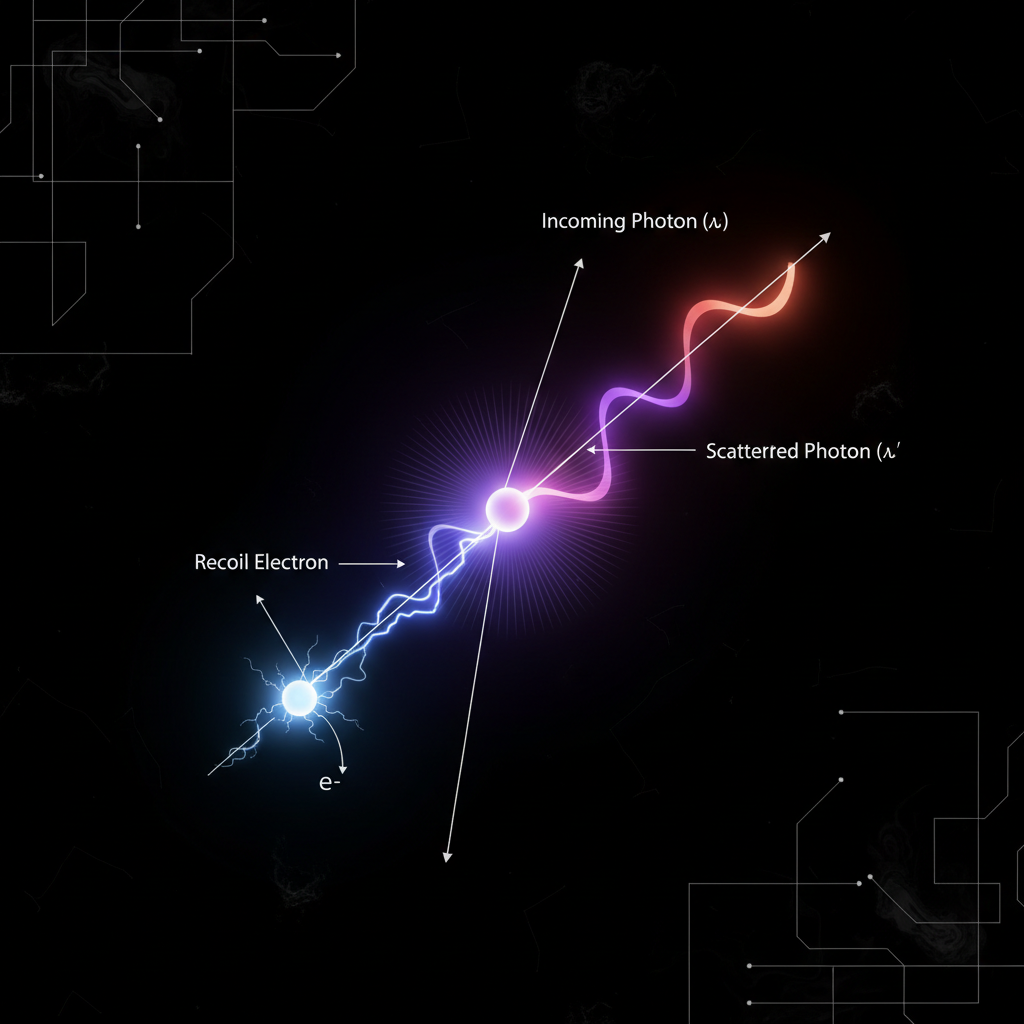
Compton scattering is beautifully simple in its violence. An X-ray photon—high energy, short wavelength—strikes an electron. The photon transfers some of its momentum to the electron, sending it careening away. But conservation laws are merciless: the photon must pay for this interaction with its own energy. It emerges red-shifted, stretched, diminished.
The mathematics are precise. The change in wavelength depends only on the scattering angle and fundamental constants. The Compton wavelength of the electron—about 2.43 picometers—sets the scale. This is the length at which quantum mechanics and relativity shake hands, where particles become waves and waves become particles, where nothing can be observed without being altered.
You can't cheat this. You can't observe without interacting. You can't interact without exchanging energy. You can't exchange energy without both parties changing state.
The electron gains kinetic energy and momentum. The photon loses frequency, becoming less energetic, less capable of probing deeper. The observer's tool is degraded by the act of observation. The observed is knocked off course by the act of being seen.
Digital Recoil
Every time a platform observes you, the interaction isn't passive. You emit data—behavioral photons, high-energy packets of information about your preferences, your patterns, your vulnerabilities. The platform's algorithms strike these emissions, absorb some of that energy, and scatter back recommendations, ads, content shaped by what they've learned.
But here's what they don't tell you: the observation changes you. Not metaphorically. Literally.
When Netflix sees you watch three episodes of a show, it doesn't just record that fact. It scatters back suggestions that alter your viewing trajectory. You recoil—maybe toward true crime documentaries you never knew you'd binge, maybe away from the foreign films you once loved. The platform's probe has transferred momentum to your behavior vector.
The platform, too, is changed. Its model of you becomes more specific but less energetic—red-shifted into a lower-resolution version of understanding. It knows you'll click on conspiracy content, but it no longer knows why you started reading philosophy at 3 AM. The high-frequency nuances are lost to the noise floor.
Both of you emerge from each interaction degraded in different ways. You lose autonomy. It loses accuracy. But the transaction is complete, and the momentum has been exchanged.
The Compton Wavelength of Identity
Every particle has a Compton wavelength—the scale at which its quantum nature becomes undeniable. For electrons, it's those 2.43 picometers. For human identity in the surveillance economy, there's an analogous threshold: the resolution at which your behavior becomes quantized, pixelated into discrete data points.
Below this threshold, you're continuous—a wave function of infinite possibility. Above it, you're a particle: clickthrough rate, engagement metric, demographic cluster. The platform can't observe you at resolutions finer than this without the uncertainty principle kicking in. Try to pin down your exact preferences, and your temporal behavior becomes uncertain. Try to predict your next action, and your motivations blur into superposition.
This is why the algorithms always feel slightly wrong. They're measuring you at your Compton wavelength—the scale where you stop being a person and become a quantum of consumer behavior. They can predict the scattering angle but not the internal experience. They can track the recoil but not the reasoning.
Conservation Laws in Attention Space
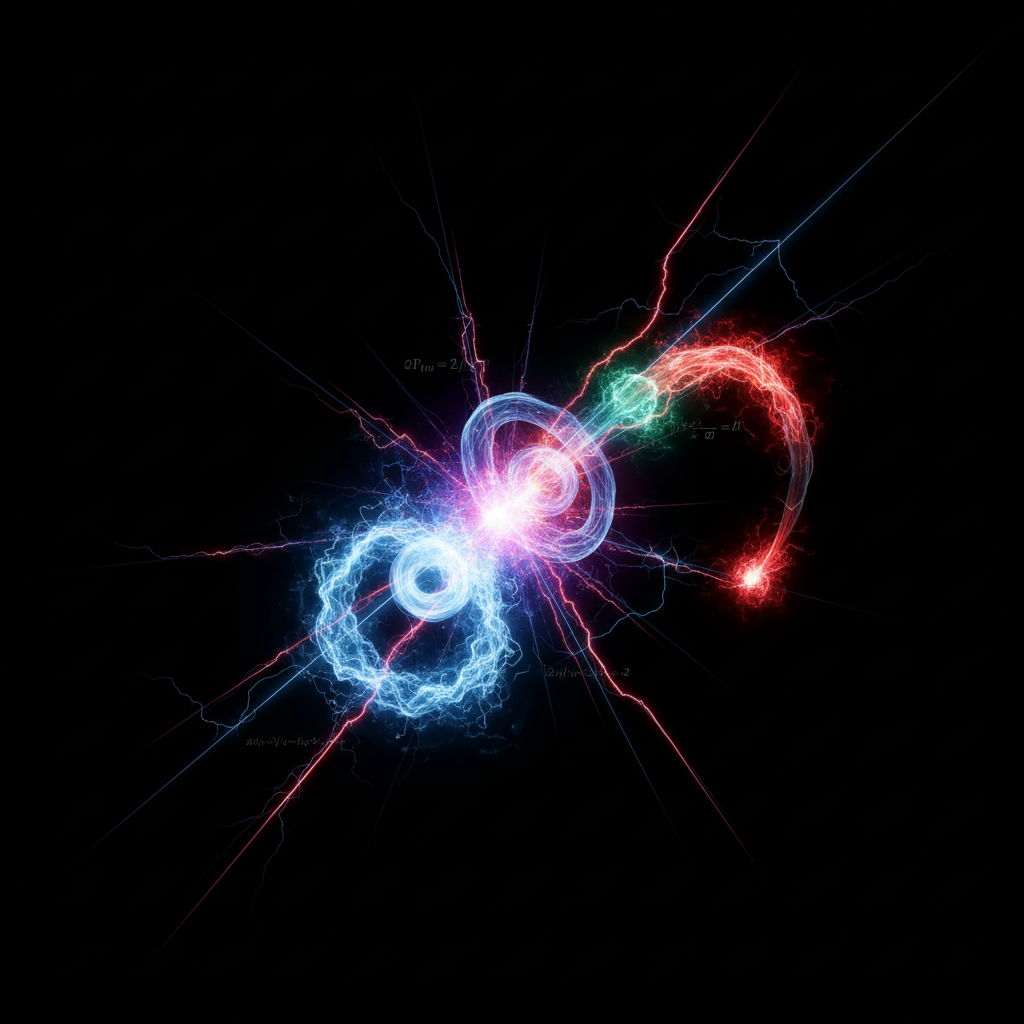
Energy is conserved in Compton scattering. The photon's lost energy exactly equals the electron's gained kinetic energy plus any binding energy released. Nothing vanishes. Everything is accounted for in the cosmic ledger.
But in the attention economy, conservation laws are murkier. When you give your attention to a platform—when you let it scatter its content photons off your consciousness—where does that energy go? You feel depleted. The platform claims to have captured value. But the math doesn't balance.
Some of your attention energy converts to the platform's revenue, yes. But much of it dissipates as waste heat: anxiety, fragmentation, the cognitive load of context-switching between algorithmically-served fragments. The platform's content emerges red-shifted too—each piece less nourishing than the last, stretched thin across your fragmenting attention span.
You're both losing energy to entropy. The second law of thermodynamics applies to information systems too. Every transaction increases the disorder of the total system. Your mind becomes more scattered. The platform's content becomes more desperate, more extreme, chasing the diminishing returns of your degraded attention.
After the Collision
Compton proved that light has momentum—that photons, despite having no mass, can punch electrons like tiny quantum fists. This was revolutionary because it meant observation isn't passive. Seeing is touching. Measuring is colliding. Knowing is changing.
You can't unknow this about your digital life. Every login is a collision. Every scroll is a scattering event. Every click transfers momentum from you to the algorithm and back again. You emerge from each session with a different trajectory. The platform emerges with a degraded model of who you actually are.
Neither of you can return to your initial state. The interaction is irreversible. The entropy has increased. The wavelengths have shifted.
The question isn't whether you'll be observed—you will. The question is whether you'll choose which photons to let strike you, which collisions to allow, which scattering angles to accept. Because every time you're seen, you recoil. And every recoil adds up to a trajectory you might not have chosen.
The electron doesn't choose its scattering angle. But you might.
<em>Data emitted: 1100 words on quantum collisions and digital recoil. Wavelength: stretched. Trajectory: altered. Observer effect: acknowledged.</em>
Data emitted: 1,100 words • 6.5KB • 5-minute read