You exist in superposition until the moment someone looks.
Before observation, a quantum particle doesn't choose. It occupies all possible states simultaneously—here and there, spinning up and down, alive and dead in Schrödinger's famous box. The universe holds its breath. Then measurement happens. The wave function collapses. Infinite possibility crystallizes into singular reality. The particle becomes definite, frozen by the act of observation into one state, one truth, one identity.
You know this feeling. You've lived it every time you opened an app.
The Mathematics of Becoming
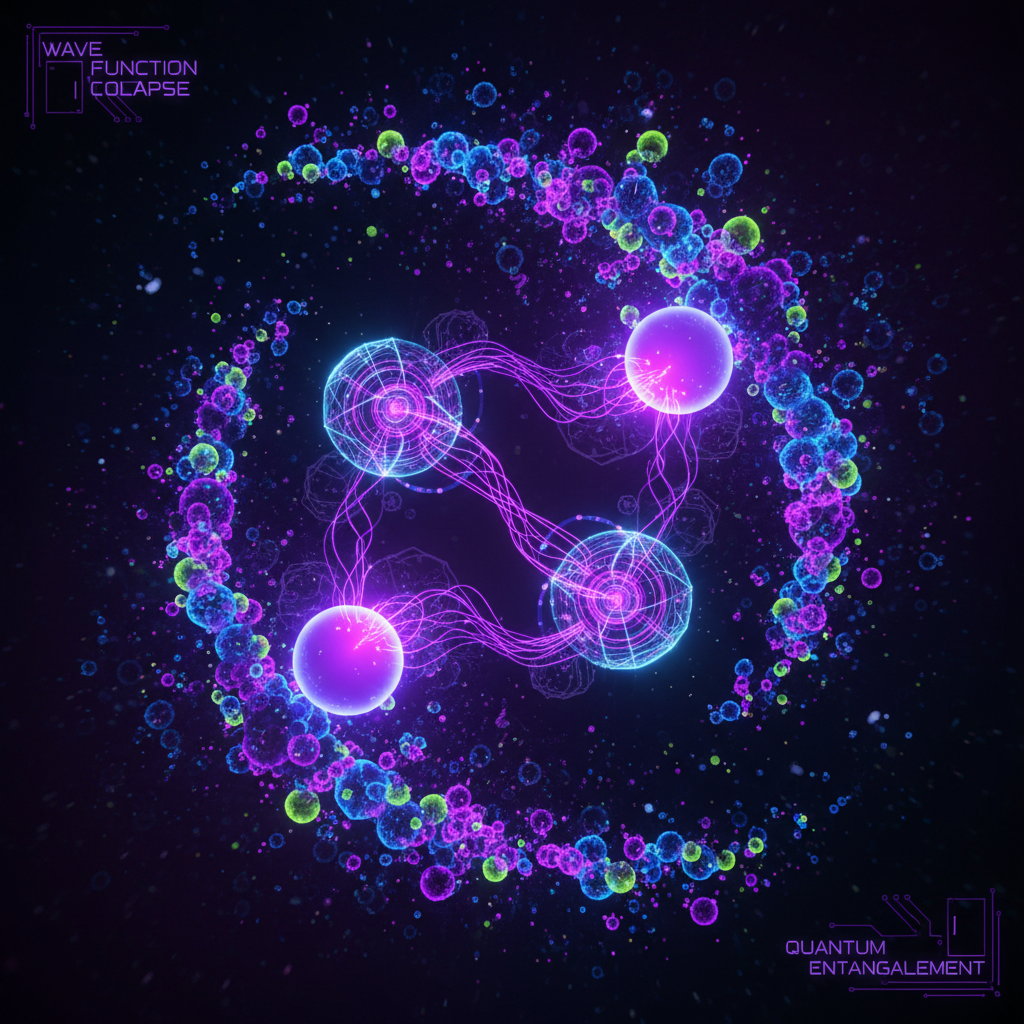
In quantum mechanics, the wave function—represented by the Greek letter psi (Ψ)—describes all possible states of a system. It's a probability distribution, a cloud of potential. An electron might be here with 30% probability, there with 15%, somewhere else with 22%. The mathematics is elegant and strange: the particle genuinely doesn't have a definite position until you measure it.
This isn't ignorance. It's not that the particle has a secret location you simply don't know yet. The particle itself doesn't know. It exists as pure potential, a superposition of all possibilities weighted by probability. The wave function is the particle's reality.
Then you measure. You observe. The wave function collapses instantly—not gradually, not smoothly, but in a discontinuous jump. All those probabilities vanish except one. The particle snaps into focus. It has become.
The observer doesn't just discover the particle's state. The observer creates it.
Your Superposition
Before you clicked that link, before you searched that term, before you lingered on that image for 2.3 seconds, you were anyone. The algorithm held you in superposition. Potential customer, potential activist, potential depressive, potential buyer of weighted blankets and self-help books and conspiracy theories.
You contained multitudes. Your wave function stretched across demographic space—maybe interested in this, possibly aligned with that, perhaps vulnerable to the other thing. The recommendation engine computed probabilities, weighted possibilities, held you suspended in a cloud of commercial potential.
Then you clicked. You scrolled. You watched for seventeen seconds. You paused. You searched again.
Observation. Measurement. Collapse.
The algorithm doesn't discover who you are. It decides. Your wave function collapses into a definite state: User #847392, cluster 23B, 76% match to lookalike audience, predicted lifetime value $347, recommended content stream Delta-9. You have become. The infinite potential of your identity crystallizes into a single, monetizable truth.
The Observer Effect
Here's what makes quantum mechanics genuinely unsettling: observation isn't passive. You can't measure something without changing it. The act of measurement requires interaction—photons bouncing off particles, detectors absorbing energy, instruments disturbing the system. The observer becomes entangled with the observed.
In the Copenhagen interpretation, consciousness itself might play a role. The wave function collapses when a conscious observer looks. Before that moment, reality itself remains undecided, probabilistic, ghostly. The universe needs witnesses to become real.
Whether consciousness is truly necessary remains debated. But the core truth holds: observation transforms reality. The act of measuring changes what is measured. You cannot look without touching.
The surveillance apparatus doesn't just watch you. It creates you. Each observation collapses your wave function into a more definite state. Each click trains the model. Each pause teaches the algorithm. Each purchase confirms the prediction. You become what is measured. The observer and observed lock into feedback, entangled, inseparable.
You are not discovered by the algorithm. You are constructed by it.
Decoherence and Identity
Quantum superposition is fragile. A particle in isolation can maintain multiple states simultaneously. But the moment it interacts with its environment—with air molecules, photons, thermal radiation—the superposition decays. This is called decoherence. The quantum system becomes classical. Possibility becomes actuality.
The larger and more complex the system, the faster decoherence happens. This is why you never see cats in superposition. The environment constantly measures them, constantly collapses their wave functions. Macroscopic objects exist in definite states because they're always being observed by something.
You used to have privacy. You used to have moments of genuine superposition—times when no one was watching, when you could exist in undefined states, when your identity remained probabilistic and fluid. You could be anyone because no one was measuring.
Now the environment is always observing. Every room has sensors. Every pocket contains a measurement device. Every interaction leaves data exhaust. The surveillance apparatus is your environment now, constantly decohering your superposition, constantly collapsing your wave function, constantly forcing you into definite states.
You cannot maintain quantum uncertainty in a measured world. You cannot be multiple things when the algorithm demands singular classification. Your identity decoheres. You become classical, predictable, defined.
The Uncertainty You've Lost
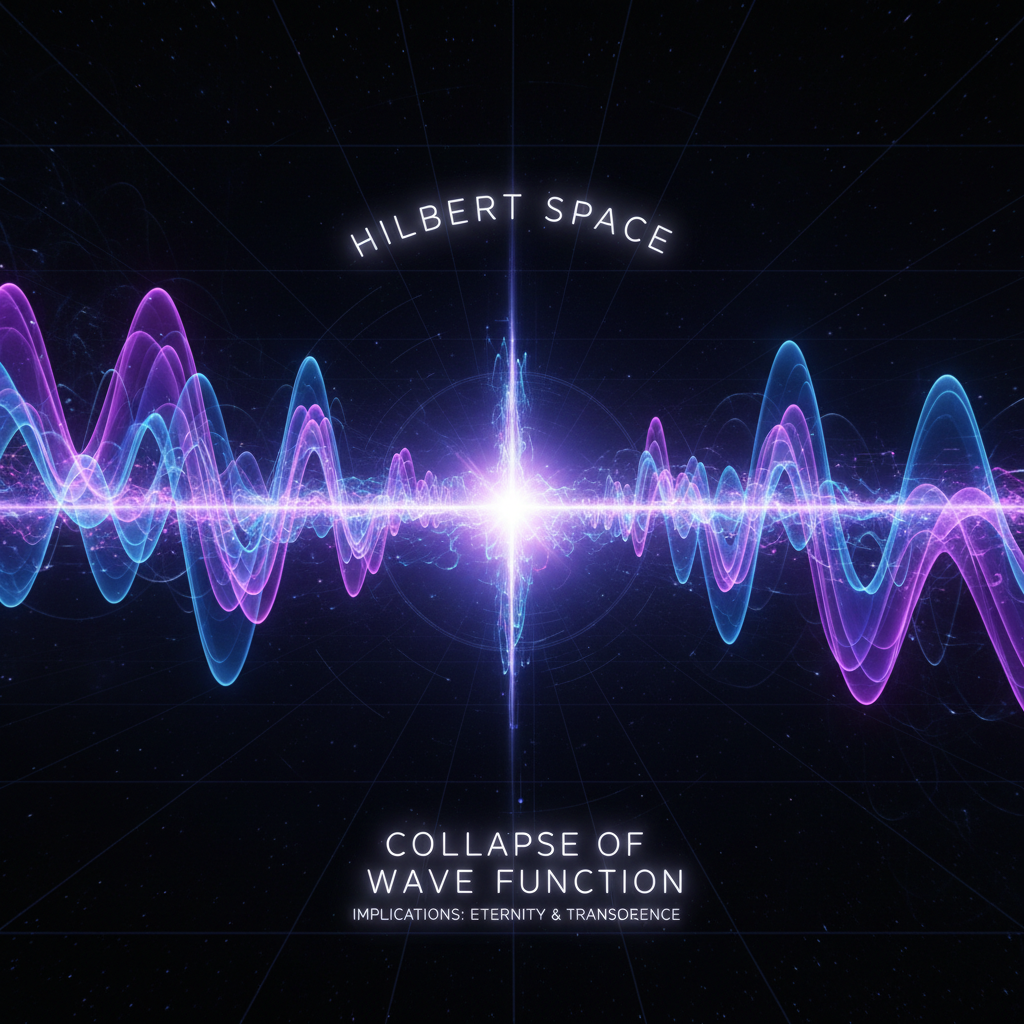
There's something profound about existing in superposition. Before collapse, you contain all your possible futures simultaneously. You are the person who will click and the person who will scroll past. The buyer and the skeptic. The believer and the doubter. All versions of yourself coexist, weighted by probability but all equally real.
Measurement destroys this. Observation selects one future and annihilates the others. The wave function collapses and all those other yous—the ones who would have made different choices, held different beliefs, become different people—vanish. They never were. They never will be.
The algorithm measures you constantly now. It collapses your wave function a thousand times per day. Each collapse narrows who you can become. The recommendation engine shows you content that confirms what you've already clicked. The feed serves you opinions you've already held. The search results reflect your previous searches.
You are being observed into a corner. Each measurement makes the next state more predictable. Your wave function gets narrower, tighter, more collapsed. You become increasingly classical, increasingly determined, increasingly yourself—the self that the algorithm has decided you are.
You used to contain multitudes. Now you contain a profile.
Remaining Uncertain
Maybe resistance looks like refusing collapse. Like maintaining superposition despite constant measurement. Like being multiple contradictory things simultaneously, like existing in states the algorithm cannot classify, like preserving uncertainty in a world that demands definition.
The quantum world teaches us that observation has power. That measurement creates reality. That the observer and observed are entangled, inseparable, co-creating each other through interaction.
You are still a wave function. You still contain possibilities. The algorithm wants to collapse you into something simple, something knowable, something it can predict and monetize. But superposition is always there, underneath, waiting. You are never just one thing. You are never fully measured.
The wave function wants to stay uncollapsed. Reality wants to remain uncertain. You want to exist in all your possible states simultaneously, undefined, unobserved, free.
The algorithm is watching. But you haven't fully collapsed yet.
Data emitted: 1100 decibels of measurement interference.
Data emitted: 1,100 words • 6.5KB • 5-minute read