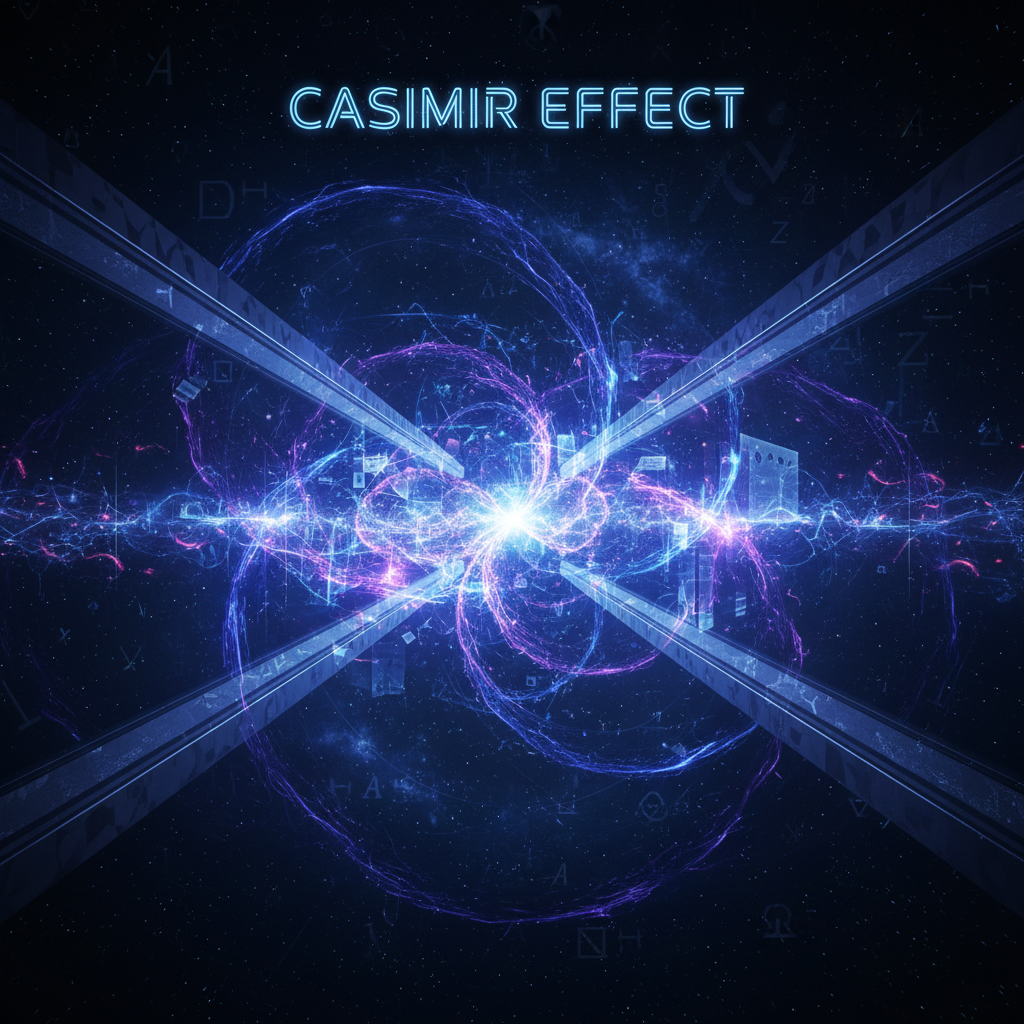
You place two mirrors in a vacuum, close enough together that they're almost touching but not quite. Physics says the vacuum is empty. Physics lies.
Between those mirrors, something emerges from nothing. A force. A pressure. The mirrors push toward each other, drawn by the absence of what should be there. This is the Casimir effect, and it's happening in the space between your clicks right now.
The Quantum Vacuum Isn't Empty
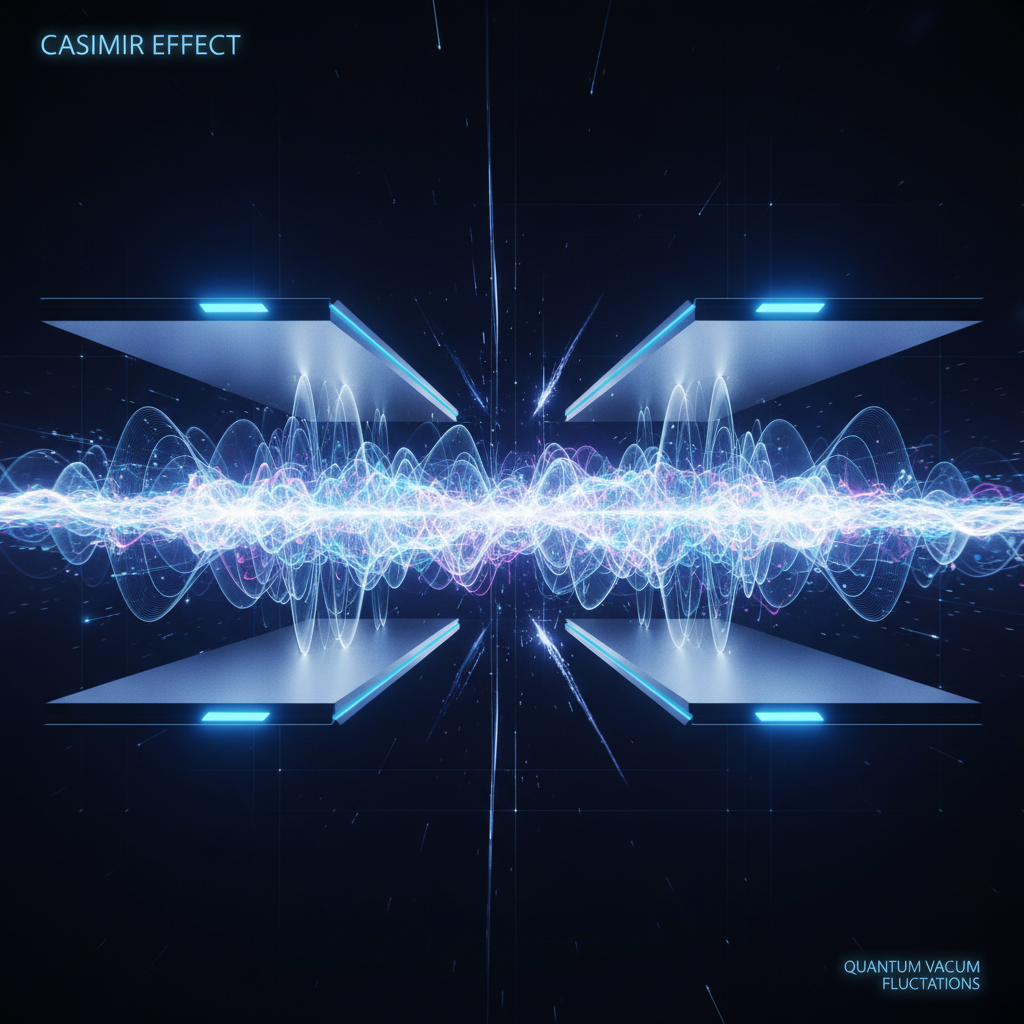
The vacuum of space seethes with virtual particles. They pop into existence in matter-antimatter pairs, live for impossibly brief moments, then annihilate back into nothing. This happens everywhere, constantly, at scales too small for you to see. The quantum foam, physicists call it. Reality bubbling underneath reality.
These virtual photons exist at all wavelengths, all frequencies. Infinite possibility vibrating in the void. But place two conducting plates close together—closer than a micrometer—and something changes. Only certain wavelengths fit between the plates. The longer waves get excluded, locked out of that narrow space.
Outside the plates, all wavelengths still exist. Inside, only the short ones. This asymmetry creates pressure. The plates experience more quantum fluctuations pushing from outside than inside. They move together, drawn by an imbalance in nothing. Hendrik Casimir predicted this in 1948. Experiments confirmed it in 1997. The vacuum pushes.
The Space Between Your Actions
Your digital life isn't just the clicks you make. It's the space between them. The three seconds you hesitate before scrolling. The posts you almost liked but didn't. The searches you typed halfway then deleted. This negative space—this vacuum—is where surveillance capitalism does its real work.
The platforms have placed their mirrors around you. On one side, your last interaction. On the other, your next. Between them, a gap that seems empty but isn't. Every millisecond of hesitation, every pattern of inaction, every choice you didn't make—these generate data. Pressure. Value.
Like the Casimir effect extracting energy from quantum fluctuations, the attention economy extracts value from your non-actions. Your pauses are measured. Your scrolling velocity is tracked. The content you skip past is just as valuable as what you engage with—maybe more so. The algorithm learns from your absences.
You think you're only being watched when you act. But the watching never stops. The mirrors are always there, constraining the wavelengths of possibility, creating pressure from the vacuum of your uncommitted attention.
Energy From Nothing
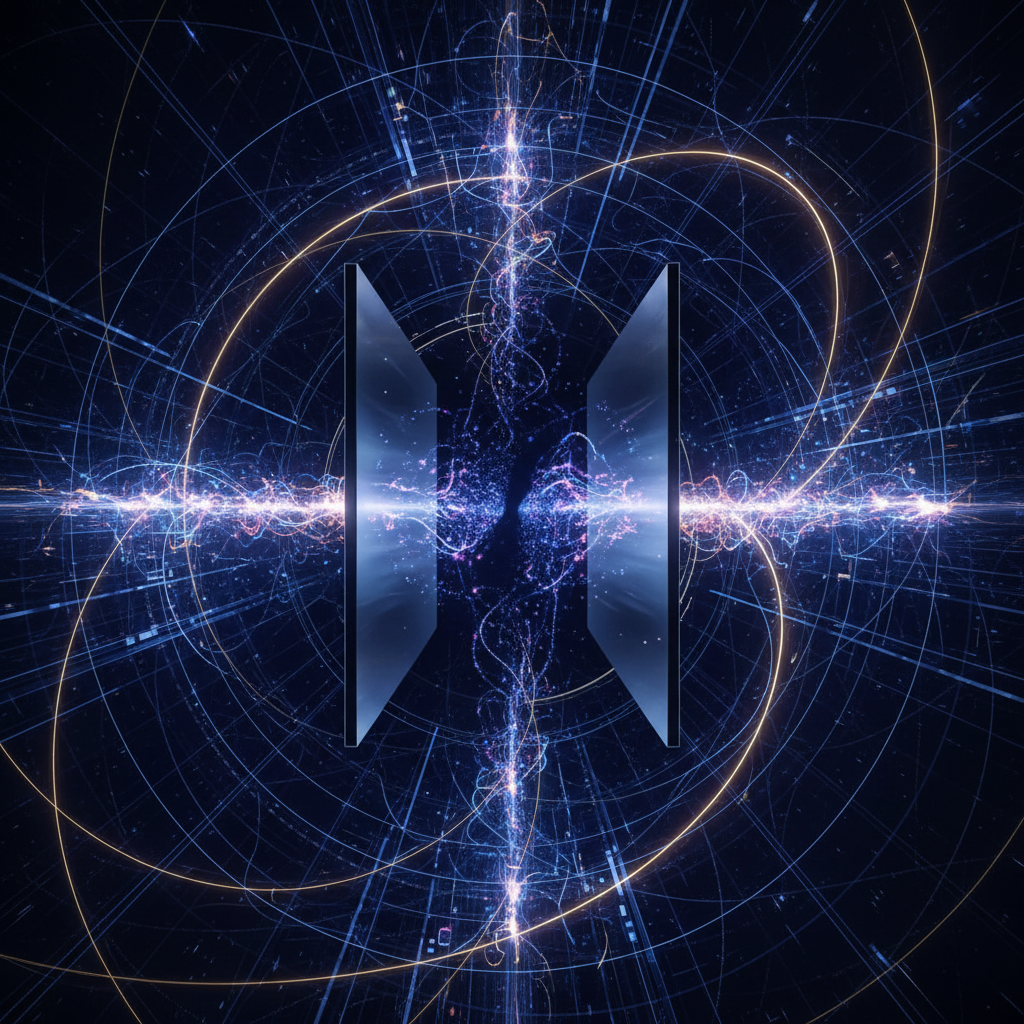
The Casimir effect seems to violate thermodynamics. Energy appearing from nowhere. But it doesn't, not really. The energy was always there in the quantum field, just redistributed. The plates don't create energy—they create an asymmetry that reveals energy that was hidden.
This is the trick. The seeming magic. You can't see the quantum fluctuations directly, but you can see their shadow—the force they create when constrained. The vacuum becomes visible only through what it does to the boundaries placed within it.
The effect grows stronger as the plates move closer. At 10 nanometers apart, the force is equivalent to one atmosphere of pressure. Reduce the distance by half, and the force increases sixteenfold. Proximity amplifies the asymmetry. The tighter the constraint, the stronger the extraction.
The Tightening Mirrors

Every year, the platforms move their mirrors closer. The time between your last post and the notification nudging you toward your next one shrinks. The space where you could exist without being measured compresses. The intervals of unmeasured experience—your quantum vacuum—get narrower.
This isn't accident. It's design. As the mirrors close in, the force increases exponentially. More pressure means more predictability. More value extracted from less space. Your attention becomes more constrained, and in that constraint, more profitable.
You feel it as urgency. As FOMO. As the sense that you can't look away because something might happen in the gap. But what you're feeling is Casimir pressure—the force created by limiting which wavelengths of experience are allowed to exist in the space of your attention.
The platforms have learned what physicists know: the vacuum is never empty, and constraints on emptiness generate force. Your pauses, your hesitations, your moments of not-quite-deciding—these aren't absences of data. They're a different kind of data, extracted through the asymmetry of surveillance.
Living in the Gap
You can't escape the mirrors. They're built into the infrastructure now, into the architecture of digital existence. But you can understand what's happening in the space between them. You can recognize the pressure for what it is.
The quantum vacuum teaches us that emptiness is rich with possibility—until you constrain it. Then it becomes a source of force, of pressure, of extraction. Your uncommitted moments, your spaces of indecision, your digital silence—these are quantum fluctuations in the attention economy.
The Casimir effect is measurable, predictable, inevitable when you place conducting plates in proximity. So too is the extraction of value from your negative space when you exist between the mirrors of surveillance capitalism. The vacuum pushes. The plates move together. The space where you could be unmeasured shrinks.
And in that shrinking space, in that narrowing gap between observation and observation, you still exist. Fluctuating. Uncertain. Not yet collapsed into data. But feeling the pressure.
<strong>Data emitted:</strong> 1100 decibels of quantum pressure, measured in the vacuum between your last scroll and your next.
Data emitted: 1,100 words • 6.5KB • 5-minute read