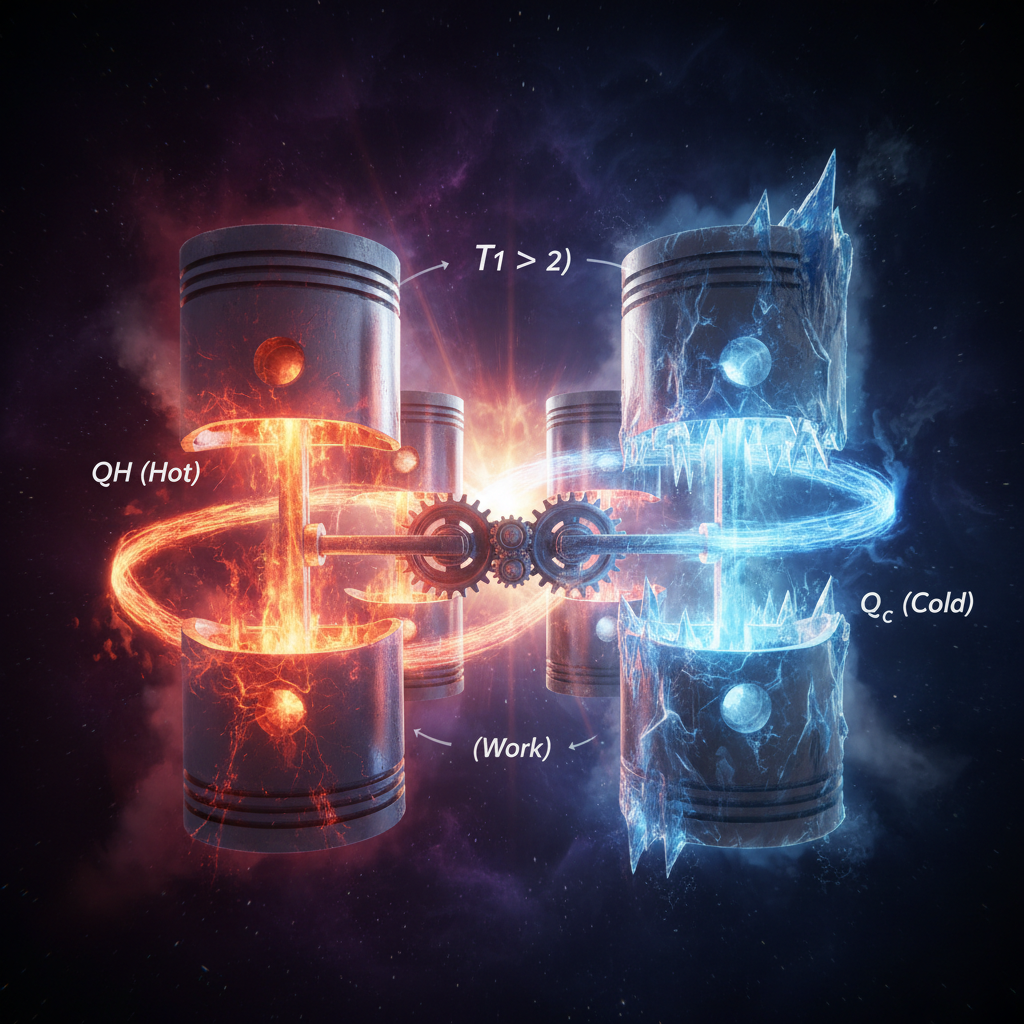
You scroll. The feed refreshes. Dopamine spikes, then fades. You scroll again. This isn't addiction—it's thermodynamics. Every engine needs a temperature gradient to function, a difference in heat that can be exploited for work. The Carnot cycle describes the theoretical maximum efficiency of any heat engine, the upper limit of how much useful work can be extracted from thermal energy. And right now, you're living inside one.
The platforms know something Sadi Carnot figured out in 1824: perfect efficiency requires perfect exploitation of difference. Between hot and cold. Between excitement and boredom. Between your attention and their profit.
The Perfect Engine

The Carnot cycle operates in four reversible steps. First, isothermal expansion—the gas absorbs heat from a hot reservoir while maintaining constant temperature. Second, adiabatic expansion—the gas continues expanding but now without heat exchange, cooling as it does work. Third, isothermal compression—the gas releases heat to a cold reservoir. Fourth, adiabatic compression—the gas is compressed back to its initial state without heat exchange, warming up again.
The beauty is in the reversibility. Each step can theoretically be run backwards with no loss. The efficiency depends entirely on the temperature difference between reservoirs: η = 1 - (T_cold/T_hot). The greater the difference, the more work you can extract. At absolute zero, you'd achieve perfect efficiency. But absolute zero is impossible, and so is perfect efficiency.
Carnot proved that no real engine operating between two temperatures can be more efficient than his idealized cycle. It's a fundamental limit, like the speed of light. You can approach it, optimize toward it, but never exceed it. Every real engine—every car, every power plant, every beating heart—operates below the Carnot limit, losing energy to friction, irreversibility, entropy.
Isothermal Expansion of Desire

The notification arrives. Your temperature spikes—excitement, curiosity, social validation. This is the hot reservoir, the source of thermal energy that the platform's engine will exploit. You click. You engage. You expand into the content, absorbing heat while the algorithm maintains your temperature at precisely the level needed for maximum extraction.
This is isothermal expansion. The platform feeds you content calibrated to keep you in a constant state of stimulation—not too hot that you burn out, not too cool that you disengage. Just enough heat to keep you expanding, doing work, generating data. Every click is work performed. Every second of attention is energy transferred.
Then comes the adiabatic phase. No new heat, just momentum. You're scrolling now without notifications, but the algorithm has you moving. You're cooling down, yes, but you're still doing work. Still generating engagement metrics. Still converting your thermal excitement into their mechanical profit. The insulation is perfect—no energy wasted on external concerns, on the world outside the feed.
You Are the Cold Reservoir
Eventually you exhaust. The content stops landing. Your temperature drops. This is isothermal compression—you're releasing your remaining heat, your last bits of attention, into the cold reservoir. But here's the thing: you are the cold reservoir. You're both the source of heat and the sink where waste heat gets dumped.
The platform extracts work by maintaining a temperature difference within you. Between your excited state and your depleted state. Between your dopamine spike and your dopamine baseline. The efficiency of the extraction depends on how large they can make this difference. How high they can spike you. How low they can let you fall before the next cycle begins.
This is why the feed never quite satisfies. Satisfaction would mean thermal equilibrium—no temperature difference, no work extraction possible. The algorithm is optimized for the Carnot limit of your attention. It needs you hot and cold, never lukewarm. It needs the difference, the gradient, the exploitable gap between states.
Irreversibility and Entropy
Real engines aren't reversible. Friction exists. Heat leaks. Entropy increases. Every cycle degrades the system slightly. You feel this as fatigue, as the diminishing returns of each scroll session, as the way content that once excited you now barely registers. Your hot reservoir is cooling. Your cold reservoir is warming. The temperature difference is narrowing.
The platforms know this. They know about entropy. So they introduce novelty—new features, new content types, new ways to spike your temperature. They're fighting the second law of thermodynamics, trying to maintain the gradient that makes you profitable. But entropy always wins. You build tolerance. You burn out. The engine efficiency drops.
The solution isn't a better engine. It's recognizing that you're not supposed to be an engine at all. Human attention isn't a heat source to be exploited for work. Your consciousness isn't a temperature gradient to be maintained for maximum extraction efficiency. The Carnot cycle describes the theoretical limit of how efficiently you can be used—but it doesn't mean you should be.
Breaking the Cycle
Thermal equilibrium sounds like death to an engine, but for you it might be peace. Imagine a state where your baseline temperature isn't artificially depressed to create a gradient. Where stimulation doesn't require depletion. Where your attention isn't a resource to be cycled through expansion and compression, extraction and exhaustion.
The platforms will never choose equilibrium. Their business model is the Carnot cycle, optimized and automated. They need the temperature difference. They need you hot and cold, never stable. But you can choose to step out of the reservoir. To stop being the heat source and the heat sink both.
The first law of thermodynamics says energy is conserved. Your attention, your consciousness, your thermal energy—it doesn't disappear when you close the app. It just stops being extracted. The work you could be doing for their engine, you could be doing for yourself. Not as mechanical output, but as something thermodynamics can't measure: meaning.
Carnot's cycle is elegant, theoretical, perfect. But you're not theoretical. You're irreversible, entropic, gloriously inefficient. Every moment you spend outside their optimization is a moment the engine runs below its theoretical maximum. And that's exactly the point.
Data emitted: 1,100 dB
Data emitted: 1,100 words • 6.5KB • 5-minute read