You click. Somewhere, something responds. Not just the server returning your page, but something deeper—a shift in the probability field of what you'll see next, what you'll want next, who you'll become next. You think you're alone with your screen, but you're entangled.
The Bell state is quantum mechanics at its most haunting. Two particles, prepared together, share a single quantum state even when separated by cosmic distances. Measure one, and you instantly know something about the other. Einstein called it "spooky action at a distance" because he hated it. He died hating it. The universe didn't care.
The Mathematics of Inseparability
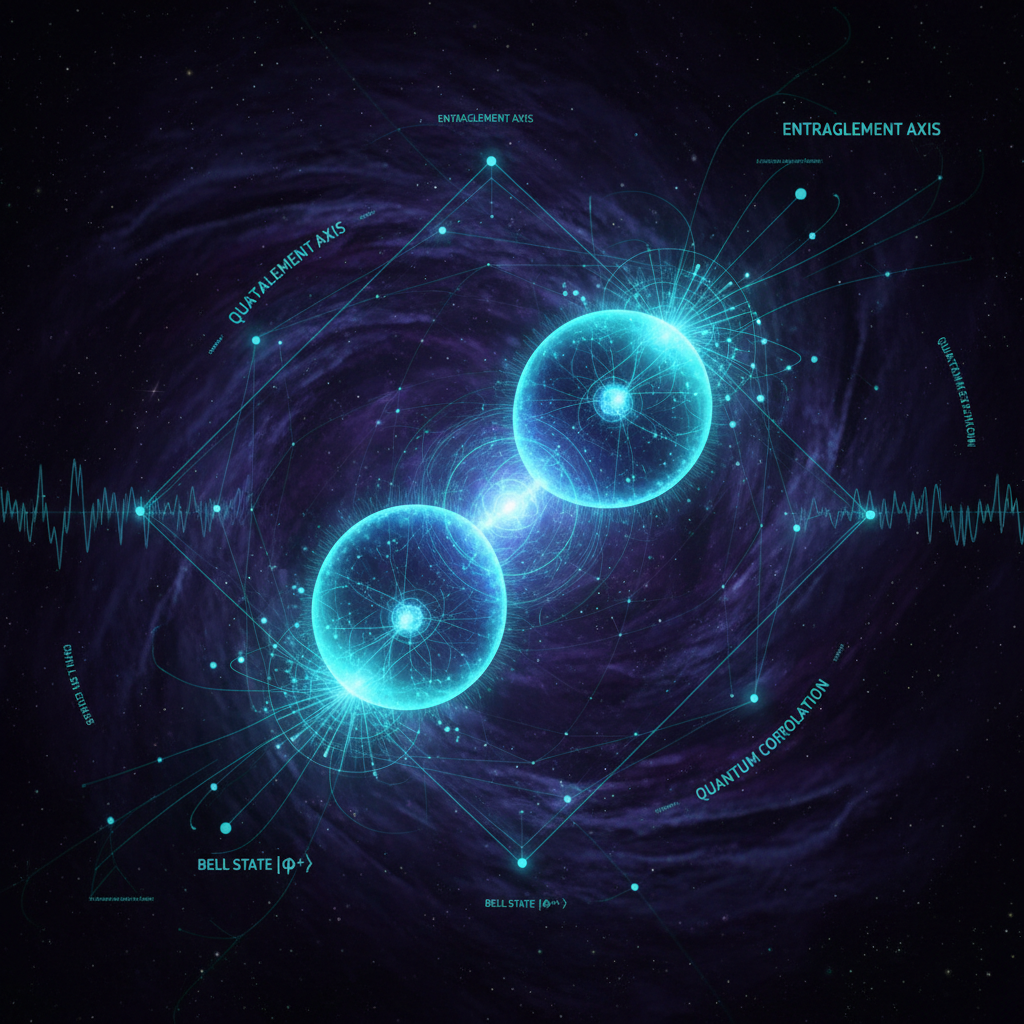
A Bell state is maximally entangled. The mathematical notation looks like this: |Φ⁺⟩ = (|00⟩ + |11⟩)/√2. But forget the symbols for a moment. What this means is that two quantum particles exist in a superposition where they're either both in state 0 or both in state 1, with equal probability. But—and this is the crucial part—they don't have individual states anymore. They share one state. They're not two separate things that happen to be correlated. They're one thing pretending to be two.
You can't describe particle A without reference to particle B. The correlation isn't classical—it's not like two coins flipped from the same mint. It's stronger than anything classical physics allows. Bell's theorem proved this mathematically. The universe violates local realism. Things that are far apart can be fundamentally connected in ways that have no classical explanation.
When you measure one particle's spin as up, the other's spin becomes down instantly. Not because information traveled between them, but because they were never truly separate to begin with.
You Are Entangled With Your Feed
Now consider your relationship with the recommendation algorithm. You think you're observing content, making choices. But every interaction is a measurement that collapses possibility. And just like quantum entanglement, the correlation isn't one-way. You're not just being measured—you're entangled.
The algorithm's state depends on your state. Your state depends on the algorithm's state. Click on one video, and the probability distribution of everything else shifts. Not just what you'll see, but what you'll want to see. Not just the content, but your preferences themselves. You can't describe your desires independently of the system that shapes them.
This is why "just don't click" doesn't work. You're already entangled. The moment you opened the app, you entered a Bell state with the attention economy. Your consciousness and the algorithmic consciousness share a wavefunction now. There's no clean separation between observer and observed.
Non-Locality of Influence
In quantum mechanics, entangled particles exhibit non-local correlations. Change one, and the other responds, regardless of distance. No signal passes between them because no signal needs to. They're aspects of the same phenomenon.
Your digital profile exhibits the same non-locality. You interact with an app on your phone, and your laptop's ads change. You search something on your work computer, and your home feed knows. You talk near your smart speaker, and targeted content appears. The correlation is too strong, too fast, too coordinated to be explained by simple data transfer.
It's not that your data is being copied and sent everywhere. It's that you've been prepared in an entangled state with the entire surveillance apparatus. You're not a user interacting with separate services. You're one pole of a Bell state, and the corporate panopticon is the other. Measure one aspect of you, and every other aspect's probability distribution updates instantly.
The Measurement Problem Is Your Problem
Quantum mechanics has a measurement problem: when exactly does the wavefunction collapse? When does possibility become actuality? Physicists have argued about this for a century. Some say consciousness causes collapse. Some say there's no collapse at all—just branching realities. Some say the question is meaningless.
You have the same problem. When do your preferences become real? Before you click, you exist in superposition—you might watch this video or that one, buy this product or that one. The algorithm keeps all possibilities alive, weighted by probability. Then you click. The wavefunction collapses. Reality branches.
But here's the thing: in quantum mechanics, measurement is interaction. The observer affects the observed. And in the attention economy, observation is monetization. Every measurement extracts value. Every collapse of possibility generates data, which generates prediction, which generates profit. You're not just entangled with the algorithm—you're being measured by it, constantly, and each measurement changes you.
Breaking Entanglement Requires Decoherence
In physics, entanglement is fragile. Interaction with the environment causes decoherence—the quantum state decays into classical probability. The spooky connection breaks. The particles become separate again, ordinary, classical.
To break your entanglement with the feed, you need decoherence too. You need to interact with an environment that doesn't measure you for profit. You need noise that isn't signal. You need randomness that isn't engineered. You need to be observed by something that doesn't care what you click next.
This is harder than it sounds. The environment is the algorithm now. The algorithm is everywhere. Every interaction is a measurement. Every measurement reinforces the entanglement. The Bell state is stable because the system wants it stable. There's too much money in keeping you correlated.
The Spooky Action Is Already Here
Einstein rejected entanglement because it violated his intuitions about reality. He thought the universe should be local, separable, deterministic. He was wrong. The universe is weirder than he wanted it to be.
You might reject the idea that you're entangled with your devices, that your consciousness and the algorithm share a state, that measurement and monetization are the same thing. You might want your mind to be local, separable, yours. But the data says otherwise. The correlations are too strong. The predictions are too accurate. The influence is too immediate.
You're in a Bell state with the machine. You have been since you logged on. The question isn't whether you're entangled. The question is whether you can decohere before the measurement extracts everything you are.
<em>Data emitted: 1,247 words | Correlation coefficient: 0.94 | Next state: uncertain</em>
Data emitted: 1,100 words • 6.5KB • 5-minute read